
Taken from Lynne’s weekly column ‘Green Scene’ for the Western Mail
10th February 2024

Super Snowdrops

Every year I forget how much I love the brilliant-white snowdrop carpets – until they appear in all their glory. They really are a stunning addition to any garden as they are the first real eye-catching burst of colour. Whilst primroses and crocuses are lovely too, it’s the bright white drifts of snowdrops that really shout ‘spring is on its way’ and pave the way for the ultimate spring-flower drifts of daffodils.
And if after seeing them work their magic, you have been smitten too and want to introduce them into your garden, then you don’t have to wait long to do so. Snowdrops are best planted (and transplanted) ‘in the green’, which means just after they’ve finished flowering and whilst the foliage is green, before it turns yellow.
Please don’t go digging them up from woodlands or hedgerows as that is illegal. Under the Wildlife and Countryside Act 1981, it is unlawful to uproot (dig up) any wild plant without permission from the landowner or occupier. You can buy snowdrops ‘in the green’ from garden centres or online or if you have a generous friend or neighbour who is willing to split their clumps, make sure they are replanted the same day and don’t dry out. They don’t like that. You can plant the bulbs singularly and let them spread or plant in small clumps of three or four bulbs for more impact.
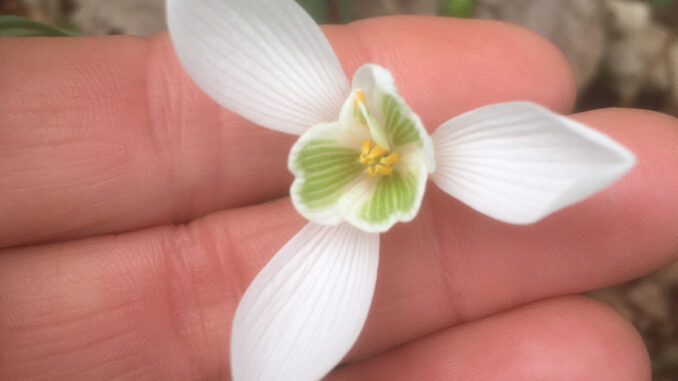
Snowdrops are particularly effective when displayed indoors in a small vase and placed on a mirror tile. The refection allows you to see the underside of the flowerhead, which is really beautifully marked – and shows the orange pollen. Although, beware if you are superstitious as folklore has it that bringing snowdrops indoors is unlucky, as the Victorians associated them with death. Bringing them into the house was thought to result in a death in the household. The snowdrop bulbs are highly toxic too, which could prove unlucky for some.
The Greek name for snowdrop, Galanthus, translates as ‘milk flower’ thought to be so named as the flowerheads resemble a drop of milk. Fans of snowdrops are known as Galathophiles, with numerous regional events taking place for them to buy ands swap different varieties. There are more than 2,500 varieties of snowdrop varying in height from 7cm to 30cm and are divided into approximately 20 species.
Galantamine is a naturally occurring substance found in the plants and it has been found to help the symptoms of Alzheimer’s Disease.
Just as there are beautiful bluebell woods and walks to enjoy the brilliant blue carpets a little later on, so there are some gardens that have wonderful white carpets of snowdrops now – there are several in Wales including Green Castle Woods in Llangain near Carmarthen, Plas Power Woods in Bersham, near Wrexham, and Marl Hall Woods at Llandudno Junction. There is a whole mile long snowdrop drift to enjoy at the Botanical Gardens of Wales, stretching from the Lower Broadwalk, along the lakeside walks and across to Springwoods. And of course Aberglasney also has a wonderful well-established display too. Bryngwyn Manor, at Raglan (NP15 2JH) is also open this weekend for stunning snowdrop walks. Open from 11 – 4pm, booking is necessary but special arrangements can be made for groups of 12 or more. www.findagarden.ngs.org.uk/garden/7666/bryngwyn-manor or email louiseviola@live.co.uk or call 01291 691485 for more information
Bee’s Knees

 I think I mentioned recently that another favourite thing of mine is to watch the honeybees visit the snowdrops as they are the first real supplier of pollen for them after the dormant winter months. It is worth taking the time to be quiet and just watch as the bees will reverse out of the bowed flower-heads with the pollen in their pollen baskets on their back legs – and the pollen is bright orange! I have known this fact for years but it still delights me. Along with the other fascinating fact that all these bees with orange knees (‘knees’ are not technically correct but it sounds good) are all female as male bees don’t do ‘pollen collection’. As the pollen is collected it is moistened with nectar, and packed into the ‘baskets’, or corbiculae to give them their proper name, to keep it firmly in place. Bumblebees do the same.
If you see these bees out and about without the orange ‘lumps’ on their back legs, then they haven’t started foraging yet and the pollen baskets are empty – and invisible. And not all pollen is orange, but a huge variation of colours and shades, which means you can tell which flowers the bees have been foraging from by the colour of the pollen in their ‘baskets’. You can buy a ‘Pocket Pollen Colour Guide’, a small leaflet – or have a look at an online pdf – which describes all the pollen colours, from broad beans to borage and a whole load in between. It’s fascinating.
I really enjoyed sharing all that – bees just never cease to amaze me, whether it’s learning something new or remembering something that I knew.
Food of Love
You know you’re getting old when you look forward to Pancake Day more than Valentine’s Day – falling next week on Tuesday and Wednesday respectively. Shrove Tuesday always falls 47 days before Easter Sunday, so the date varies from year to year and can fall anywhere between February 3 and March 9.
But of course you can enjoy pancakes any day of the year. And they can be savoury or sweet – or make enough batter and have both. Add lots of chopped herbs to the savoury ones for added flavour but don’t forget that you can also add certain herbs like basil and mint (you can use fresh, chopped or peppermint oil) to the sweet versions too.
I am ‘old fashioned’ and prefer a squeeze of lemon and a little sugar on my sweet pancakes but if you add mint oil to the batter and then spread the pancake with Nutella, that, apparently, is the ‘food of love!’
Leave a Reply