
Taken from Lynne’s weekly column ‘Green Scene’ for the Western Mail
10th October 2026
In the Pink
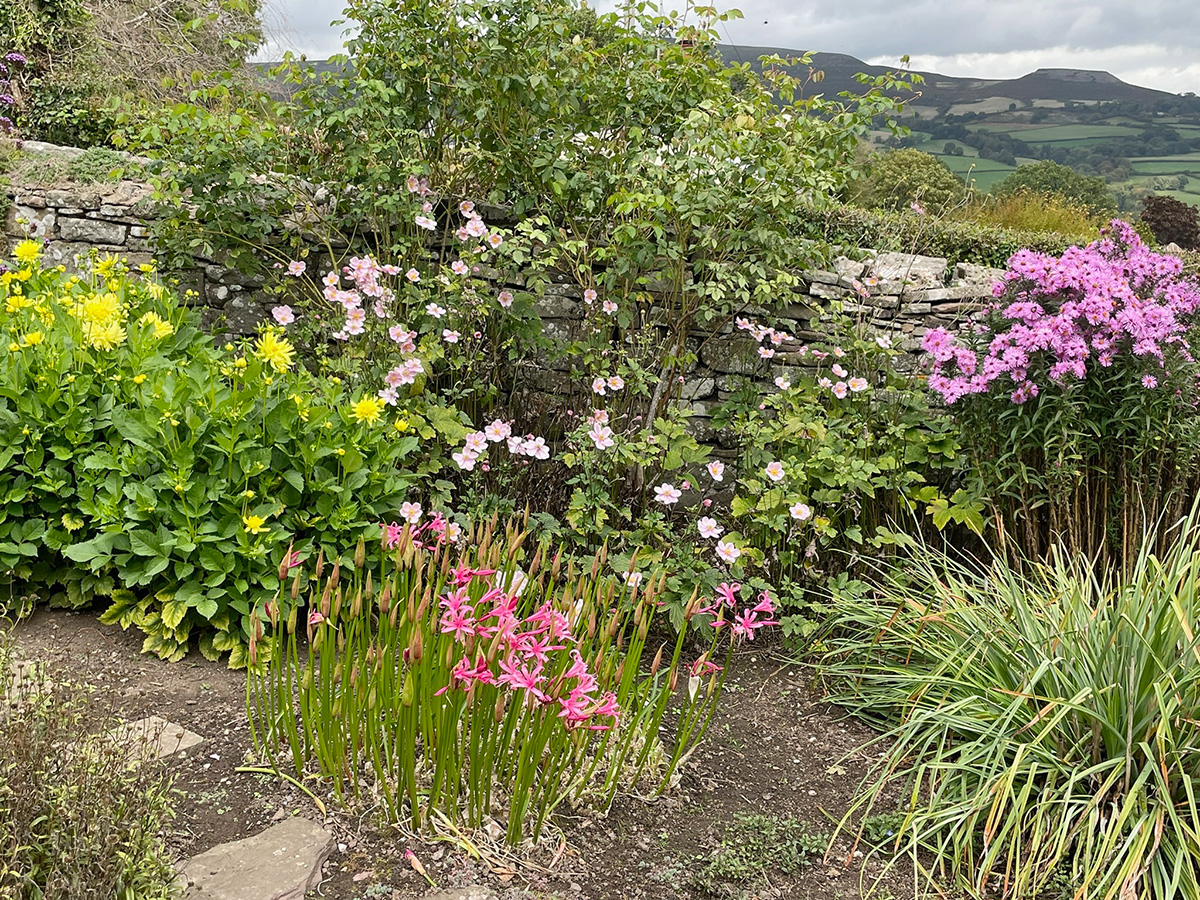
It’s Nerine time. I write about them every year – although it feels more like just a few months ago! I remain fascinated by these late flowering bulbs as they have survived the most hostile of summers, with the top of the bulbs literally being just above the soil level, how on earth they maintains enough moisture to put up the most beautiful flowers I’ll never know.
Every year around the end of August I clear away the dried, spent foliage doubting the appearance of any blooms that year. And every year they strut their stuff magnificently. They really are a ‘must have’ for all gardens. They also are very effective in pots and make great cut flowers for the house.
Also known as the Guernsey Lily, or the Bowden Lily, the most common and hardy species you’ll find in the garden centres are the Nerine bowdenii, which are usually a Barbie pink although are also available in softer pinks and white.
Most nerines are pink, but there are species and varieties with white, pale pink, magenta and red flowers. A variety worth looking out for is Nerine ‘Mr John’, which produces glittering, cherry pink blooms on long stems. The true Guernsey lily, Nerine sarniensis is also worth growing with its star-burst flower-heads of a brilliant red, but it will need a bit more protection. They will grow in almost all conditions and the hardy varieties are just that – hardy and hard working.
You can see the Nerines in the forefront of the photo of a client’s garden, which I took to show just how much colour it’s possible to have in a garden at this time of year. Admittedly I don’t have as much colour in my own garden but ‘cobbler’s children … ‘ and all that.
Autumnal Auras
Japanese anemones and autumn asters, or Symphyotrichums, are also adding much appreciated late autumn colour too. There is a huge range of both species to choose from with height, spread and colour for even the fussiest of gardeners. Japanese anemones and all aster varieties are much loved and appreciated by pollinators too, providing an ideal, much needed late food source for all types of bees and hoverflies. As well as these three recommendations, a great way to get late autumn colour into your garden is to visit the garden centre now and see what is in bloom.
And don’t forget that autumn colour can also be in the guise of foliage. Parthenocissus varieties (Boston Ivies and Virginia Creepers) are strikingly autumn-coloured leafy climbers which you will often notice hugging cottages, houses and other forms of support now, as their foliage turns the most brilliant orange and red. Personally, although they are stunning at this time of year, I wouldn’t introduce them. I inherited mine and although it earns its keep at this time of year, it can be invasive and annoying for most of the time. Harsh but true.
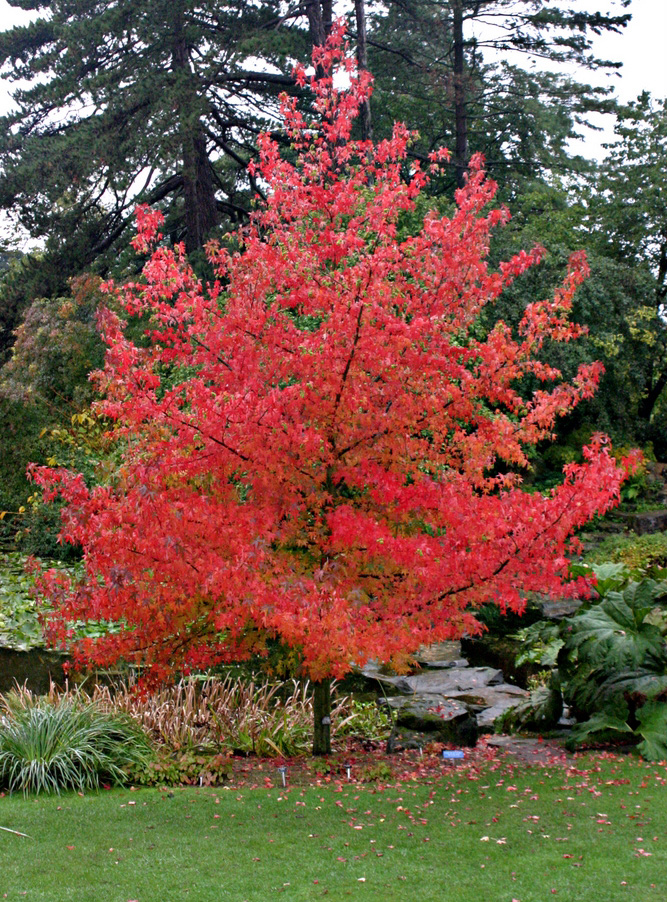 Chosen for it’s autumn colour, my brother has a stunning Liquidamber styraciflua in his garden (planted by Dad) – which is much better behaved and works harder all through the year.
Commonly known as the ‘sweetgum’, it is a large deciduous tree prized for its star-shaped, maple-like leaves and brilliant autumn displays of orange, crimson, and purple. It always receives a remarkable amount of compliments for it’s autumn show and in winter it produces unusual, spiky round ‘gum balls’.
The bark is also attractive – deeply furrowed, and corky. Its name derives from the Latin ‘liquidus’, meaning fluid, and the Arabic ‘ambar’, referring to the sweet, fragrant resin that exudes from the bark, and which gives it the common name of sweetgum.
Ask Twice. In Welsh or English
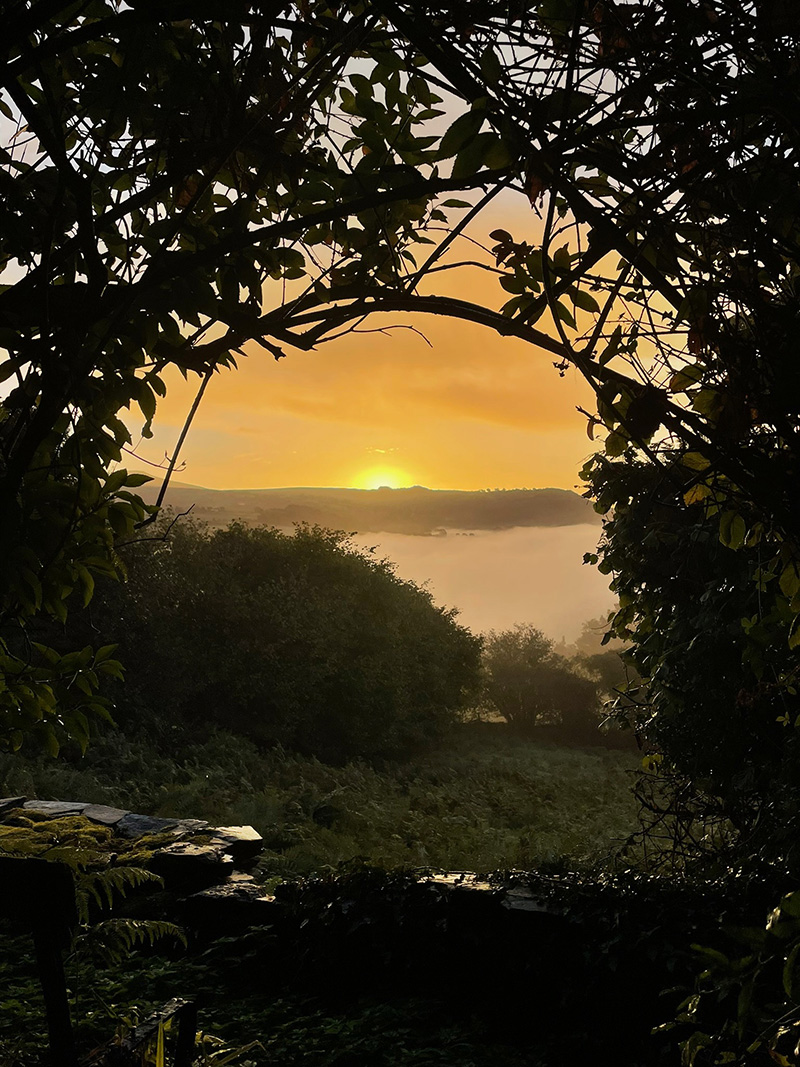 Another photo I took this week and I’m rather proud of is one of the stunning sunrises we had last week.
The sunsets were pretty spectacular too – although as one of the lads in work observed, ‘It’s the bit between the sunrise and sunset that’s often tricky to navigate’.
And on that note, today, (the 10th) is World Mental Health Day, and there is no shortage of evidence to prove that getting out in the fresh air and nature improves people’s mental states. Whilst I appreciate it’s not always that easy – ironically the very nature of a low mood and depression often encourages people to shut themselves indoors and isolate themselves – I really encourage everyone to get out and walk more. As a dedicated runner for years, I now rely a lot more on walking and the combination of movement and fresh air can absolutely ‘fade’ those unwanted dark, circling thoughts.
It is also a scientific fact that places like mountains, waterfalls and beaches have a greater number of negative ions in the atmosphere and although it sounds contradictory, the negative ions are the ones that are beneficial to us. So if you can get up in the hills or down to the coast, all the better.
I was disappointed to read that a survey showed a whopping 93% of a social media audience said they felt there is not enough awareness and understanding of what it means to be severely affected by mental illness. Although I can’t help but comment that, in my opinion, that particular audience has to be the most likely to have poor mental health. The ‘Ask Twice Theory’ suggests asking someone you are worried about, if they are OK – not once but twice. With the second time just being genuine reassurance that you care and are concerned. It is often the second time that someone will give an honest answer instead of the knee-jerk and deflective ‘I’m fine’.
It’s probably an appropriate time to mention that – after inspired by recovering from a Long COVID/CFS diagnosis – I have recently qualified as a ‘therapist’, specialising in these types of ‘autoimmune issues’. It has been a fascinating – and often brutal – journey and I will share more relevant details in a few weeks.
On the 15th, Shwmae Sumae Day (or Diwrnod Shwmae Sumae) marked each year here in Wales to celebrate and promote the Welsh language, with Shwmae and Sumae being informal greetings used in the south and the north respectively. The dedicated day promotes use of the language and encourages non-Welsh speakers to consider learning the language. My nan was a fluent Welsh speaker (from Resolven) and I really regret not learning the language from her. The main barrier was that she would revert to Welsh when she was furious with us kids for some reason – and so we would often be running away as she threatened us with the wooden spoon on the back of the legs. In Welsh of course.
Rally Abound
And finally – huge Congratulations to our very own Elfyn Evans. In his late teens, my brother spent a lot of time behind the wheel of Ford Escorts – Mk 1, 2 and Mexico’s – in various Welsh forestries, with me supporting him.
I think anything that you do at that sort of age, stays in your system somehow, so I have been following Elfyn for a while.
Thanks to a determined personality, sublime skill, great support and true Welsh grit, he has just made history by becoming Wales’ first ever World Rally Champion. Elfyn has been runner up five times in the last six years and impressively gracious about it.
No one deserves this recent accolade more.

Leave a Reply