
Taken from Lynne’s weekly column ‘Green Scene’ for the Western Mail
17th February 2024
No ‘Hurry Potter’
Whilst I have managed to keep working right the way through the winter, I love having a bit more time at this time of year to ‘potch and potter’ about in my own garden.
I have just checked the spelling of ‘potch’ and found that it is a Welsh word for ‘mess or trouble’, or ‘potsh’ is a sort of Welsh Bubble and Squeak. The Oxford Dictionary lists ‘potch’ as ‘an opal which has no play of colour and is of no value’. I was sure it meant to potter. Anyway, I digress. As I get older I get more like a squirrel trying to cross the road – so easily distracted.
Where was I – yes, once things start growing in the garden with purpose, it is usually just a race to keep up with it all, but these last couple of weekends I’ve been able to sort out seed trays and seed packets, rearrange my little greenhouse and just ‘daydream’ a bit.
Whist pottering, I am always reminded of the things that have worked and the things that haven’t – and will inevitably try a few new things this year.
Like putting trays of just-sown seeds in clear plastic shoe storage boxes, complete with the lid for extra warmth – having pottered in the house a bit too and donated a load of never-to-be-worn again shoes to the charity shop! It might be too early to be hugely effective but it is mild and I think spring will be early, so it’s worth a go. As I often say – gambling with a packet of seeds is the best vice!
In his latest newsletter, No-dig guru, Charles Dowding, advises ‘Seeds germinate more strongly when kept warm night and day. That’s why I recommend keeping newly sown trays in your house. Most seeds do not need light to germinate, so you can park sown trays in a corner of a warm room, even stacked on top of each other. Just for a few days until you see little shoots emerging. That’s when they need the light.’
He also says that, ‘Once you see weeds emerging, you absolutely need to hoe or rake the ground shallowly. ASAP! Use any tool to disturb the surface, before the weed seedlings grow too large. If allowed to grow bigger, that would become a laborious weeding job. The old saying is, hoe your weeds before you see them!’
Give Leaves a Chance
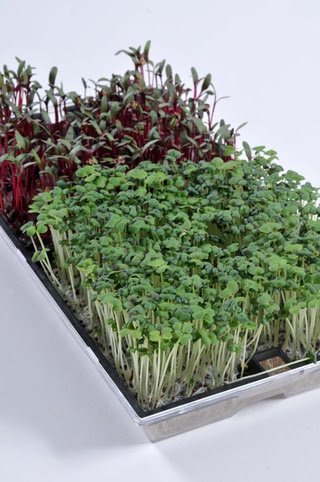
 One of the things I thought I would try at the end of last year is to leave the red mustard, rocket and chard in one of my older veggie beds, instead of clearing it. I was still harvesting it all before Christmas – and remarkably, I still am. The occasional hard frost that we’ve had knocked a few leaves back but it has all kept producing enough new leaves for me to have them in my sandwiches and the odd green salad with dinner. They don’t look very pretty, and neither does the bed, but they are still very edible, and the mustard leaves are hotter than ever!
Whilst clearing rotting autumn leaves from a corner of a client’s garden this week, I said to my brother, ‘Go careful, this is the type of place you will find a hibernating hedgehog’ – and sure enough, I found a softly-snoring, sound-asleep hedgehog. Without disturbing it at all, I covered him back up and built a study little shelter over him for extra safety – as he kept dreaming of someone rearranging the furniture. So if you are starting to tidy up your garden in the more clement weather, do please ‘tread lightly’ – not everyone is ready for spring yet.
Hazel Heroine
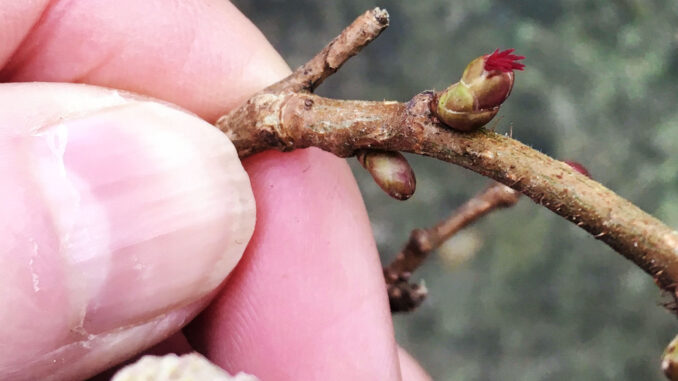
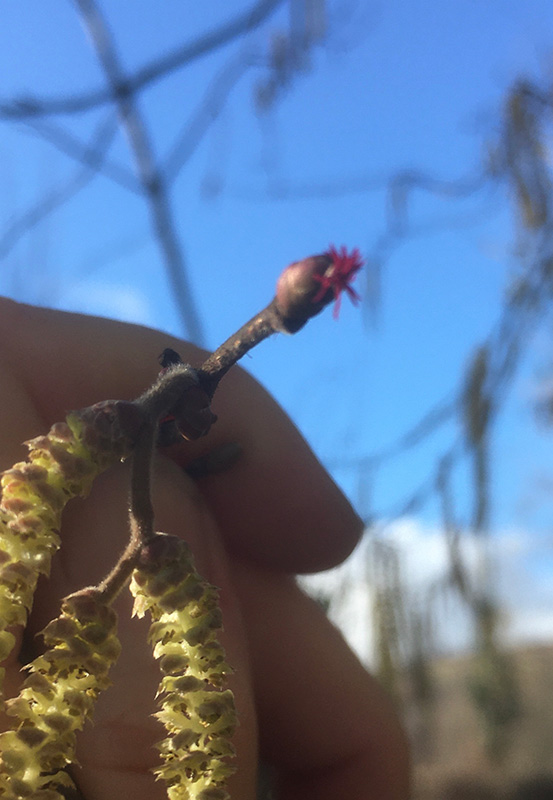 One of my (many) favourite things in nature is the fabulous understated little red hazel flower that shares the hazel twigs – but not the glory – with the waggly male catkins at this time of year.
I have mentioned it before, and if you haven’t seen one yet, do please make the effort. They are just wonderful. It may take a while to find one, or like I did last weekend, I simply spotted one almost ‘glowing’ in the sunshine.
This little shy flower is what will get pollinated and become the hazelnut in the autumn. It always amazes me that such a small almost insignificant flower does such a big significant job.
Warming to Winter
Apparently so far, it is the warmest February on record but despite a snowy, freezing start to February 2019, it still holds the record for the warmest February day with 21.2C being recorded in Kew Gardens in London on 26th Feb 2019 and 20.8C recorded in Porthmadog, Gywnedd on the same day, which also set a new Welsh record.
But do be warned, Derek has already forecast a cold snap toward the end of the month and remember that the Beast from the East in 2018 lasted from February 24th until March 4th, as Anticyclone Hartmut hit the UK, bringing with it unusually low temperatures and heavy snow. We are not out of the woods – or the winter – yet.
Best Nests
 National Nest Box Week is being celebrated until the 21st February. It began on Valentine’s Day – which is very apt as our garden birds get busy establishing their breeding territory and attracting potential mates to nest. It’s why the birdsong is more noticeable at this time of year too – they have lots to shout about.
The official site of Nest Box Week has been encouraging us to make more homes for our little feathered friends since 1997 and has lots of great advice on how to set up nest boxes in your own gardens to help with this.
Nest boxes fulfil two valuable roles – now, just before spring, they help birds to prepare for the breeding season, as wild birds slowly start looking for suitable breeding sites and places to set up home. And during the winter months, ‘artificial nesting aids’ offer protection from the wind and weather, making them ideal places to spend the winter. It’s a worthwhile thing to do and there’s room in most gardens for at least one nest box.
CJ Wildlife at www.birdfood.co.uk shares their 5 top tips for hanging nest boxes in your garden, so that they will be quickly ‘feathered’ by local birdlife.
- Choose a quiet place that is difficult for cats and other nest predators to access! (Minimum height is 1.5 to 2 metres)
- Make sure that the nest box is installed in a place that is protected from wind, rain and sun – so the entrance hole should be oriented as far as possible to the east or northeast.
- If you hang your nest box near bushes, it will help young birds when they make their first attempts to fly.
- Nest boxes with open fronts (half-caves, half-open nesting boxes) offer less protection than closed nesting boxes and should therefore be hung in a sheltered location like amongst dense ivy.
- To attach the nest box to a tree trunk, it is best to use an aluminium nail so you don’t damage the tree.

And finally …
I hope you enjoyed Pancake Day (remember pancakes aren’t just for Shrove Tuesday) and thought I’d share my brother’s latest observation with you – ‘have you noticed that the first pancake you make is like the oldest child – they always turn out a bit wonky.’
Leave a Reply