
Taken from Lynne’s weekly column ‘Green Scene’ for the Western Mail
24th February 2024

Money Saving Gardener
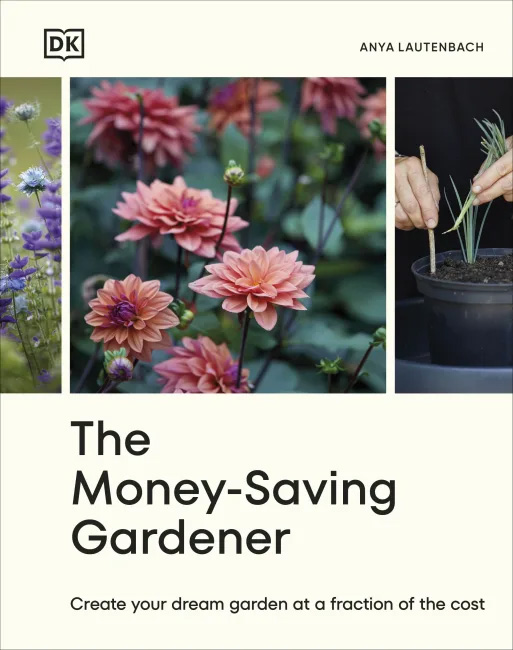 I have recently enjoyed reading ‘The Money Saving Gardener’ by Anya Lautenbach – made easier with my Serious Readers Light of course. Despite being familiar with a lot of the creative hacks in the book, it is interesting how we often need a ‘prompt’ to take action. I think Anya’s book will inspire or prompt a lot of people to get creative and courageous in their garden – without spending a fortune.
Anya has ‘grown’ a healthy following on various social media platforms, where she has shared her favourite frugal tips. Known on Facebook as @anya_thegarden_fairy, Instagram as @anya_thegarden_fairy and on TikTok as @anyathegardenfairy, she has shown followers and fellow gardeners how to create a garden for a fraction of the often-expected cost. It is a timely book when everything is so expensive.
She admits to being obsessed with taking cuttings and propagation, and basically getting plants for free and openly shares her poignant personal story of grief, depression and a recent diagnosis of ADHD. She refers to this as her ‘super power’ and credits gardening for getting her through some very dark times. Not surprisingly, she wants to help others by showing them how they can do the same.
As well as lots of advice and easy to follow ‘how-tos’, it is an uplifting read as Anya is self taught and naturally thrifty. There are a lot of things in it which remind me of my grandparent’s attitude and I love that return to ‘simple and effective’.
I recall my own mum being obsessed with cuttings too. I think it was a generational thing. She would wear elasticated trousers and a coat with big pockets when visiting any public gardens, to accommodate all the cuttings that were pinched – pinched between finger and thumb and pinched as in ‘without permission’. I feel I need to add a ‘Please don’t try this now’ caveat.
Like lots of other gardeners, I have got in the habit of visiting garden centres and nurseries for plants, especially as my clients prefer ‘instant’ options, but Anya reminded me that I really could be propagating far more at home.
I think the word ‘propagating’ puts a lot of people off as it sounds technical but it’s really doable, and will bring you a lot of satisfaction, as well as new plants. The trick is to enjoy and embrace the whole process –it’s mindful and quite magical in many ways. Taking cuttings of ‘special’ or meaningful plants is also a great way to continue the memory of someone or somewhere. I still have lots of lemon-scented geraniums that came from my Nan’s cherished plants, and via my mum.
The Money Saving Gardener will hopefully hit a whole new generation and encourage them to propagate, and as Anya says, “Just do it. You don’t need any special equipment or experience to create something amazing. Just be with nature and let it take over your mind and your heart.”
The book is not all about plants, it also has some great up-cycling ideas for garden furniture, pots and containers and lots more. I have been inspired to repurpose a couple of old dustbins that I had used to keep food in for my still-much-missed piggies into ‘carrot-growing containers’ – which will hopefully outwit the rabbits this year too.
One of the many lovely things about gardening is there is so much scope to be creative – and it really doesn’t have to ‘cost the earth’.
Hooray for Hilliers
 This seems a bit incongruent having just written about the positive aspects of propagating, but last week I ordered a couple of shrubs on-line. I specifically wanted three Lavatera ‘Rosea’ for a client and none of the local garden centres and nurseries could help. I could actually have propagated them with cuttings from another client’s garden (they are very easy to take cuttings from) but they are to fill a gap for a wedding later in the year. Not being able to source them locally, I went on-line where the first company I saw had them for sale at £29.99 per plant – in a 3 litre pot – one of the reasons gardening is considered ‘prohibitingly expensive’. I eventually found them at a very reputable nursery for £17.99 each.
I was a little nervous, as I like to see the plants I’m buying – these could have arrived as little more than sticks. I needn’t have worried – they are in rude health and absolutely fantastic plants, which will indeed fulfil their purpose before the August celebrations. They also arrived on time and were ‘perfectly packed’. Thank you for great plants and service Hiller – hillier.co.uk
I specifically wanted Lavatera ‘Rosea’ as it is more enthusiastic and energetic than the more common Barnsley Baby, and will cheerfully reach 5-8 ft by August. Now known as Lavatera x clementii ‘Rosea’, when I started gardening it was known as Lavatera olbia. It attracts bees and butterflies but – topically – rabbits hate it. It’s always been one of my favourite shrubs as I think it works hard and needs very little attention.
All plants want to survive and will do their best to do so, and the ones that fail have usually been planted in the wrong place – which reminds me of possibly the most important gardening phrase or advice of all, ‘Right plant, right place.’
Polar Bear Day
 Tuesday the 27th is Polar Bear Day. The main reason for mentioning this is that it gives me a chance to share Nima Sarikhani’s image of a polar bear snatching a nap on a small iceberg which recently won top honours in the People’s Choice category of the Wildlife Photographer of the Year competition (developed and produced annually by the Natural History Museum, London).
Polar Bear Day encourages us to raise our awareness of these magnificent creatures with lots of information at polarbearsinternational.org
With most of us of a certain age, polar bears are synonymous with a certain clear mint as a result of a very clever advertising campaign, but they deserve far more recognition, and are far ‘cooler’ than that.
A polar bear mum can go 8 months without a meal, making them one of the longest-fasting animals in the animal kingdom. Females who are fat enough to sustain a pregnancy, build and enter their ‘maternity den’ in the autumn, which is soon hidden under drifts of snow. While in the den, the mother bears don’t eat or drink but just live off their stored body fat. In early winter, they give birth to one to three tiny and helpless cubs, nursing them until they are strong enough to leave the den three to four months later. This ‘denning period’ is considered the most vulnerable time in a polar bear’s life.
Once the cubs are strong enough to withstand the challenges of the Arctic outside their den, the family will head to the sea ice to hunt seals straight away – not surprising if you have gone 8 months without a meal.
As a teenager I gave myself the challenge of reading and remembering one fact per week from my ‘brand new glossy Encyclopedia, and one of the more random facts I have never forgotten is ‘never eat a polar bear’s liver’.
And it’s not because of the toxins and heavy metals that get stored in a carnivore’s liver but because of vitamin A. A single polar bear liver – weighing around 500 g – has an astonishing 9 million IU of vitamin A. Acute human toxicity occurs at about 300,000 IU.
Post menopause, I have a job to remember my pin number but can still remember that fact (and many of the others I learnt all that time ago).
Now, I don’t learn something new every day, but forget something new each day.
Leave a Reply