

Taken from Lynne’s weekly column ‘Green Scene’ for the Western Mail
17th August 2019
 For Dog’s Sake

It has been four months since Yogi (my terrier-ist) ruptured her cruciate ligament and, as I have diarised through my column, she was healing nicely, especially with the help of her Doggy Buggy. Well, last week whilst off the lead for just 10 minutes, she chased a squirrel and ruptured the cruciate ligament on the other back leg.
Apparently it is common for the second one to go within months of the first because if the one is weak then the other one is likely to be too, and also she will have been putting more pressure onto the (then) healthy leg.
At least I am familiar with the recovery process now, but her mood is low again and I am worried that she is now out of sorts, not only emotionally but biomechanically too. With her back legs being weak, she is bound to be overcompensating for that physically which will put undue stress on other parts of her body. As well as just feeling miserable that she can’t tear about as usual.
It has made me realise that although Yogi is my complete world and I would do anything for her, I sometimes just don’t know what to do, and buckets of TLC isn’t enough. There is no substitute for knowledge, so I did some research and have found an amazing 2-day workshop being held in Tredegar at the end of August.
Called ‘From the Hound Up’, and run by Gemma Hodson of All About the Dog, the workshop will enable you to ‘read’ your dog and use the non-verbal indicators, including movement, posture, behaviour and even coat patterns, to understand what is going on with your best friend. Did you know, for example, that if your dog were panting, his tongue would provide all sorts of information, with a curled tongue indicating stress of some sort?
There is so much in the media about the importance of optimum mental and physical health for humans but it’s exactly the same for our four legged friends too. Yogi brings me an unsurpassed amount of joy and I want to reciprocate that.
I believe workshops like this should be mandatory before you even own a dog, but until they are, for Dog’s Sake book on to one.
I will be joining Gemma at Four Seasons K9 Hydrotherapy and Boarding Centre in Tredegar on the 31st Aug and 1st Sept. Find out more about this weekend and other workshops at www.allabouththedogtherapy.co.uk or follow Gemma on Facebook at allaboutthedogtherapy
Waspish Woes
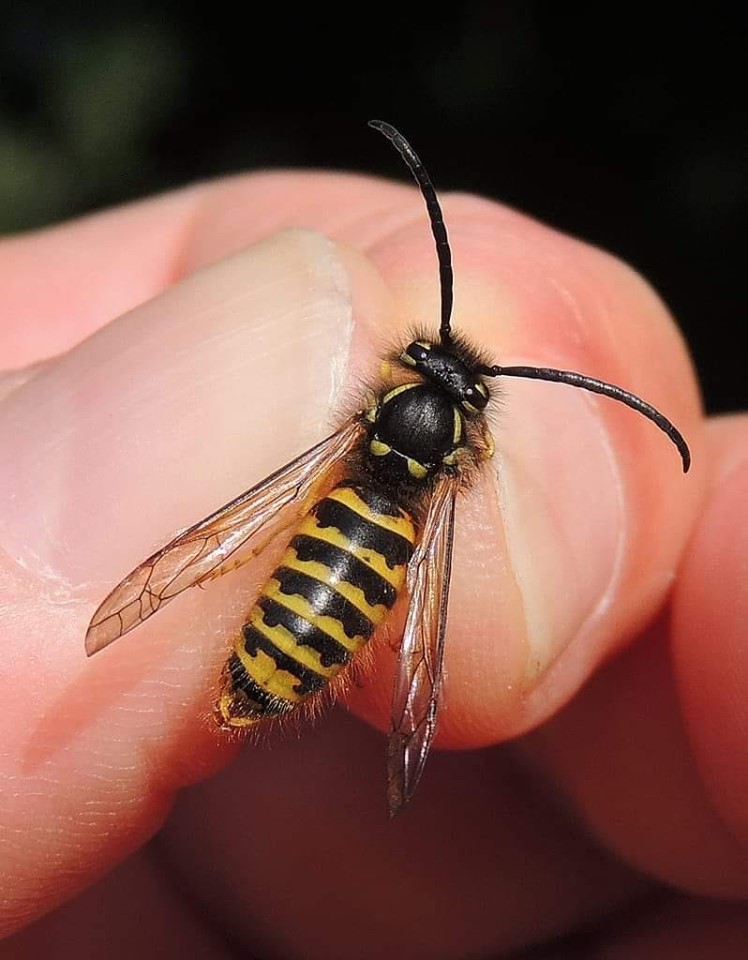 I wrote about the dangers of wasp stings recently, with more reference to disturbing a nest, but in the last week or two we have been more bothered in work by the cantankerous insular wasps that just make a nuisance of themselves whilst we eat or work. And of course they are the nations nemesis if you are trying to have a picnic or BBQ.
The reason that they become August’s Angst is down to their life cycle.
Common wasps live socially like bees but, unlike honey bees, they haven’t evolved a way of storing food to allow the colony to survive the winter. The only survivors are the young, fertilised queens who hibernate over winter. They emerge in the spring to build little walnut sized nests where they lay around 20 eggs.
The queen feeds the larvae until around May, when they mature and become workers. Then she focuses on more egg-laying and the workers get on with feeding them, enlarging the nest as they go along. By this time of year the nest has grown to around a foot in diameter, often larger, and that nest can contain up to 10,000 wasps, Not helpful to know, is it?
Then, in August and September, a dramatic change takes place. The queen more or less stops her egg laying and no longer releases the pheromone that causes the workers to work.
That means that these workers are made redundant, so are left jobless and disorientated. Although adult wasps prey on insects, that ‘meat’ is used to feed the larvae not themselves. In their adult state wasps are not able to digest solid food and need sugary liquid to survive. So with no larvae to feed, they become uncontrollably and hungry and angry. My brother says I’m the same when I’m hungry – he calls it ‘hangry’.
Over ripe fruit and fizzy drink are easy prey for wasps and towards the end of their brief lives, their hunger drives them to search for this easy sugar at exactly the time when we are indulging in it outdoors. The timing couldn’t be better for them or worse for us.
So the next time you get harassed by those angry solitary wasps remember that they are, in fact, jobless, homeless and about to die.
“Not soon enough”, says my unsympathetic brother.
Leave a Reply