
Taken from Lynne’s weekly column ‘Green Scene’ for the Western Mail
21st February 2026

Favourite Flower
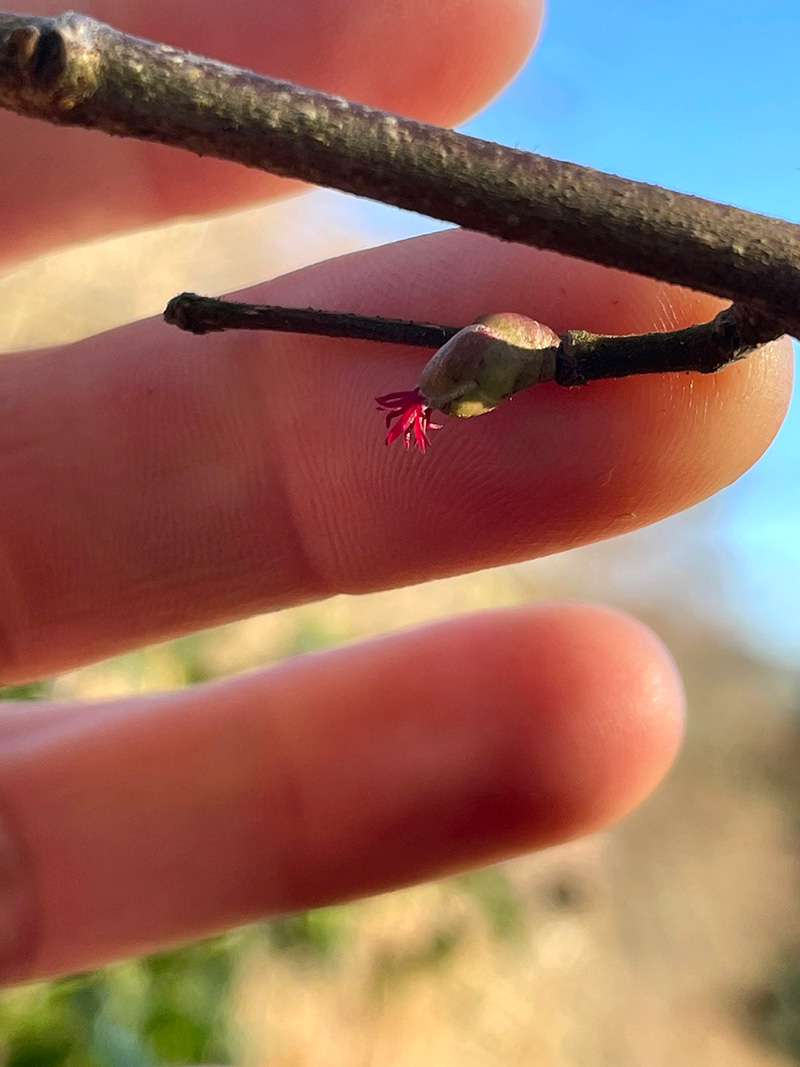
It’s the time of year for one of my very favourite things and something I write about and share enthusiastically every year. The hazel flower. And because I’m a creature of habit, I always go to the same tree and keep checking for her arrival. And last week, there she was, making me ‘smile out loud’.
I think it’s the fact that the tiny little red spiky hazel flower is so understated and overlooked and yet so absolutely pivotal in an aspect of nature that we all recognise, that hooks me every year.
At the same time as the male catkins are wriggling in the breeze and showing off, making sure everyone knows about them, the humble hazel flower opens quietly and without fuss. And yet it is this fabulous flower that develops into the hazelnut that we all recognise and love (especially if you’re a squirrel) later in the year. This year I have ‘marked’ the little flower in the photograph and am going to try to monitor her development throughout the year, hopefully resulting in a big fat nut.
Which incidentally is what my brother calls me for being so totally enamoured by something so small that most people can’t even find when they look for it. Do take the time to try – I guarantee your face will give the game away as soon as you see one.
Leaf of Life
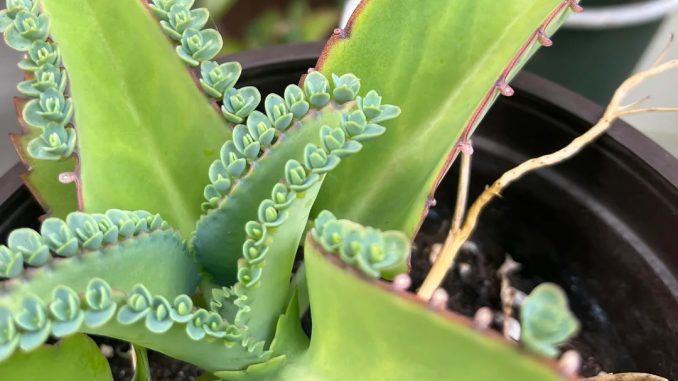
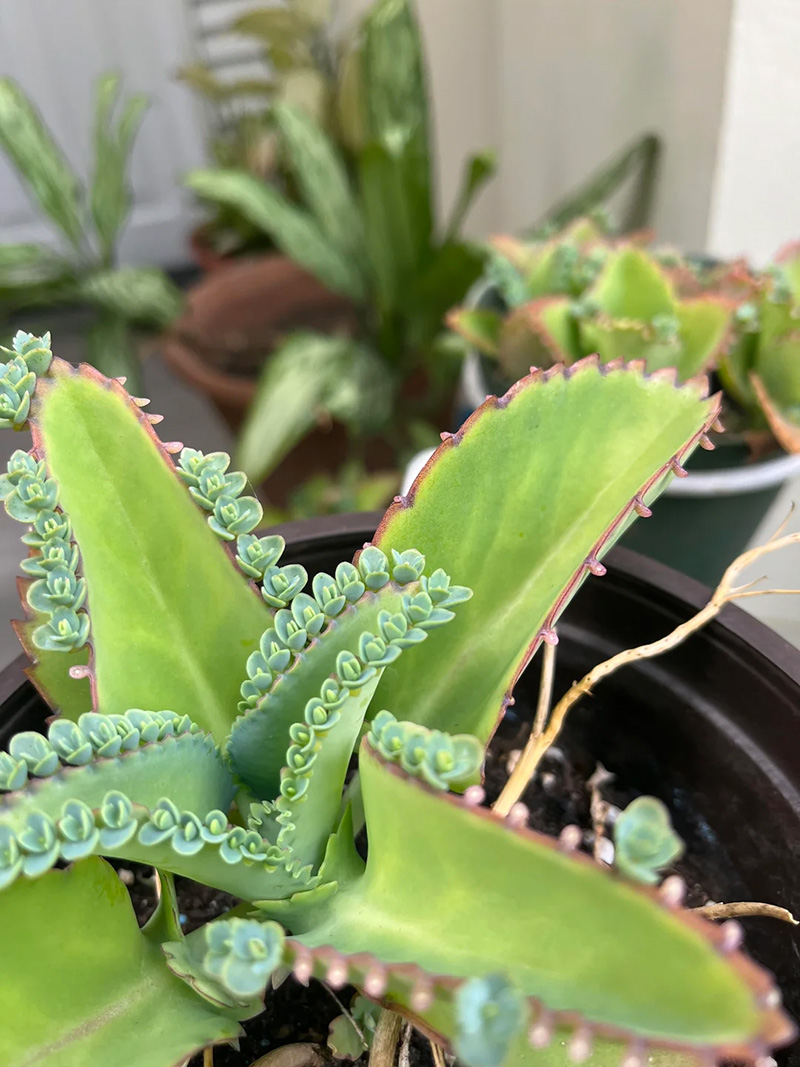 And whilst on the subject of being enamoured by nature’s wonders, I can highly recommend growing a Leaf of Life plant (Kalanchoe Pinnata). Also known as Miracle Leaf, it’s not difficult to see how it gets these lofty names.
There are several magical things about these plants. They actually grow from just a single leaf, producing a profusion of miniature plantlets on the edges of that leaf. I think it is one of the most fascinating things I have seen for a long time – other than my hazel flower, of course.
You can grow them in bottles or simply plant the leaves either on end or on their sides, which I think allows for more ‘oohs and ahhs’ as the little plantlets develop. These little plantlets can then be removed and planted up to provide more single leaves to swoon over.
Native to Madagascar, the Leaf of Life is happy to spend summer outside or in the greenhouse, but will need a warm conservatory or sunny windowsill to get through the winter. Despite looking quite diva-ish, it is a very low maintenance plant, which is almost impossible to ‘accidentally kill’. That makes it perfect for enthusiastic little green fingers as well as the older gnarly, arthritic ones!
And, as its name suggests, the Leaf of Life does have many health benefits. It is traditionally used to alleviate respiratory issues, to promote wound healing, and for treating skin conditions like eczema, insect bites and even ulcers. Rich in anti-oxidants, is often consumed as a tea, offering anti-inflammatory, antimicrobial, and antiviral properties. It can also be applied topically and is said to help relieve arthritis and gout.
One of my favourite descriptions of it is as ‘a herbal remedy for stress and anxiety, with its calming effects helping promote relaxation and alleviate tension.’ I think you would only have to watch the little plantlets develop as magically as they do, to forget about any anxiety and tension in your life.
Seedy Socks
 When we were kids, I always remember my nan putting old socks over our shoes when the roads were icy, so we didn’t slip. It always caused great excitement, being allowed to do what seemed a ‘really silly thing’. But, like lots of old fashioned seemingly silly things, it worked.
Recently a friend, who knows I’m not on social media, sent me something she had seen on one of the platforms.
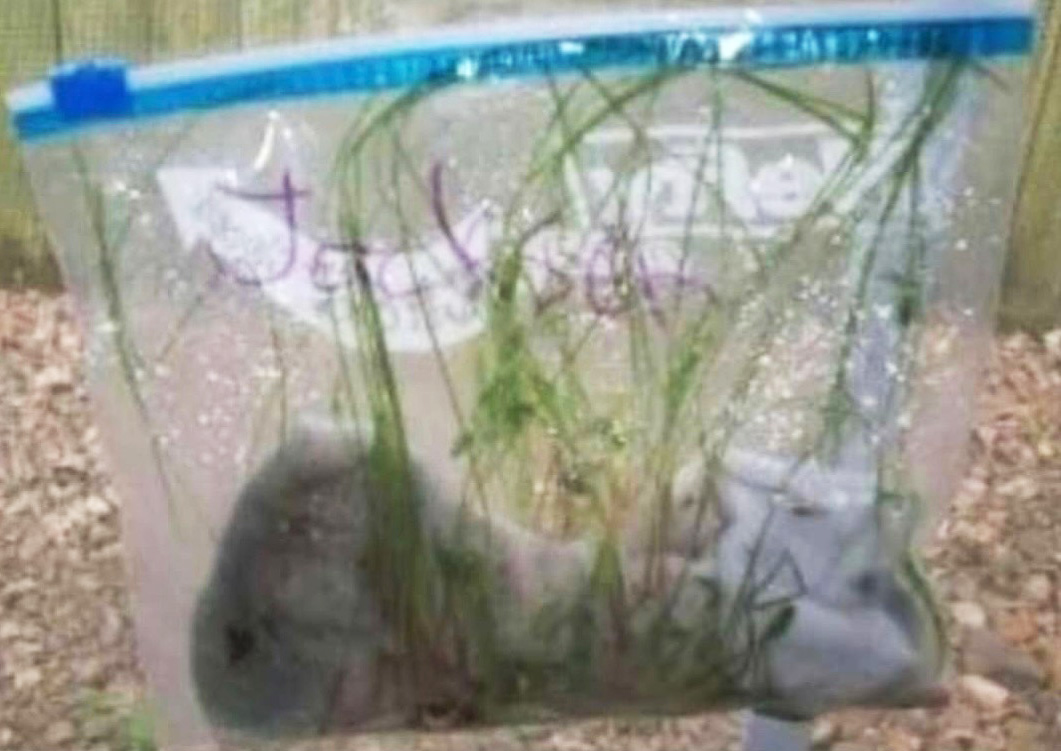
Apparently you wear an old sock over a shoe and go for a walk through the woods. Then remove the sock, spritz it with warm water, seal it in a Ziploc bag (or loosely tie an ordinary, clear plastic bag) and leave on a warmish windowsill for a couple of weeks.
The photo shows the result that accompanied the TikTok instructions. I am intrigued (although not convinced yet) so will try it, but I like to share these things whilst I remember, otherwise it might not happen.
Super-smart Snowdrops
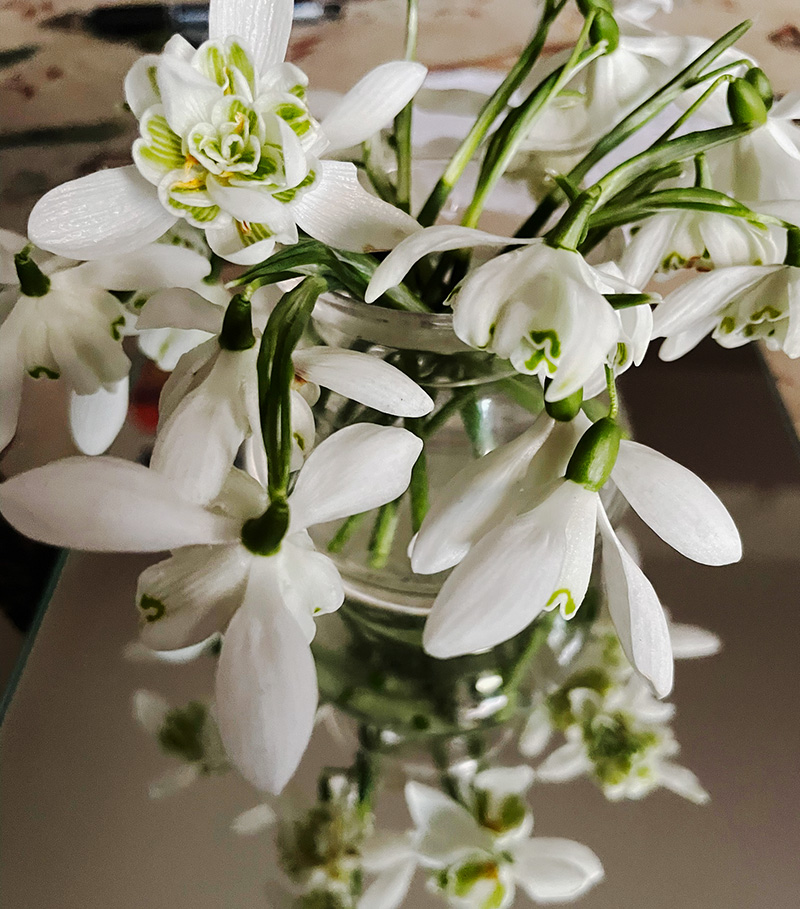 As the carpets of snowdrops continue to impress, I love looking into the little bowed flower heads to see the different petal patterns and varieties. There are lots of them, and all coming from just three species initially. Many of them will have hybridised naturally, often giving some lovely and unusual patterns inside the ‘hanging heads’.
There are over 2,500 named cultivars too, adding to the wide array of petal size and shape. If you look inside the flowers, the intricate patterns will amaze you and it’s easy to see why these beautiful early bloomers have such a dedicated following. Fans of the snowdrop are known as Gallanthophiles and some varieties are much sought after by avid collectors. The most expensive snowdrop ever sold is the Galanthus plicatus ‘Golden Tears’, which fetched £1,850 for a single bulb four years ago. That was a sharp increase on the most expensive snowdrop bulb bought at auction in 2011, Galanthus ‘Green Tear’ which sold for £360 then.
I always watch the honeybees visit the flowering white carpets as an early source of food, but I haven’t seen a single honeybee yet this year. The honeybees, and Bumblebees, will visit and reverse out of these bowed white lampshade-esque flower-heads with orange pollen in their pollen baskets on their back legs. The bright orange dots are vivid and seem highly unlikely to have come from such a pure white flower head. The flowers are clever too, and outer segments of snowdrops can move in response to changes in temperature. When air temperatures are above 10°C, pollinating insects such as bees are more likely to be flying, and so the petals move upwards and outwards, opening the flower to allow easier access. That’s proper collaboration.
Whilst folklore has it that it’s unlucky to bring snowdrops into the house (it is said that a death will follow), I always take the chance and display a small vase of the little beauties from my garden on a mirror tile. It is a lovely way of enjoying the beautiful interiors of the otherwise unseen interiors.
As Aristotle said, “In all things of nature there is something of the marvellous.”
Wonderful Word. Inspiring State
And whilst on the subject of ‘marvellous nature’, how’s this for a word – ‘Verdure’. Referring to lush, fresh green vegetation, foliage, or the vibrant green colour of growing plants, it is often used in literary contexts, to describe healthy, thriving nature, such as in a forest, garden, or meadow.
It can also symbolise vitality, freshness, or a healthy, flourishing condition. Which, despite recovering from another debilitating bout of COVID, is what I am aiming for.
Brilliant as usual and captures the emerging spring.❤️❤️