
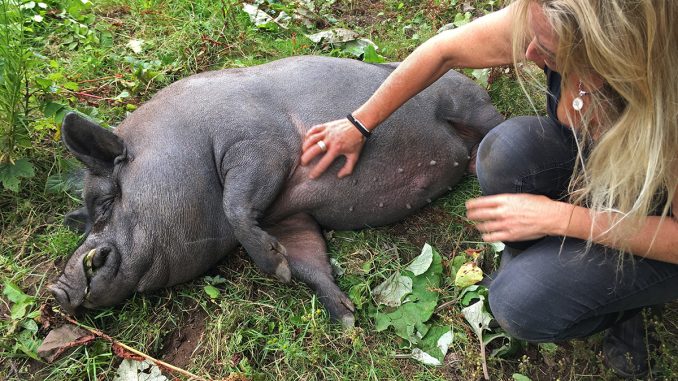
Taken from Lynne’s weekly column ‘Green Scene’ for the Western Mail
28th February 2026

Piggin’ Brilliant
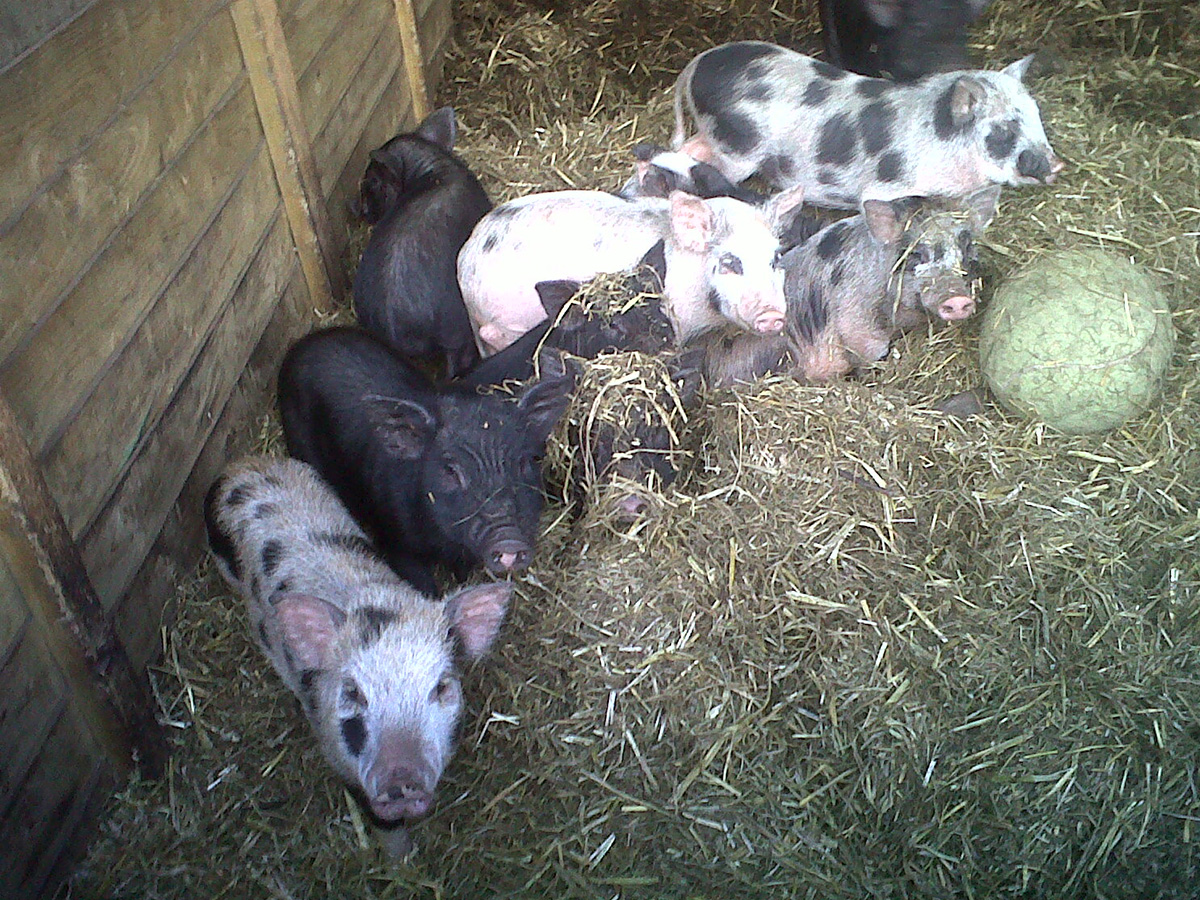
Tomorrow (1st March) is World Pig Day. The National Pig Day was founded in 1972 by two sisters from North Carolina and has since gone global. It is now recognised as International Pig Day, as well as World Pig Day. The sisters created the day to honour pigs as highly intelligent and domesticated animals, aiming to give them the recognition they deserve but seldom receive.
I have had quite the journey with pigs myself. Several years ago I decided to get two little pet pigs. They weren’t the then-trendy micro pigs but were ‘old-fashioned’ breeds that had been bred over several years to reduce their size by about a third, making them more ‘manageable’. I had decided to get two but, blaming the nursery rhyme, I came home with three little female piglets. The first thing I learned very quickly was that a pig’s squeal can be as loud as 115 decibels, and that’s ‘3 decibels higher than the sound of a supersonic airliner’.
Due to popular demand, I decided to breed from one of the gilts (a female who hasn’t yet bred) and borrowed a small, local boar to put with her when she came into season. What I didn’t realise is that he would bring the others into season too. I came home from work one day and I swear he was reclining, smoking a big fat cigar, looking very pleased with himself. I phoned the vet to see if there was such a thing as the morning after pill for pigs and he eventually stopped laughing for long enough to explain that pigs seldom had many in their first litter and there would inevitably be ‘casualties’ so, I would probably only end up with four or five piglets from all three gilts.
They had 28. And despite the odds, I managed to keep them all alive.
Not surprisingly, my venture into pig midwifery is a bit of a blur and I’m sure I aged about 20 years in as many weeks. But I did learn a lot about pigs and developed a very deep love and respect for them.
The stories are endless. I recall spending one very long day going to buy and erect an electric fence to try and keep them contained in a corner of the field. They watched me work with interest and as soon as I began packing up my tools – feeling very accomplished – one of them simply sniffed the bottom wire, flipped a large stone over onto it, sniffed it again (it had shorted and was therefore technically ‘switched off’) and walked straight through it. The others followed.
Pigs are renowned for having good memories – as well as making them – and they are described as being ‘socially manipulative with others’. I used to spend hours with them hiding bits of fruit and veg under flowerpots in their field for them to ‘forage’ and to keep them entertained. It soon became obvious which of us was the more entertained. They dug out their own hollow next to the water trough and one pig would get into the trough so the water cascaded over the sides of the trough into the adjacent hollow, whilst the other one bathed in it.
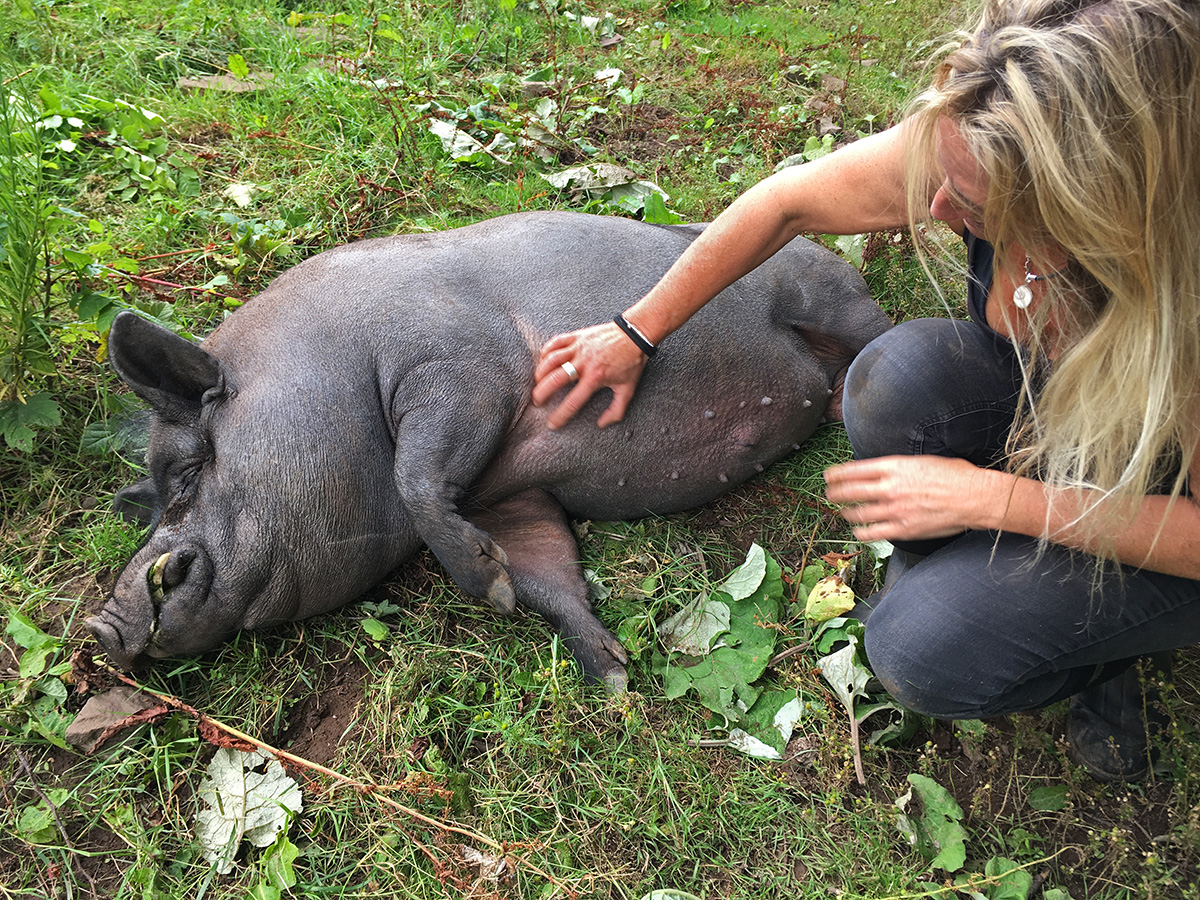 I discovered the art of ‘pig tipping’. If you scratch a pig behind it’s front leg, it’ll just tip over in a state of bliss.
They are real escape artists, and can also run at speed of up to 11.5 mph (almost 20 km/h) which I often found out whilst trying to get them back into their field after another ‘break out’. They are said to have a good sense of direction and are able to find their way home over great distances, but I never had the courage to test that particular aspect.
Wiki Leeks
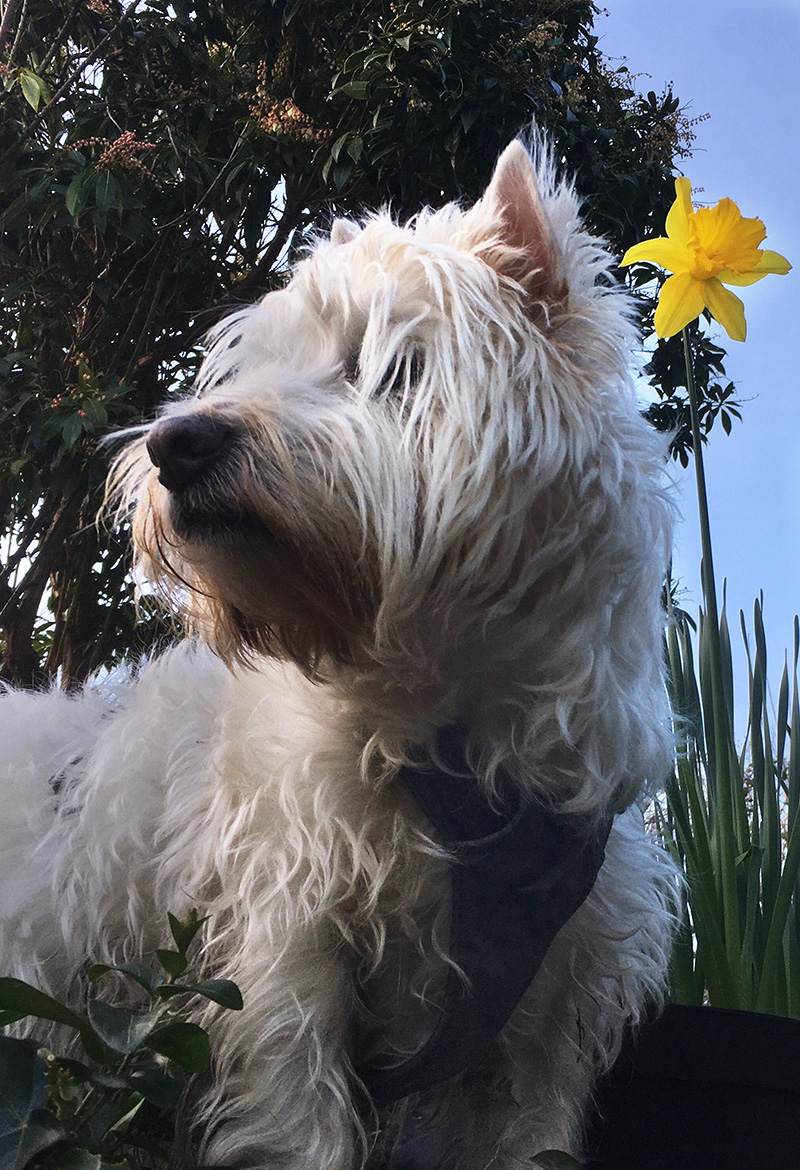
Tomorrow (1st March) is also St David’s Day, of course.
A favourite saying associated with St David’s Day is ‘Gwnewch y pethau bychain’ which means ‘Do the little things’. These words were apparently the last words uttered by Wales’s patron saint, before his death in 589AD. The words remind us that it is the small actions we take in life that are just as important as the big ones. I love that sort of ethos.
St David was also one of the earliest vegetarians. He didn’t eat meat, choosing to consume only herbs, vegetables and bread. And maybe leeks. As the vegetable is associated with him, here in Wales, it’s easy to think that they are Welsh in origin. But leeks are actually native to the Middle East and the eastern Mediterranean areas. Today, Indonesia is the biggest leek producer country. I suspect Terry Walton’s allotment is a close second.
I think in the kitchen leeks are often just associated with leek and potato soup but there are numerous ways to enjoy the veg – and although most people discard the green tops, they are perfectly good to eat and you can cook them with the white parts. If you don’t fancy adding them to your leek dish, then they can be used to make stock, leek Pesto, crispy fried leeks, and even dehydrated to make crunchy leek crisps.
Studies published in the Journal of Nutrition (2023) highlight that prebiotic-rich foods like leeks stimulate the growth of key players in gut balance. This microbial support helps reduce inflammation and strengthens the gut lining, lowering the risk of digestive disorders.
Growing up, whenever leeks got mentioned in our house, the same story would be told. When my brother was very little, the first time he saw our dog cocking his leg against a tree in the garden and went running into the house crying, ‘Chip’s got a leak, Chip’s got a leak’.
Hocus Crocus
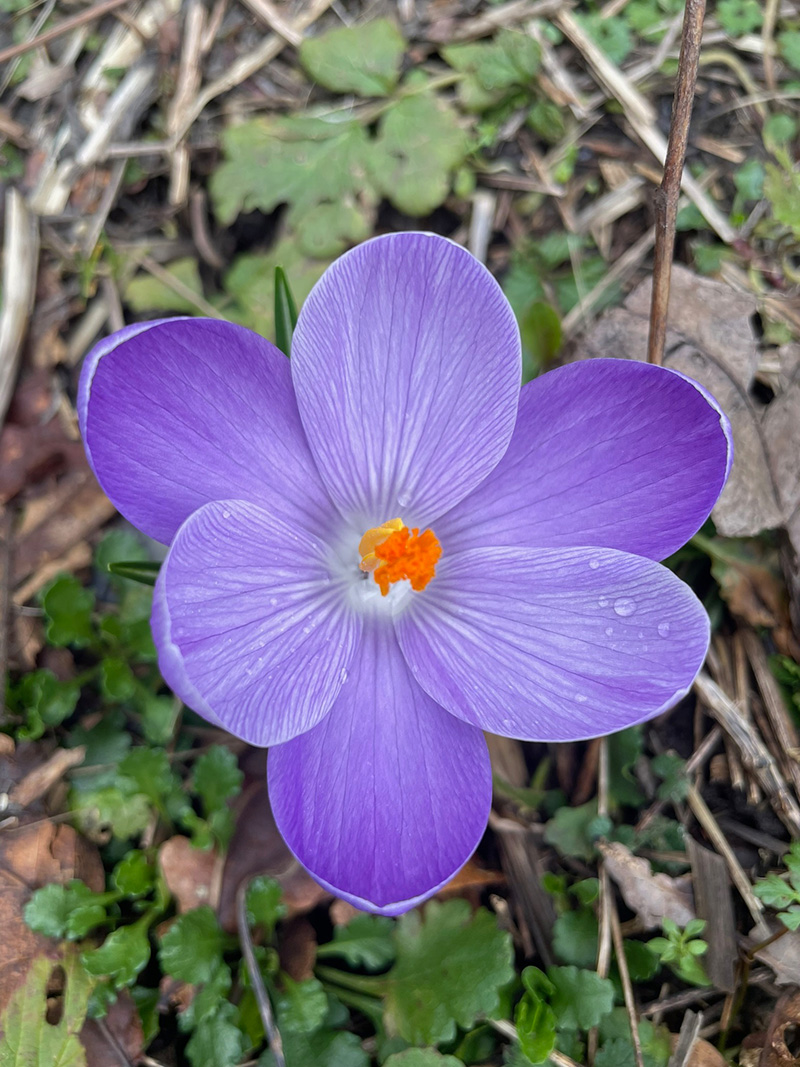 The humble spring flowering crocuses have been adding colour and joy to many gardens for a few weeks, but the crocus has actually enchanted civilizations for thousands of years.
I always find it hard to comprehend such a legacy, but the ancient Greeks and Romans also admired this little flower for its beauty and fragrance. Despite not really being thought of as a fragrant flower now, it was often used in perfumes, as well as medicinal concoctions. Throughout history crocuses have symbolized rebirth and joy and were therefore gathered with reverence – and not only by people. There is famous Fresco reconstruction depicting a monkey picking crocus flowers, from Knossos, Greece.
Today, the warm subtle scent of crocus flowers is still used in perfumery, often being blended with floral and spicy notes to create luxurious compositions. Saffron – from the Crocus sativus – apparently adds an exotic, slightly leathery aroma to high-end perfumes, making it a prized ingredient in the fragrance industry, as well as for its culinary prowess.
This valuable species, Crocus sativus, or the saffron crocus, is an autumn-flowering bulb that produces violet flowers with three deep-red, fragrant stigmas, which are dried to produce the world’s most expensive spice, saffron. I’m quite a regular at my local Indian restaurant and always enjoy a gardening-orientated conversation with the green fingered owner, Shalim. He gave me some fresh saffron, which he had grown, at the end of last year. So I swiftly ordered and planted a trough of saffron crocuses, just catching the end of the planting window in December.
With my garden design hat on, I like to plant the spring flowering crocuses en mass, on a bank as they are particularly effective, visually, on a slope. Cut the grass short at the end of the year to be able to see the low-growing flowers and don’t mow again until the foliage had died right back after flowering.
Crocus bulbs are poisonous to rabbits, who helpfully know that, and leave them alone.
Leave a Reply