
Taken from Lynne’s weekly column ‘Green Scene’ for the Western Mail
30th April 2022
I’m not quite sure why I feel it necessary to highlight the end of one month and beginning of another, but I do. Maybe it’s to remind you how quickly time wiggles by and to try to make the most of each day, although admittedly whilst I try to take a day at a time I often get hit by a whole week at once!

A Stitchwort in Time
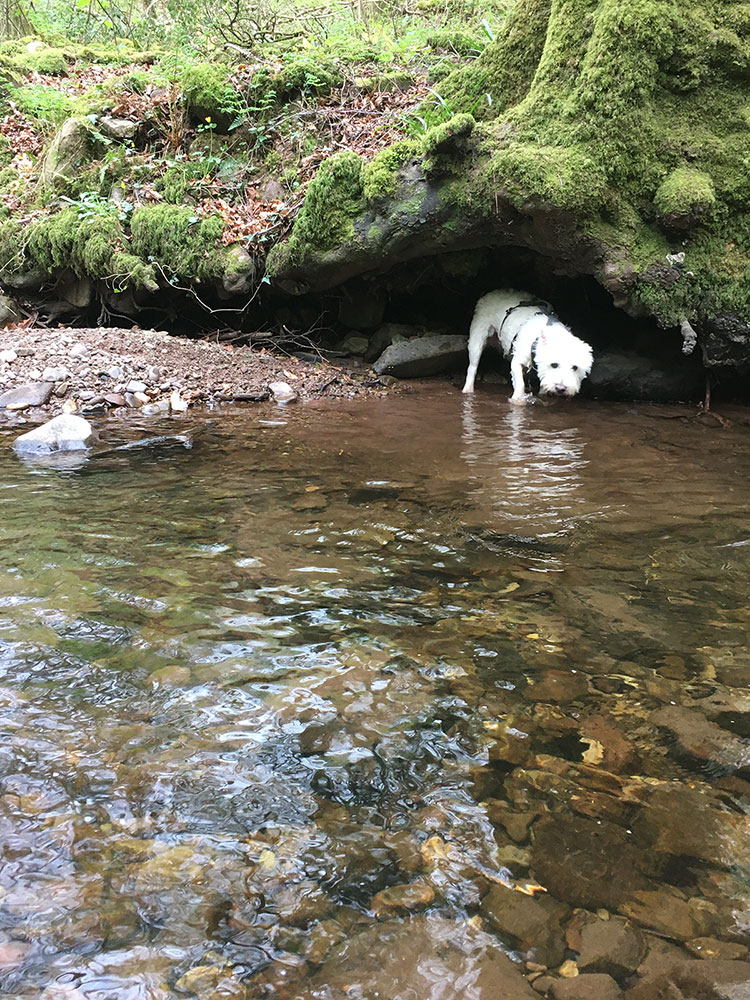 Due to Yogi having slowed down considerably in the last couple of months, our walks have organically become slow and gentle ‘sniffari’s’. It took a while for me to adjust to this new pace but I am finally acknowledging and appreciating the benefits of these more leisurely ambles. I notice far more of our surroundings and am (once again) appreciative to Yogi for ‘leading the way’.
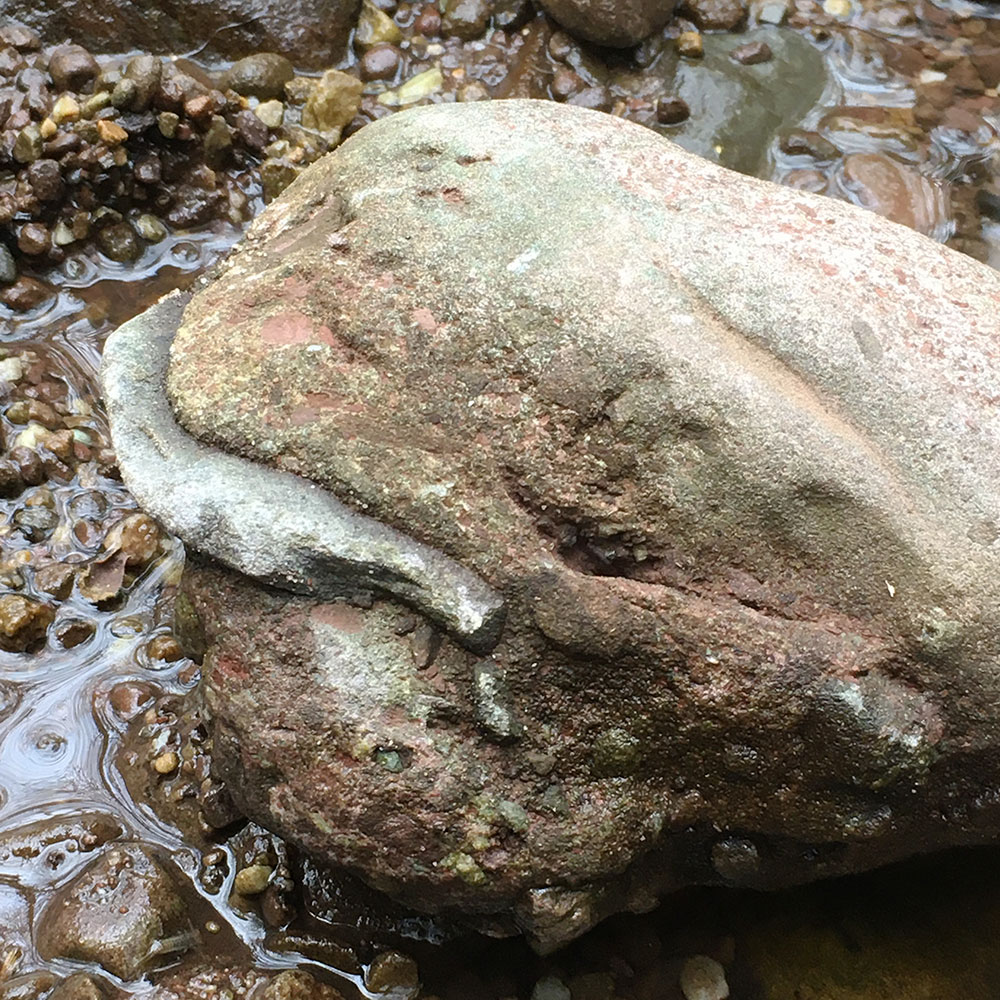
Last weekend, one particular sniffari yielded the most brilliant blue song-thrushes eggshell being jettisoned out of the nest and floating down beside us; I spotted the contrasting and contrary bright-red berries still on a holly tree amid a carpet of bluebells, saw faces in trees, a stone eating stone, and indulged in revisiting my childhood pastime of popping the stitchwort seed-heads in the hedgerows. And I loved it.
 John Muir – considered to be this country’s most famous and influential naturalist and conservationist – summed it up deliciously when he wrote:
“I don’t like either the word hike or the thing. People ought to saunter in the mountains – not ‘hike!’ Do you know the origin of that word saunter? It’s a beautiful word. Away back in the middle ages people used to go on pilgrimages to the Holy Land, and when people in the villages through which they passed asked where they were going they would reply, ‘A la sainte terre’, ‘To the Holy Land.’ And so they became known as sainte-terre-ers or saunterers.
Now these mountains are our Holy Land and we ought to saunter through them reverently, not ‘hike’ through them.”
Screen Free Week
 Next week (2-8 May) is ‘Screen-Free Week’. As it suggests, it is an annual attempt to encourage people to rediscover the joys of life beyond the ever-increasing amount of screens in our lives. It started life as ‘TV Turnoff Week’ in 1994, where children were encouraged to turn off their TV’s and go outside to play instead. In 2010, TV Turnoff Week became Screen-Free Week as it was adopted by the non-profit organisation, ‘Fairplay’.
Now, during the first week of May, thousands of people around the world will try to put down their ‘entertainment screens’ for seven days of alternative connection, and discovering new things.
Even though it’s about turning off screens, Screen-Free Week isn’t about going without, it’s about creating new habits. An hour usually spent on YouTube can be an hour spent outside; ten minutes scrolling on social media can become ten minutes spent doodling, sketching or journaling; watching a movie can be replaced by time spent reading, chatting, or playing games.
You can celebrate Screen-Free Week at home, in your school, in your community, by yourself or with friends. Simply do something else instead of spending time in front of an ‘entertainment screen’ – of course, many will have to still use a screen for college, work and homework but please try to get your entertainment ‘sans screen’ for a week. See how you get on – and how long you last.
Fairplay also encourage you to take part in Screen Free Saturdays. More details at www.fairplayforkids.org/screen-free-week
Pig Love
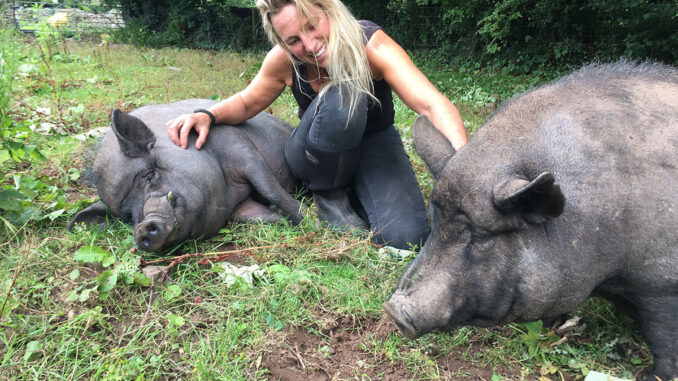
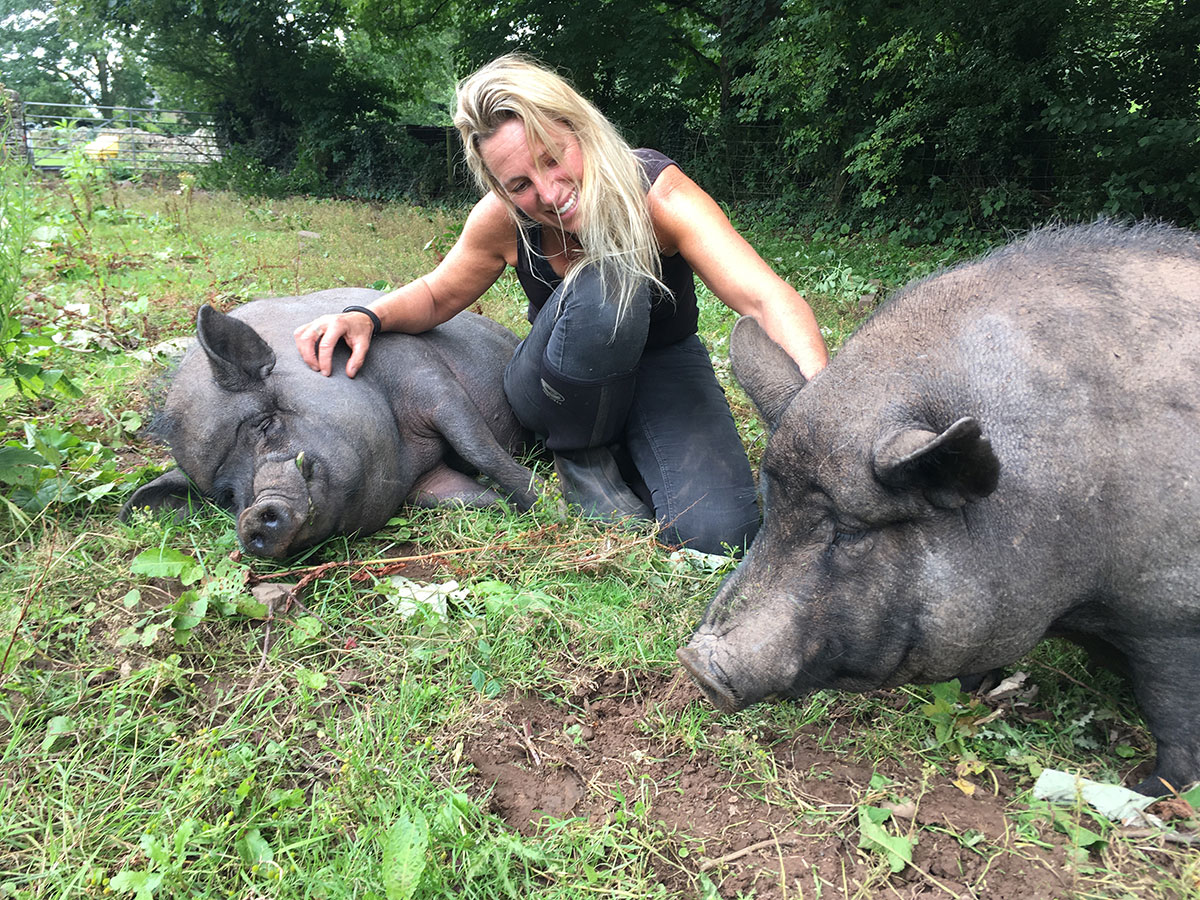 Last Wednesday, the 27th, marked 12 months since my perfect piggy pals, Frank and Edna, left me for the big pig sty in the sky. The huge gap they left in my life is still raw and weeping. I still can’t bring myself to recall the fabulous memories they gifted me. It is just too painful to think about them in detail. I can just about manage to allow them to come into my thoughts as a sort of fuzzy outline in the background and allow myself a fleeting snapshot of one or two of their ever-amusing antics but as soon as they start to come fully into focus and that memory-reel plays, I have to block it out. I think subconsciously that I also choose to imagine that they are actually still in their field. Not in a totally delusional way but in a soothing, protective way. Consequently, I avoid their field, choosing to believe that they are still there, safe and sound, mooting about, grunting and cheerfully swishing their little piggy tails.
I guess it’s all part of grief. I can’t say the ‘grieving process’ because I am not allowing the process. The inky black searing pain of having to not only ‘let them go’ but having to ‘arrange’ for them ‘to go’, was just traumatising. The initial inky black intense pain has just faded into a dark grey ache.
They taught me so much, enriched my life in more ways than you would imagine two pet pigs ever could, and also impacted the lives of friends, neighbours and numerous visitors. They were so intelligent, and yet lived the simplest and most contented of lives. Something I aspire to.
I was fortunate enough to write quite extensively about my piggy path in my autobiography Barefoot and Before, sharing personal anecdotes of my own pet pigs. For example, after numerous successful escapes on their behalf, I had no choice but to resort to an electric fence to keep them from mooting up the neighbouring farmer’s field. It took me a whole day to go and buy the electric fence and to work out how to install it. It took them 10 minutes to realise that if they upended a large stone onto the lower electric wire it would earth the fence and they could step through it quite safely. They would actually sniff the wire to see if it was on. I never saw them get it wrong.
And 12 months after their departure, they continue to educate and enamour. Whilst writing this tribute to them, I searched for words I didn’t have – and discovered that the pig is a mammal belonging to the order Artiodactyla and the family Suidae, which is also known as the even-toed ungulate family. That family is further subdivided into another four to eight genera, with domesticated pigs and wild boars belonging to the genus Sus. The scientific name for a pig is Sus scrofa scrofa. The plural is scrofe and the word derives from sker, to cut and referred to a ‘digger’ or ‘rooter’.
It is often said that where there is deep grief, there is deep love – but in this case, also deep respect. These two much missed, super-special ‘scrofe’ continue to teach, and reach the hearts of many – even from the big pig sty in the sky.
Another lovely read! The only word I think you missed out was ‘rootling.’ It’s probably made up, but I always think of it when I see a pig going about its business of rummaging for food.
You certainly have a way with words. As always a gentle lovely read to start the day.