
Taken from Lynne’s weekly column ‘Green Scene’ for the Western Mail
17th July 2021

Try for Scythe
 Strimmers are inevitably busy at this time of year but please be ‘Wildlife Aware’ if you are cutting grass that may be providing a haven or hideaway. The forecast is for hot weather in the next few days so slow worms will be out sunning themselves and although hedgehogs shouldn’t be out in the day, sometimes they are … so please just be careful.
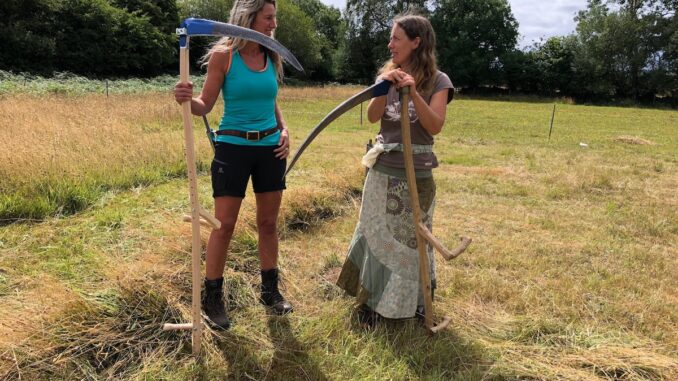
A few years ago I learned to scythe – ironic really when my granddad was probably the King of scything. I remember watching him in absolute awe as a youngster as he scythed the long grass in the orchard down as short and neat as a lawn mower would. It was mesmerising to watch. He was in his seventies at the time too and although very fit, I remember him saying it was more about technique rather than strength.
So 45 years later I travelled over to west Wales to learn the art of scything. It was as mesmerising to do as it had been to watch all those years ago, and definitely hadn’t lost any of the perceived magic. I loved it.
Sadly it’s the maintenance of things that I get bored with. I could scythe all day long but the peening of the blade leaves me cold, and to be honest I could really do without sharpening the blade every hour or so too. Peening is the process of working a metal’s surface to improve its material properties and is an intimidating skill for many new scythers to learn. It can take years of practice to become really proficient and I have no interest whatsoever in doing so.
A sharp blade is absolutely essential for efficient scything so you do need to sharpen the blade with a sharpening stone regularly during use. It’s not difficult to do, and quite relaxing in itself so I can manage that!
Although we have ‘progressed’ to machines like strimmers and brushcutters, there are still lots of advantages to cutting grass with a scythe. There’s no need for ear protectors and goggles (which always steam up) or a hot, safety helmet. You don’t have to walk half a mile to retrieve your can of fuel. It’s peaceful, ticks the ‘mindfulness’ box and is great exercise.
I seriously wonder why council teams don’t train up staff to use scythes for road side verges and roundabouts. There is no danger of flinging stones and bottles out into the operator or passing cars and you are aware of your surroundings far more than if you are wearing a helmet and ear protectors with an engine on your back.
Obviously it’s better for wildlife but also as a way of life, I think.
Interestingly, scything isn’t just for cutting long grass, you can actually scythe a regular lawn, keeping it as short as a mower would – and as my granddad did. I think I will have to overcome my aversion to blade maintenance to reach that level of expertise.
I trained at Scythe Cymru with an Austrian scythe, which was fitted for me. They offer a range of courses and also other relevant services (including a peening service, thankfully). You can buy a scythe through them and they will give you lots of useful advice even if you can’t actually get to west Wales to ‘get mowing’.
Alternatively, Tools for Self Reliance in Crickhowell also sell a good range of traditional wooden and modern light weight scythes and sharpening stones – and also have an impressive stock of advice!
What’s Your Poison?
 I’ve been asked a few times in the last couple of weeks to identify hemlock (and hemlock water dropwort) and giant hogweed. I remember a townie-friend saying that she was shocked by how many things in nature were ‘out to get you’ and although it sounds a bit dramatic, it’s a good reminder to be respectful to it all.
As the name suggests, hemlock water dropwort is found in damp conditions – near streams and rivers and on marshy ground – and is often regarded as the most poisonous indigenous plant in Britain. It is a large, stout plant between three and five feet high that flowers this month. The lower stem is usually thick and joins to clusters of fleshy tubers that gives it it’s common, and rather unnerving, name of ‘dead man’s fingers. The entire plant is poisonous – except the nectar and pollen, as nature obviously cares more about its bees and pollinators. Although sadly animals are the usual unsuspecting victims, human fatalities are not uncommon.
You have to wonder about nature a bit mind – hemlock water dropwort has a really nice smell, a bit like sweet parsley, which totally belies its murdering abilities. Apparently the roots even taste like parsnips – before they kill you.
Hemlock, on the other hand, smells disgusting, which theoretically should warn you off. It is acutely toxic to people and animals and symptoms can appear twenty minutes to three hours after ingestion. All parts of the plant are poisonous and even the dead canes remain toxic for up to three years. It doesn’t just have to be eaten to cause problems, it has been reported that pulling up large areas of hemlock without gloves has allowed the toxin to penetrate the skin and make the person involved very ill.
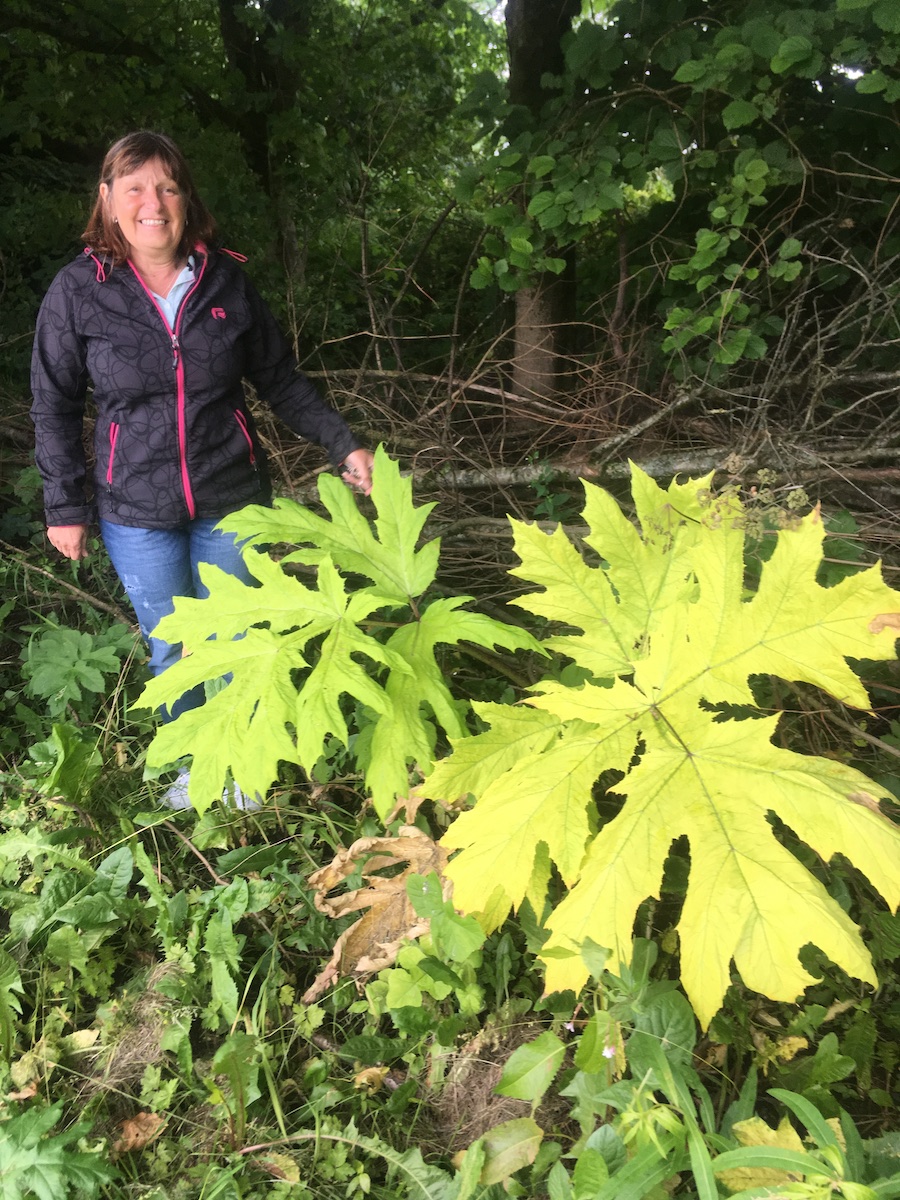
Giant hogweed is nasty stuff but unlikely to kill you. If the sap is in contact with bare skin it causes horrendous blistering. People have also had long-term sensitivity to sunlight after touching the plant, as well as blindness if it comes into contact with the eyes. Please be aware that dogs can be affected too if they walk through or brush past this plant.
Once you have seen giant hogweed you’ll realise that if you have to ask, ‘Is it giant hogweed?’, it won’t be. Aileen (in the photo), may be compact and bijou but you get my point!
The ‘hemlock horrors’ on the other hand, can be easily confused with other members of the Umbellifer family like cow parsley and even herbs like flat leaved parsley and chervil.
Please familiarise yourself with these and other poisonous plants. Nature doesn’t abide by any Health and Safety regulations, it is your responsibility to be respectful and stay safe. As the old saying goes, “Nature takes the best revenge.”
Open Garden
 Amid the ever-confusing COVID chaos, some private gardens are still opening to the public this year under the National Garden Scheme. Clytha Park and its giant Redwoods is famous for the historic lakeside setting and the walled garden, on the old A40 between Abergavenny and Raglan, and is open on Sunday (18th) from 2 – 5pm.
Dogs on leads are welcome, wheelchair access is good and you are encouraged to bring your own picnic or to order a cream tea from the nearby Clytha Arms, to bring and enjoy by the lake. There are also some lovely local places open for a pub lunch, which you could walk off around the gardens afterwards – or ‘walk up’ an appetite and stop off somewhere on the way home for a bite to eat.
My brother swears I’m part Labrador because of my obsession with walking and food!
Tickets for all open gardens must be pre-booked through the NGS website where you can also find the nearest open gardens to you this year.
Leave a Reply