

Taken from Lynne’s weekly column ‘Green Scene’ for the Western Mail
10th July 2021

Poppy Love
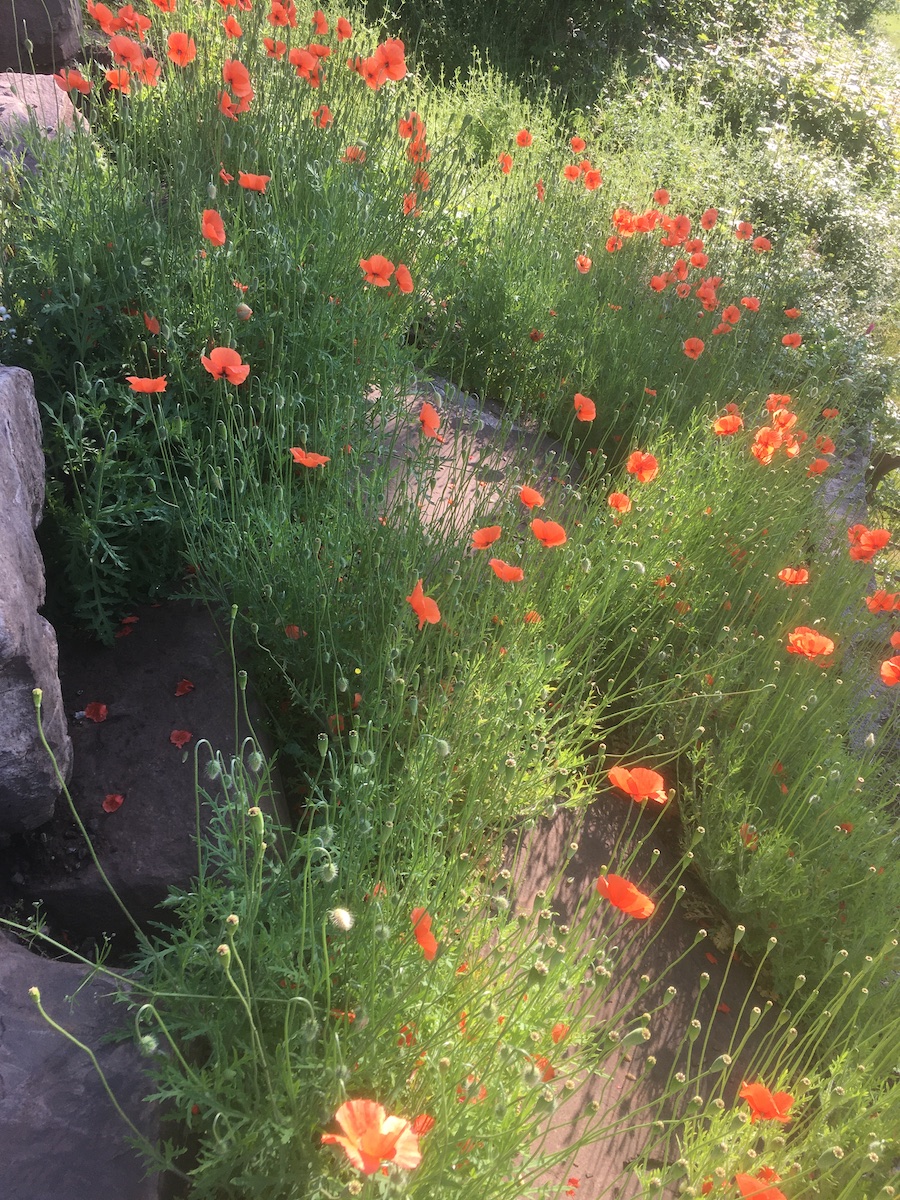 It’s been a week of two halves from a nature point of view this week. On the plus side, we gained a whole bank of ‘free poppies’ after some landscaping work was carried out earlier in the year.
Poppy seed is nothing short of miraculous, as it can lay dormant in the soil – if undisturbed – for around 50 years. Once that soil is disturbed, the seeds will seize their opportunity to shame garden designers and steal the show.
It’s quite poignant to realise that the beautiful little red corn poppies we associate with Poppy Day and the Flanders Field, were flowering because the soil had been disturbed not by cultivation but by exploding shells and mines.
None of the poppies in the photo were sown or planted – they all just appeared as a result of the area being cleared and the soil being agitated back in the spring. Sadly, more often than not this year’s poppy seeds will once again become dormant until the soil is disturbed again.
Because of this, some people lightly rotorvate a wild flower area to keep the poppy seeds active, although some of the Shirley poppy varieties have actually lost their preference for dormancy and are quite happy to germinate each year.
Either way, corn poppies are still considered to be erratic germinators but what an absolute treat when you do wake the sleeping beauties.
Hornet Horrors
The heartbreaking side of my week was that a hornet annihilated the bumble bee nest in my riding hat and assassinated all my bees. I feel responsible as I witnessed the hornet making a nuisance of himself around the hat when I went to work one morning. Groups of four or five bumble bees were chasing him off and I couldn’t get close enough to kill him myself without risking disturbing the riding hat. I know that hornets can decimate a hive of honeybees, but assumed that was for the honey and just didn’t think long enough to appreciate how vulnerable my brave bumble bees were.

Interestingly, although once in a hive a hornet can decapitate a honey bee every 10 seconds, researchers have recently witnessed something quite incredible. Honey bees united to totally cover the hornet in a tight ball of bees and working in unison vibrated to produce heat, raising the temperature in the formation, like a tiny oven, to over 115 degrees. Bees can survive the high temperature, but the hornet can’t and after around an hour of cooking, the hornet died.
Unfortunately, it appears that my bumble bees didn’t know about this roasting method and when I came home that evening, the hornet had annihilated the whole nest. Dead bees were littered on the floor and the nest had been ransacked for the pupa and larvae. I was absolutely devastated.
After my rant last week about the need to protect our wildlife rather than rescue it, I felt I had really let my little bumble bee buddies down. But you can be assured of one thing – it won’t happen again. The next time I see one of these miserable stripy assassins I will hunt them down before they have a chance to murder any more of my beautiful little buff bottomed friends.
Bee Humble
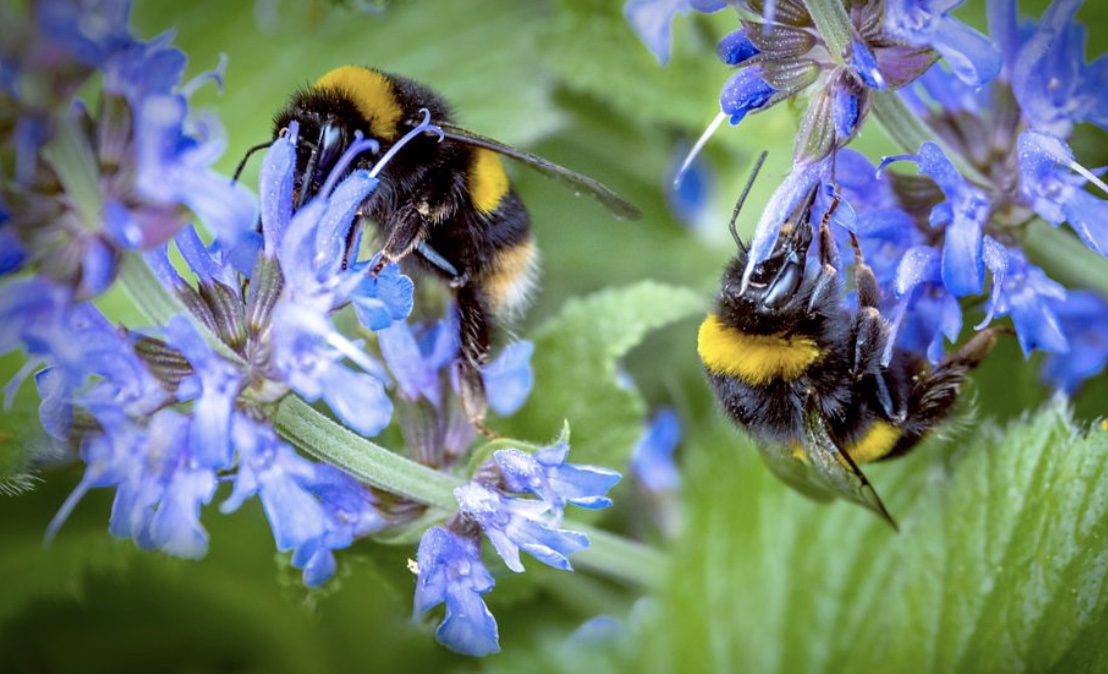 Despite my rant last week I was still ‘secretly’ pleased to be asked to help judge BBC Radio 2’s Big Bee Challenge.
The quality of the entrants was absolutely staggering and unbee-lieveably diverse. It is reassuring to realise that there are young ‘hive minds’ who have our bees interest at heart and will hopefully go on to protect wildlife rather than save and rescue it.
Moth Magic
 I have always given moths bad press. I think it’s largely been based on the numerous little brown ‘clothes moths’ that seem to want to take over my cottage at this time of year and threaten to munch their way through my already limited wardrobe. Although I do have it on good authority that it is actually the larvae that does most of the munching, as the adult moth has no teeth. Still, it‘s the adult moth that lays the larvae so I’m not cutting this variety any slack.
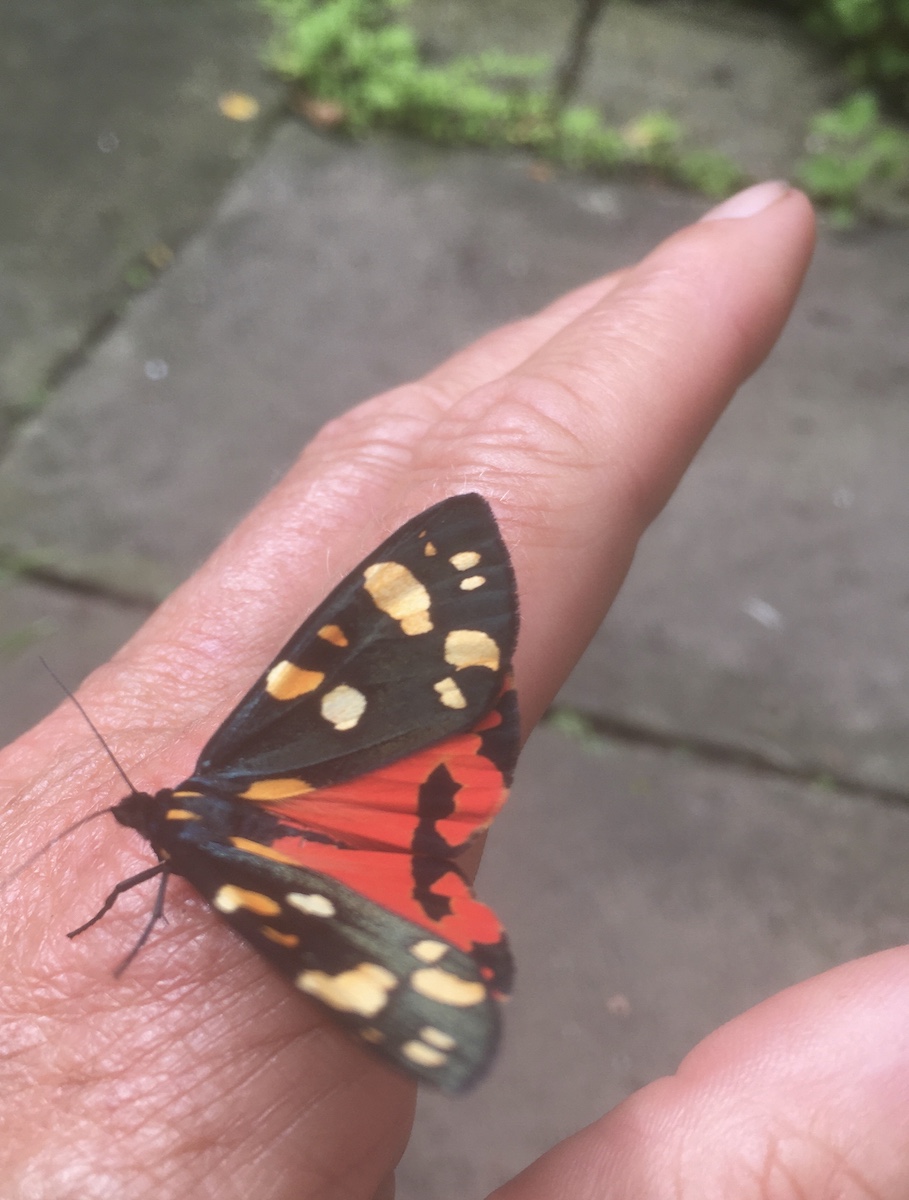
However, as I sat and ‘chatted’ to this colourful Scarlet tiger moth (see photo) last week, I realised I had to review my opinions about moths in general.
There are over 2,500 species of moth in the UK – and not all of them are night flyers, many are out and about in the day. It’s surprising to learn that most people think all moths are nocturnal and also consider them to be the drab and boring cousins of our beautiful butterflies.
But some of the moths are also beautiful and not only are there pretty ones, there are ones that are pretty clever too – at camouflage anyway. Have a look at the Buff-tip moth that looks just like a birch twig, and the Angle shades moth that looks just like a dried leaf.
 And the pretty ones include the White ermine moth (see photo) – you’ll see how that one got its name – and the Elephant hawk moth – named because of the caterpillars’ resemblance to an elephant’s trunk. And then there’s the Hornet moth – whose protective stripy coloration is a great example of Batesian mimicry. By imitating a harmful species, the mimic can avoid predation – in this case, the moth relies on its similarity to a hornet to make it unappealing to predators.
This is of course unless a hornet has just assassinated your bees and you are over zealous and over reactive in your revenge.
So, note to Hornet moths – I’m not going to ask to see your ID, so I wouldn’t rely on your Batesian mimicry methods in this garden!
Leave a Reply