
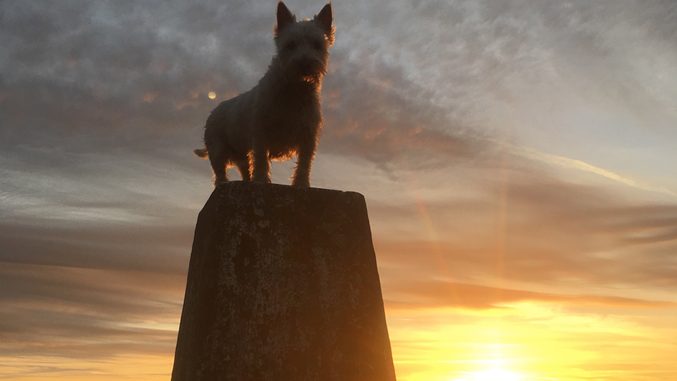
Taken from Lynne’s weekly column ‘Green Scene’ for the Western Mail. 24th September 2016 
Super Sunsets

Over the week or so, I have been fortunate enough to witness some of the most beautiful sunsets and sunrises with the skies hosting bright orange and even deep red streaks. I wondered what conditions contribute to such spectacular skies and weather watcher Gareth Harvey explained, “It’s often said that a spectacular dawn or dusk is brought about by particles within the atmosphere, usually through manmade pollutants or naturally occurring dust. However, this is in fact a myth with pollutants generally having the opposite effect on sunsets and sunrises. One of the ingredients that helps produce such bright colours in the sky as the sun sets and rises is clean air.
The sun’s rays are made up from a spectrum of colours ranging from violet through to red, with each colour having a slightly different wavelength. Air molecules scatter sunlight as it travels through the atmosphere, and explains why the sky appears blue during the day (the blue and violet part of visible light is scattered by air molecules more than other colours in the spectrum, due to its wavelength, and thus dominates over the other colours). When the sun is lower in the sky, around sunrise and sunset, the light must pass through more atmosphere. With more atmosphere for the light to travel through, there is more scattering of the blue light, so much so, that the reds and oranges of the spectrum begin to dominate and reach us at the surface.
For those vivid reds to occur, high level clouds usually play an important role. These types of cloud, such as cirrus, receive the sun’s light with little interference from dust and pollutants, which, as already mentioned, tend to dampen the bright reds and oranges. Ice crystals within the cloud scatter and reflect the red light, causing the sky to glow, like it were on fire.
The saying “red sky at night, shepherd’s delight. Red sky in the morning, shepherd’s warning” was first recorded in the Bible and was a way to help shepherds predict what the weather was likely to turn out like over the coming day or night. The saying may bear some truth, in those locations where weather systems generally move in from the west, such as the UK. With the sun setting generally in the west, a red sky supposedly implies that skies are clear and pressure is generally building, which often gives dry and settled conditions. In contrast, a red sky in the morning can imply that the sun, coming up in the east, is shining its red glow on to clouds in the western sky. Cloud in the west would suggest the approach of a frontal system and poor weather on its way.
Feel Good Factor
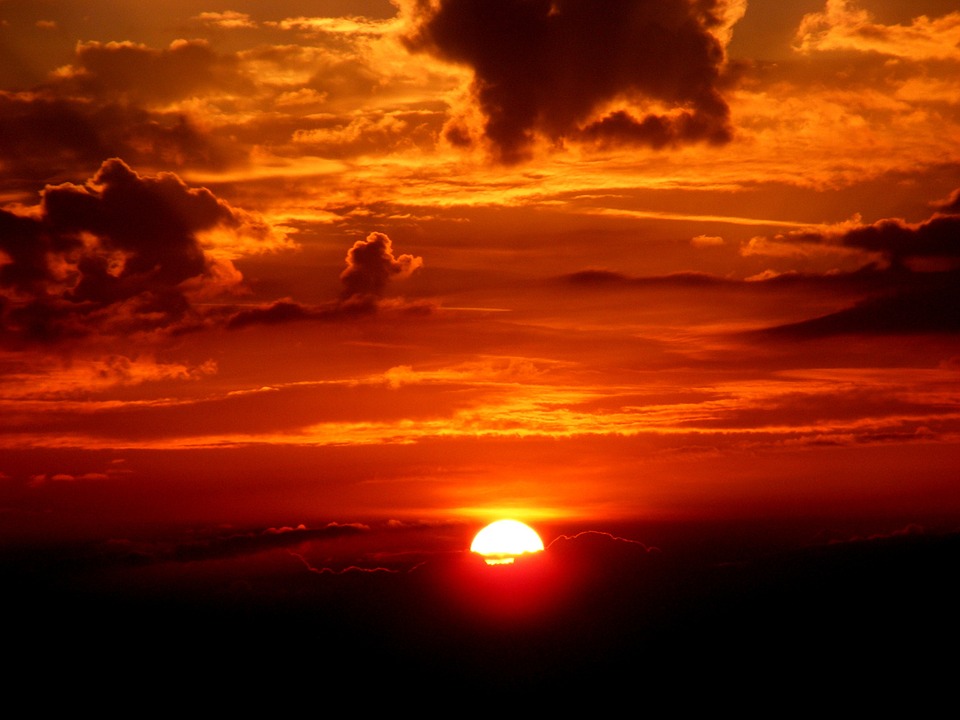 Studies show that appreciating natural beauty may boost well-being, increase generosity and enhance life satisfaction. The key is to actively engage with the experience. To reap the rewards of that sunset, you need to stop whatever else you’re doing and really notice and appreciate the show in the sky.
Health writer and psychologist Linda Wasmer Andrews advises that the psychological effects of admiring the sunset may persist long after the colour has faded.
“Allowing yourself to be captivated by a sunset may have a number of psychological benefits.
In general, people who feel connected with nature report being happier and having more positive emotions than those who don’t share this connection. A recent study led by Jia Wei Zhang at the University of California, Berkeley, helps explain why: Researchers found that connectedness with nature only predicted well-being in people who were attuned to the beauty of nature. Need to tune up your awareness of natural beauty? It’s hard to beat simply sitting outside and soaking up a stunning sunset.
Another study by Zhang found that the positive emotions aroused by natural beauty led to increased pro-sociality — feelings and behaviours characterized by concern for others. In one experiment, volunteers first looked at pictures of nature scenes and then played a game, which allowed them to be generous or stingy about giving away points to other players. The nature images had been pre-rated to determine how beautiful people thought they were. Volunteers who viewed beautiful nature images gave away more points, compared to those who viewed less attractive pictures. In short, it wasn’t just looking at nature that put people in a generous mood. It was perceiving the beauty of nature — and a sunset is a prime example of that.”
Whatever the reasons, I highly recommend it anyway, especially here in Wales where we are blessed with the most beautiful skies – whatever colour they are.
Slugging it Out
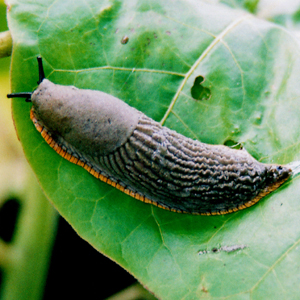 Apparently this year has been a bumper year for slugs; they remain active when temperatures remain above 5C (41F) and last winter December 2015 was the warmest since records began in 1910, with temperatures around 7.9C (46F). This made it feel more like April or May which meant slugs didn’t go into hibernation but kept eating and breeding through the winter months.
This has earned them the name of ‘Sleepless Slugs’. The average British garden usually has as many as 20,000 slugs – and they can lay as many as 200 eggs per cubic metre. A decline in many of the slugs’ predators, such as frogs and toads and hedgehogs, is also a factor and spurred on by the prediction that slug numbers could increase year on year by 10%, Harper Adams University are using tracking devices to monitor slug’s behaviour and feeding patterns.
So how do you get a tracker inside a slug? With tiny tools and surgery, it turns out. Slugs are anaesthetised in a chamber of carbon dioxide before a small cut is made, and the tracker inserted. Each chip contains a unique tracking number that responds to radio signals emitted by the tracking device – which looks a bit like a metal detector.
Hundreds of tagged slugs are released into the fields, and researchers go and track them at night to build up a daily picture of how the slugs move and cluster.
They have already found that slugs congregate in patches in fields or gardens. These patches normally form in areas where the soil moisture is high, or even waterlogged. They are being called ‘slug utopias’ and it seems that if you have a lot of slug activity in your garden it could be because you are unlucky enough to be hosting a ‘slug utopia’ …
They have also found that slugs spend more time just below the soil surface than we realised – which makes sense as many of the questions I get asked about damaged foliage indicate slug activity but the person dismisses it, as they haven’t actually seen any.
Leave a Reply