
Taken from Lynne’s weekly column ‘Green Scene’ for the Western Mail
8th August 2020

Scythe Ways
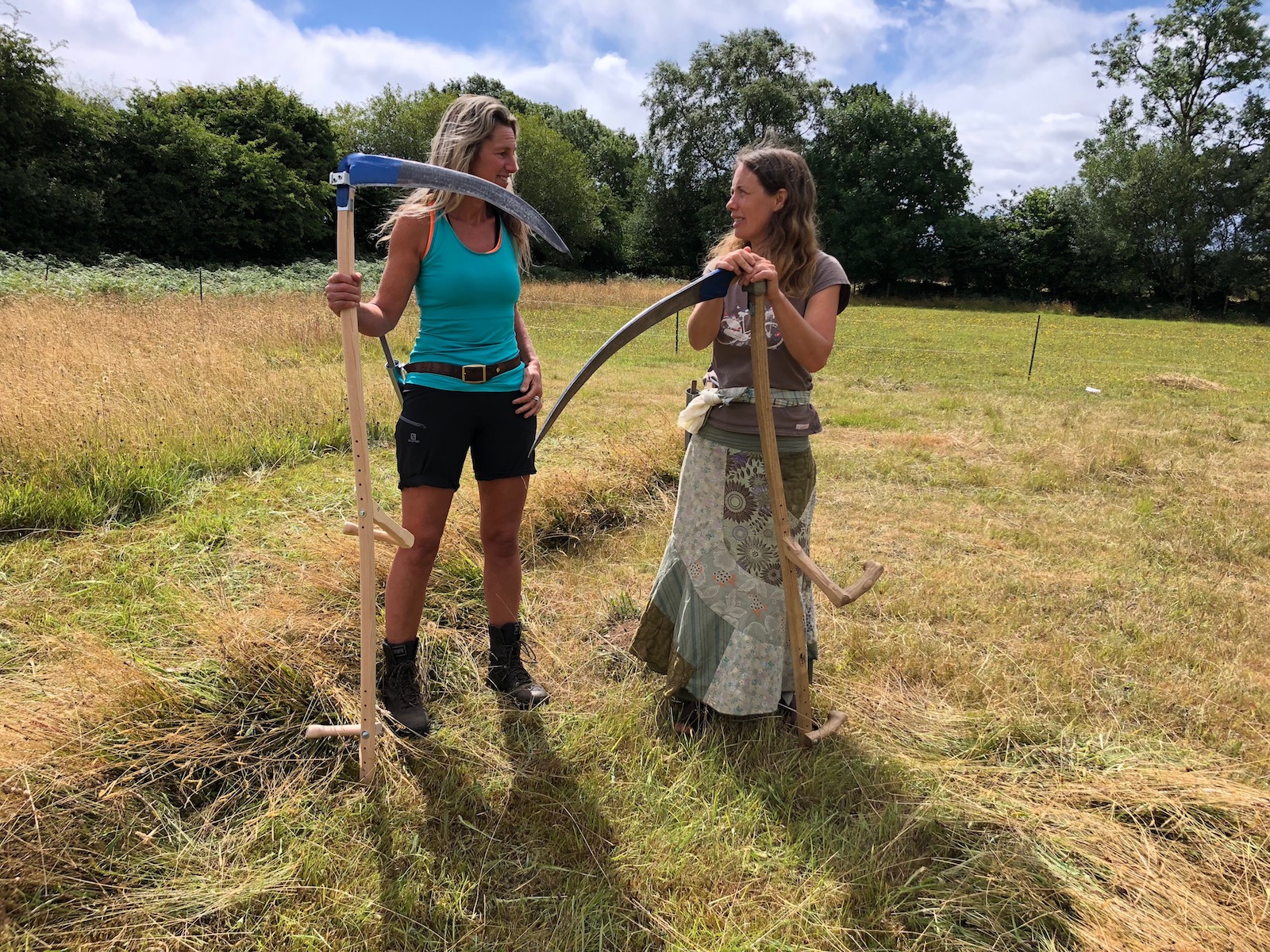
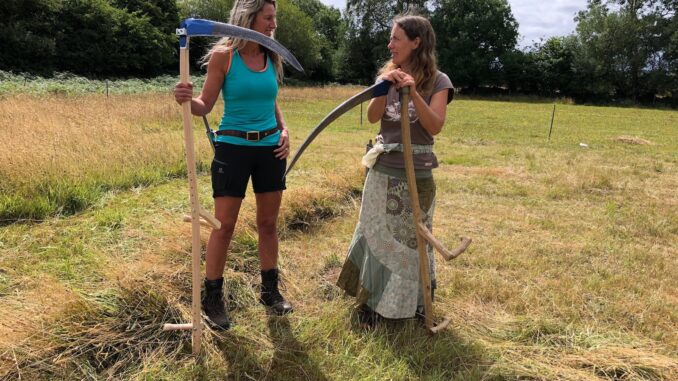
I have just finished scything a few areas of long grass in various gardens. I only learned to scythe about three years ago, and not surprisingly, I absolutely love it. I could scythe and dry stone wall all day every day. They are my happy places.
I can recall watching granddad scything his orchard when I was a kid. Even at a young age I fully appreciated the skill it took to get the grass so short with a ‘Grim Reapers’ blade. He also used a cut-throat razor to shave – that was pretty awesome to watch too.
Back in the orchard, the other thing I remember is that he stopped a lot. For every ten minutes or so he spent scything, he stopped for what seemed to be the same amount of time, to sharpen the blade with rhythmical strokes of the sharpening stone he kept in his pocket. The whole process was mesmerising.
Like a lot of things, I wished I had asked him to teach me. Maybe not at that young age but I certainly could have been scything before secondary school, and it would have been far more fun.
Fast forward 45 years, and I went to West Wales to learn what my granddad could have taught me. I was fitted for my scythe – it’s crucial the handle (or snath) is the right length for the individual – and given that all-important sharpening stone to hook on my belt.
My teacher was Michelle, an incredibly ‘lithe scyther’, indicating scything was not only good for the environment but good for the operator too. The movement felt natural straight away and I was immediately taken with the peace and quiet, peppered with bird song, whilst felling the long grass. Normally I have a helmet, visor and ear defenders on and my head is still ringing with the noise of the strimmer. The vibration can result in white finger after a while, and my shoulders always ache from the weight of the machine relying on the harness. To cut grass that hasn’t yet been cut this year, you need a big strimmer and they’re heavy. You also tend to get a little pebble dashed, no matter how careful you are and I won’t even explain the misery of hitting dog or cat sh*t or even worse a dead squirrel, which I have only done once but have never forgotten.
I always cringe when I drive passed council workers strimming the side of the road, or roundabouts – one small stone could result in one big accident. And then there’s the fact that when you have finished a full tank of fuel you inevitably have to walk back a fair way to retrieve the petrol can to refuel.
All the above reasons are why I genuinely think we should be scything more and strimming less, especially on roadsides. The breaks enforced by having to keep the blade sharp means you get a chance to ‘have a whiff’ and the whole process requires ‘organic mindfulness’ – something that isn’t so organic at the moment.
It is also a fabulous form of exercise, helpfully targeting the (menopausal) midriff, as well as upper body and core. At a time when the Government are trying to reduce obesity among the population, they could do a lot worse than to prescribe scything.
And I tell you something else – it is, without a doubt, the most effective way I know of maintaining a 2 metre social distance.
Tools for Self Reliance in Crickhowell have some beautiful lightweight scythes for sale, with details at www.tfsrcymru.org.uk and you can find out about courses and work shops at www.scythecymru.co.uk
Grandfather Tree
 A fungi-foraging friend recently shared that had recently had a wonderful haul of ceps, or porcini, as they are more commonly known. So last weekend Yogi and I set off on a ‘shroom search of our own. Ceps love the soil under beech trees and sometimes oaks. On a guided forage a few years ago, I was taught to look for them at the edge of clearings in broad-leaved and coniferous woodland. Since then I have a ‘special spot’ where I know they can usually be found, weather permitting.
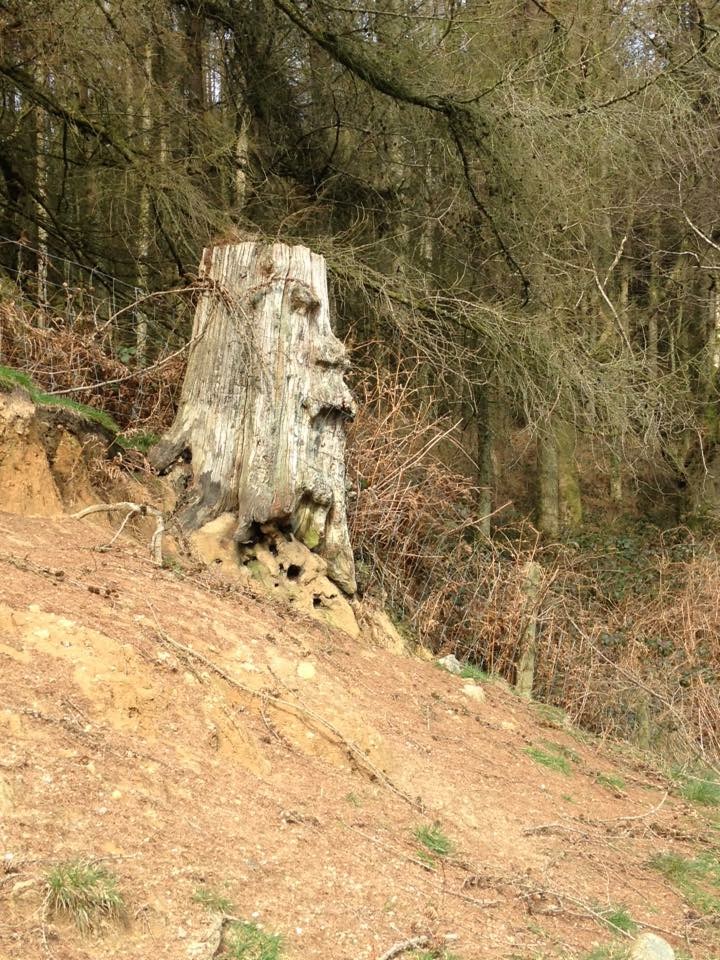
Sure enough it wasn’t long before we spotted our super ceps and ‘had supper in the bag’. But the best discovery was yet to be made. We wandered on a bit further, following a stream so Yogi could cool off. I sat on a stone whilst she splashed about, and as I felt I was being watched, I looked over my shoulder and saw the grandest of tree stump faces.
Whilst I am quite well known for communicating with nature’s elementals, including tree spirits, I think this is about the closest I’ve actually been to one.
Re-Cep-ies
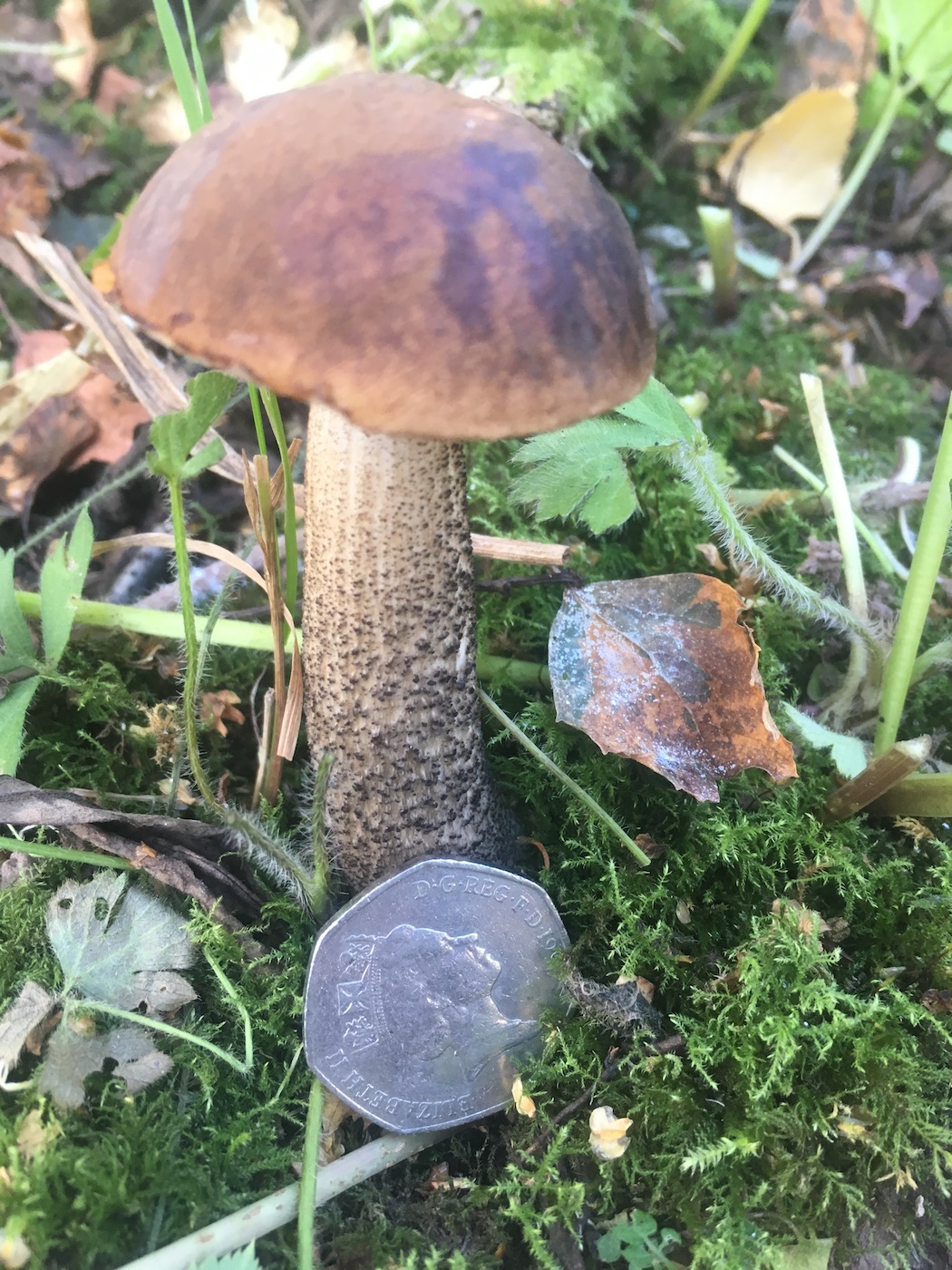 Porcini are thought, by many chefs and connoisseurs, to be the finest eating mushroom and a grilled porcini cap is often known as a “poor man’s steak.” They have a wonderful earthy flavour and are indeed a great steak substitute for a vegan or vegetarian.
My preferred method of cooking is simply to slice and fry in a little butter, lemon and thyme or mint (yes mint) and I must admit, at the risk of making chefs take a sharp intake of breath, to often just having them in a sandwich. I do browse through all the recipes that suggest adding them to posh pasta and super-sauces but to be honest a cep sandwich, or ceps on hot buttered toast is quick and delicious.
However, there are some great recipes on the internet should you be a bit more disciplined, including cep stroganoff, creamy cep sauces and soups, porcini and potato gratin and even porcini and pistachio Pesto.
They also freeze and dry well, although I have never managed to save any of mine to do that with. I love the phrase, ‘live in the Now’ and that’s when I like my food too.
Leave a Reply