
Taken from Lynne’s weekly column ‘Green Scene’ for the Western Mail
7th June 2025

Swift ID
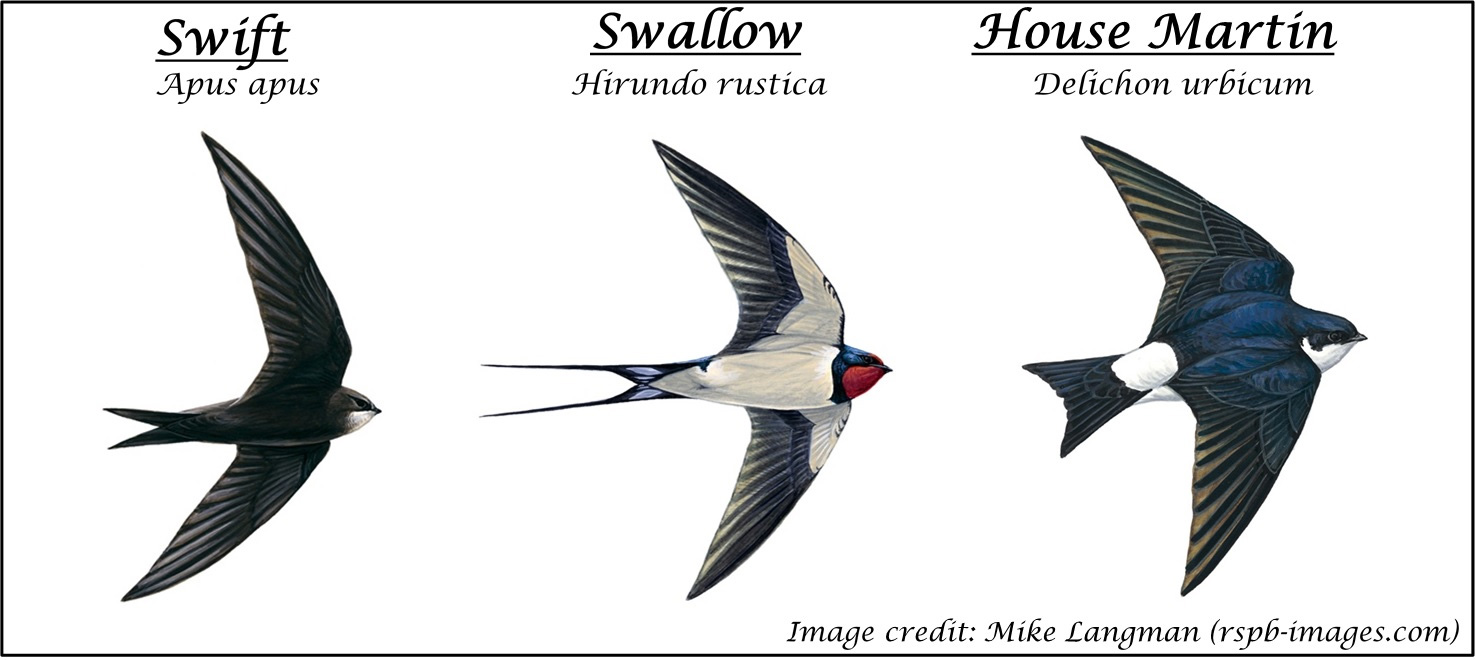
I am often asked to explain the difference between a swift, a swallow and a house martin at this time of year, as all of them grace our skies with their acrobatic displays. It took me ages to remember the differences, so maybe this’ll help.
Swifts have forked tails, which are shorter than a swallow (‘swift’ is also shorter than ‘swallow’ letter-wise), and as they spend almost their entire lives in flight – eating, drinking, sleeping and even mating on the wing – you’ll never see them perched on overhead wires like swallows. They stay ‘swift’. They have dark, streamline bodies and nest in cavities in walls and in the eaves of old buildings, returning to the same nest each year. Their call is very shrill (or ‘swift’) – you can often hear them before you see them. When flying around their nests, they are often referred to as ‘screaming parties’.
Swallows have longer forked tails (remember swallow is a longer word than swift). Their tummies are pale but not the striking white of a house martin, and they build cup-shaped nests made of mud under the eaves. You will often see them swooping over water to collect insects – and sitting on overhead wires.
House Martins are smaller than swifts and swallows, have shorter wings and shorter (forked) tails. They are also plumper in the body and have a white ‘undercarriage’ and rump. Whilst they also build their mud nests under the eaves of buildings, unlike the swallow’s open cup nest, house martins only leave a small opening at the top of their nest. They tend to prefer ‘neighbours’ too, and will often build their nests side by side.
I hope I don’t get into trouble for this but I always think of the band, The House Martins – plump and white.
A Stitch(wort) in Time
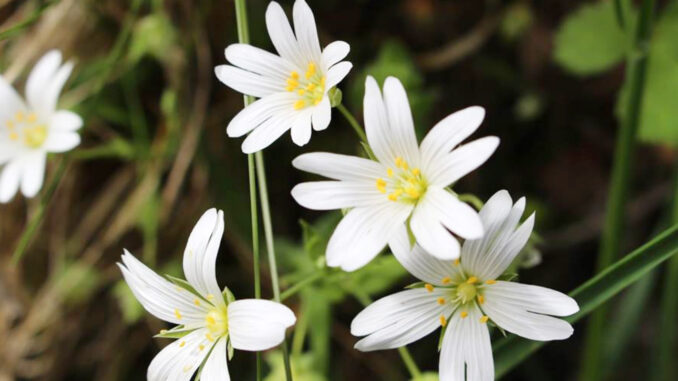
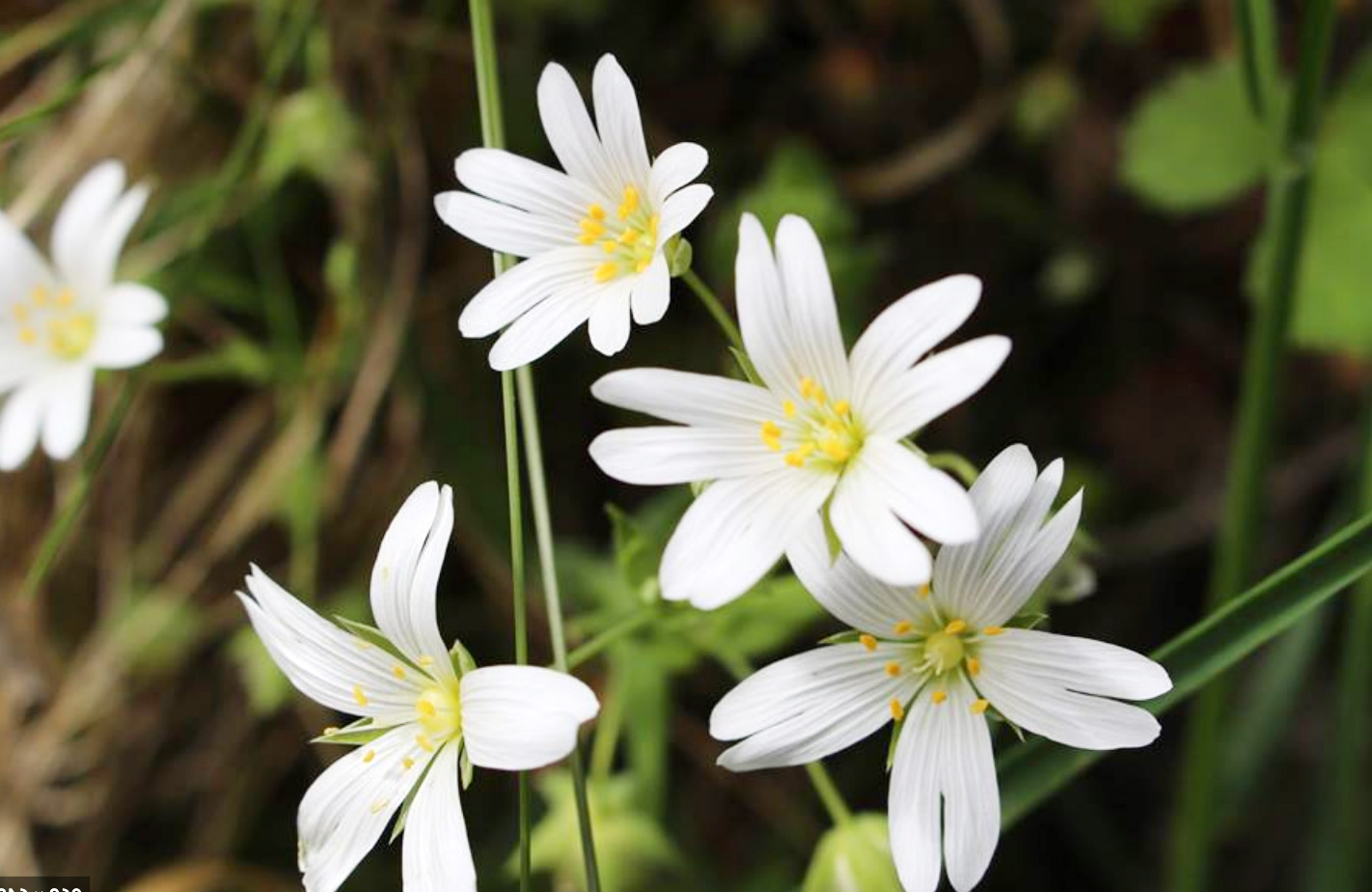 When I see the stitchwort going to seed in the hedgerows at this time of year, it always reminds me of Nan telling me about one morning when I was about 5 or 6 years old, and she was walking me to school. Apparently we were ‘very’ late getting to school … and the reason? I had insisted on trying to ‘pop’ all the seed-heads of the stitchwort on the way. And then she would recall another day where we were even later – that morning I had apparently insisted on walking the whole mile to school – backwards. Neither of those incidents surprise me at all, but what I can’t work out is why Nan let me. I probably asked her but can’t remember the answer. In the same way that I can’t remember much of the Welsh that she taught me. Nan was brought up in Resolven and was Welsh speaking but the trouble was that as kids, the only time she spoke fluent Welsh to us was when she was telling us off – and I was far more keen to ‘get out the way of the wooden spoon’ than to learn a new language. I can’t tell you how often I wish I had paid more attention in the latter years.
Anyway – back to stitchwort. Stitchwort got its name as the plant was traditionally used as a herbal medicine to alleviate the pain felt in your side during exercise – called a stitch. It has lots of other common names, including ‘wedding cakes’, ‘Star-of-Bethlehem’, ‘daddy’s-shirt-buttons’ and ‘snapdragon’ – the latter because its stems are brittle and easily break, rather than the popping sound the seed heads make when you crush them between thumb and finger. As the seed capsules ripen, they can be heard ‘popping’ in the hedgerows all by themselves.
The green shoots are edible and can be added to salads, or briefly cooked in a stir fry. In addition, the flowers look great when added to a salad. There is a ‘greater’ and ‘lesser’ stitchwort – as the names suggest the former having slightly larger flowers and leaves.
Some say that if you pick greater stitchwort, you will cause a thunderstorm, and in some areas, it was believed that greater stitchwort was the property of the pixies and picking it would anger them. Goodness knows what ‘popping’ it did to the pixies – but it didn’t seem to anger my Nan.
Great Big Green Week
Next week (7th to 15th June) is Great Big Green Week, described as ‘the UK’s biggest ever celebration of community action to tackle climate change and protect nature, celebrate the heartfelt, brave, everyday actions being taken to stand up for nature and fight climate change.’
Thousands of events take place throughout the UK under the theme of ‘Let’s swap together for good’. In the past events have included tours of local wind farms, nature restoration afternoons, mini festivals that celebrate the community and you are encouraged to swap skills or items, or perhaps organise a repair café. The website states that, ‘Events are hosted by teachers, bus drivers, sport clubs, artists, community groups, places of worship, libraries, builders. People like you who care about climate change.’
You can find out more, including any events in your area at www.greatbiggreenweek.com
Muffling Mittens
 I am still making the most of my and Yogi’s sniffari’s to take notice of what in the hedgerows and verges. My wing-dog is nearing 16 now and in her dotage, our walks have become very slow and much treasured, as is every single day together.
My recent ‘Awww, look that’ moment involved a foxglove whose flowers have grown in a cluster rather than in the traditional long spikes. It might seem a small thing to some people but it is noticing these little things that make up big joy.
Did you know that folklore has it that foxgloves got their name as foxes wore the pink flowers as gloves to muffle their steps and allow them to creep up on their prey.
Scatter Some Love (and Food)
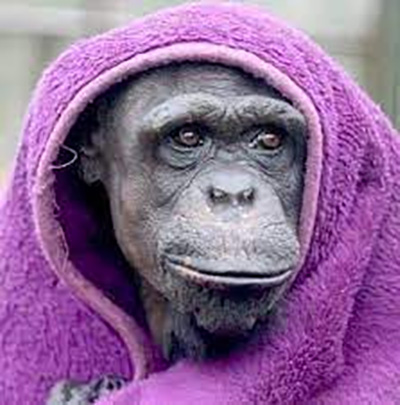 The Welsh Ape and Monkey Sanctuary are currently appealing for what they call ‘scatter food’ (dried fruit and nuts) for their ‘special rescued residents’. The Sanctuary, situated between Caehopkin and Abercraf in Powys, rescues and provides a home for all sorts of unwanted animals, especially primates, such as chimpanzees, baboons, spider monkeys, vervets, capuchins, macaques, tamarins and marmosets. But they are not all who benefit from a safe, loving, forever home. Other rescued animals include African savannah cats, meerkats, wolf dogs, horses, donkeys, and pigs. All in all you can meet around 200 animals, as owners, Graham and Jan describe as, “All are equally important members of our extended family.’
It is important to remember that it is a Sanctuary and not a zoo, with animals being rescued from zoos and laboratories where animals have suffered mistreatment and deprivation or are no longer wanted. Some of the animals have been rescued from overseas and their stories will fracture your heart. As they are no longer equipped for survival in the wild, their lives are now made as enjoyable and stress free as possible by Graham, Jan and their incredible team. It is a truly a labour of love and any help you can give will be very much appreciated by the animals and the humans who care for them alike.
The Sanctuary welcomes visitors all year round (and without appointments) to see the animals and the wonderful work undertaken but ask that you please understand that dogs are unable to go into the site as they may upset the ‘residents’.
As well as visiting, there are numerous ways you can contribute to the fab’luss work done at the Sanctuary from making donations on-line, or on-site during a visit, adopting an animal (great presents) and also contributing food and other necessary items which can be found on their Amazon Wishlist.
You can find more details on their website www.ape-monkey-rescue.org.uk
And thank you in anticipation of ‘scattering’ some generosity (and food) their way.
Photos: Stitchwort (small white flower): Foxglove cluster: Wales Ape and Monkey Sanctuary resident: Swallow, swift, house martin.
Leave a Reply