
Taken from Lynne’s weekly column ‘Green Scene’ for the Western Mail
2nd September 2023
So here we are in September already – and what’s the betting the weather will improve once the ‘kids go back to school’, as everyone is forecasting, along with predictions of ‘being due a hard winter’. More about that in the coming weeks.

Rabbit or Rarebit
 A client recently asked for some ideas for rabbit-resistant plants. I think they dislike anything strongly scented – lavender, oregano/marjoram, salvias, marigolds and the like. But it is reassuring to know they don’t differentiate between gardeners – even Monty Don has been ‘rolled over’ by rabbits recently. They have mowed off his lettuce and carrot tops! I’m glad I ‘kept the faith’ and sowed more lettuce seed recently – in an old zinc water tank, which I hoped would be rabbit-proof. It was and finally, the crisp, tasty leaves are all mine!
Fed up hearing about me rabbiting on about my bunny problems, last week one of the lads in work said, “When I dropped the strimmer off at your place yesterday, there was a slice of cheese on toast on your lawn.”
“What are you on about?” I asked.
He laughed – “Or maybe it was a Welsh Rarebit.”
You can’t beat site banter.
But whereas his humour is questionable, his timing is spot on, as tomorrow (3rd) is National Welsh Rarebit Day. Despite no rabbits being harmed in the recipe, the original name for the dish is in fact ‘Welsh rabbit’. It is thought to date back to the 17th century and somewhere along the line, ‘rabbit turned into rarebit.’
The traditional Welsh dish apparently first appeared in print in 1725 in a cookbook called ‘The Art Of Cookery,’ It differs from cheese on toast as the topping is more like a fondue and takes a bit more effort to make than just slapping a slice of cheese onto a slice of bread. And I can absolutely vouch for the effort! The traditional ingredients are cheese – cheddar or Caerphilly seem to be preferred choices – mustard, a dash of Worcestershire sauce and ale (or a little milk as an alternative if preferred or for kiddies). There are of course a few variations today, which include putting an egg on top of the cheese to make a ‘Golden Buck’ or adding tomatoes to create a ‘Blushing Bunny’. Caramelised onions are added by some people – making a ‘Caramelised Bunny’ perhaps?
Whereas it was thought to be a simple snack, today it can make a filling meal if served with soup or a good salad and even has the recognition it deserves at The International Welsh Rarebit Centre in Defynnog, in the Brecon Beacons. Established and run by Rose Geraedts, the lovely, friendly little café is in a Victorian school building right on the side of the A4215, and attracts visitors from miles around. You can find out more on social media or telephone 01874 636843
As well as the classic Welsh Rarebit, you’ll find an Irish version – made with stout, a Spanish option with added chorizo, a Patagonian option and there is always a seasonal choice on the menu, as well as tea, coffee and homemade cakes.
Be-Yew-Tiful
 Whilst in Defynnog pop in to say hello to the massive, majestic and much-revered Defynnog Yew in St Cynog’s Churchyard.
Tree ageing expert Janis Fry, 64, who has studied yews for more than 40 years, said: ‘I’m convinced this is the oldest tree in Europe, at around 5000 years old.” Janis is almost as fascinating as these magnificent yews and you can find out more about her work at www.janisfryart.co.uk
Wales is thought to have the largest collection of ancient yew trees – they thrive in Wales due to our wet climate and lower light levels – every cloud, and all that! I am lucky enough to have visited most of them – and met Janis at some of them.
Whilst the Defynnog Yew looks like two trees, DNA by Roslin Forestry research confirmed the two trunks are identical and are therefore it’s classed as a single tree. They also confirmed that the tree is ‘monoecious’ – both male and female.
Better Late Than Never
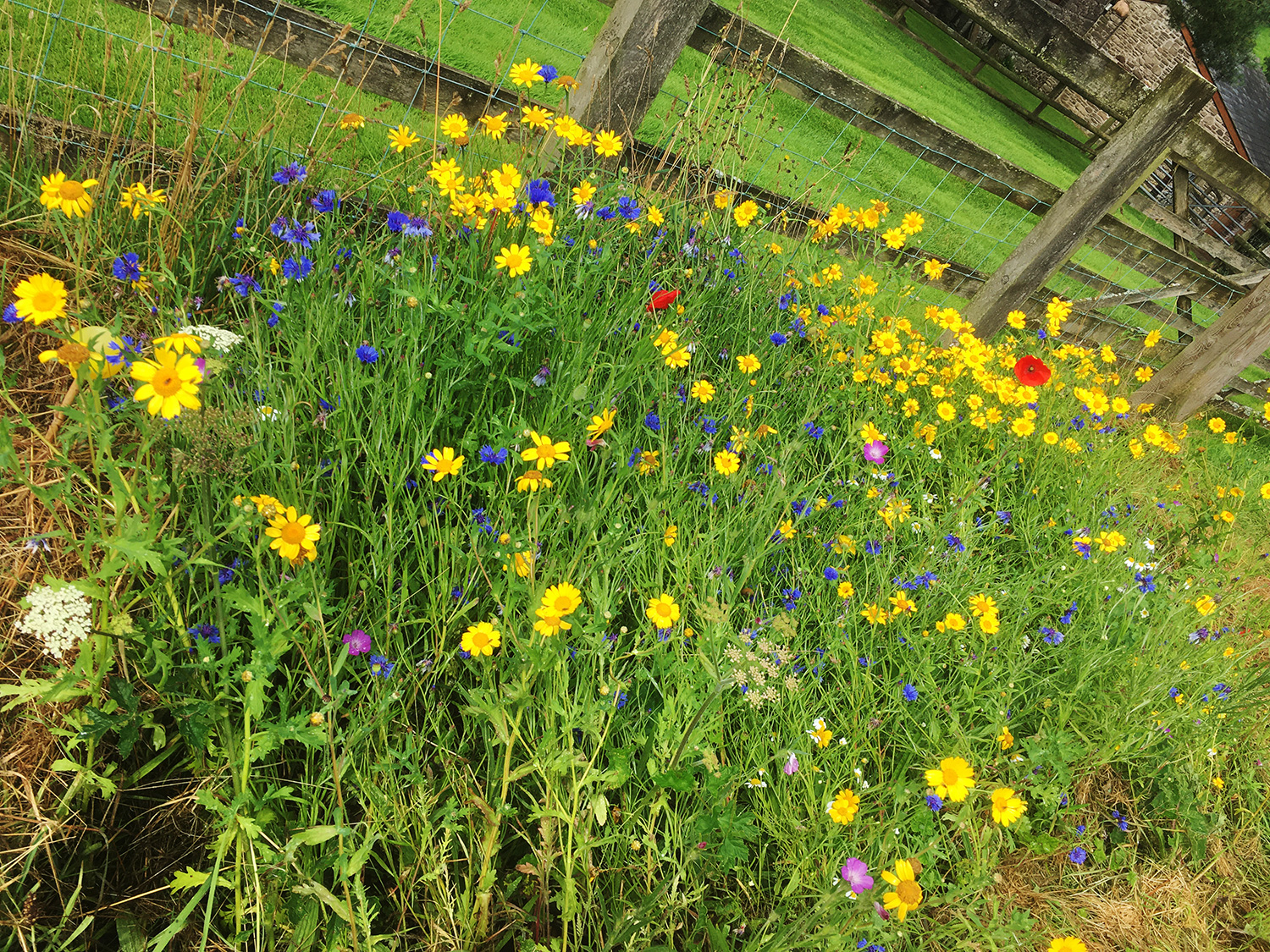 As a sort of experiment, (one which I feel is loaded in my favour) I have just sowed more of the Rigby Taylor wildflower seed. www.rigbytaylor.com/flower-seed
We had such a brilliantly successful result with the earlier sown swathes – using the CornField Annual Mix, a conservation mix from the Flora Native Collection. It had to contend with the scorching temperatures of June and parched ground, so is a good hard working choice.
I am working on the premise that it takes about 8/10 weeks to bloom from seed, which takes us to the end of October or beginning of November. We shouldn’t have any really hard frosts before then so, hopefully, we’ll get another beautiful drift of wildflowers during the early winter months. We might not, of course, but I am confident! I’ll let you know.
Water Well
September is a lovely month for gardeners. The urgency of keeping everything in check – like trying to herd wild cats through a garden gate – has passed and you can focus on planning ahead a bit. As long as it’s not too dry, it’s a good time to split and replant (or swap) perennials and to introduce new plants. I planted large drifts of new herbaceous plants last week, and despite it feeling like it hasn’t stopped raining since June, the ground is surprisingly dry below the surface. So always make sure you water the plants in well.
I like to fill the hole with water before putting the plant in – others hate it as it’s messy and like planting in slurry but it gives the plant the best chance. Water is the key to get those little roots actively secure in their new home and if you are planting large, leafy herbaceous plants that are in flower, that top growth needs a lot of water to support it. Another ‘top tip’ is to submerge the whole plant pot in a bucket or Gorilla tub of water before you plant it. Hold the pot so the surface of the compost is under water and wait until the bubbles stop. It’s a great way of rehydrating the compost, which will provide essential moisture for the plant to become quickly established in it’s new home.
I also left my new additions to soak for a couple of days before planting, in Yogi’s paddling pool – even though the hiring of it cost me a substantial amount of dog treats!
Leave a Reply