
Taken from Lynne’s weekly column ‘Green Scene’ for the Western Mail
11th February 2023

Divide and Conquer
I love seeing the drifts and clumps of snowdrops reminding us that we are the ‘right side of Christmas’ and spring is the next stop. Every year when they are first noticeable, I fret that they are shorter and fewer in number than the previous year and then within a week or ten days they have reached their full height and potential and are just as striking as previous years.
They are a favourite for early pollen for the bees and if you watch carefully on a sunny day when a few brave honey bees are flying, you will see them enter the bowed white flower-heads and reverse out with little ‘dots’ of orange pollen on their back legs. These are the pollen baskets, which they fill whilst foraging. It never ceases to delight me that the pollen of such a pure white flower is such a vibrant orange.
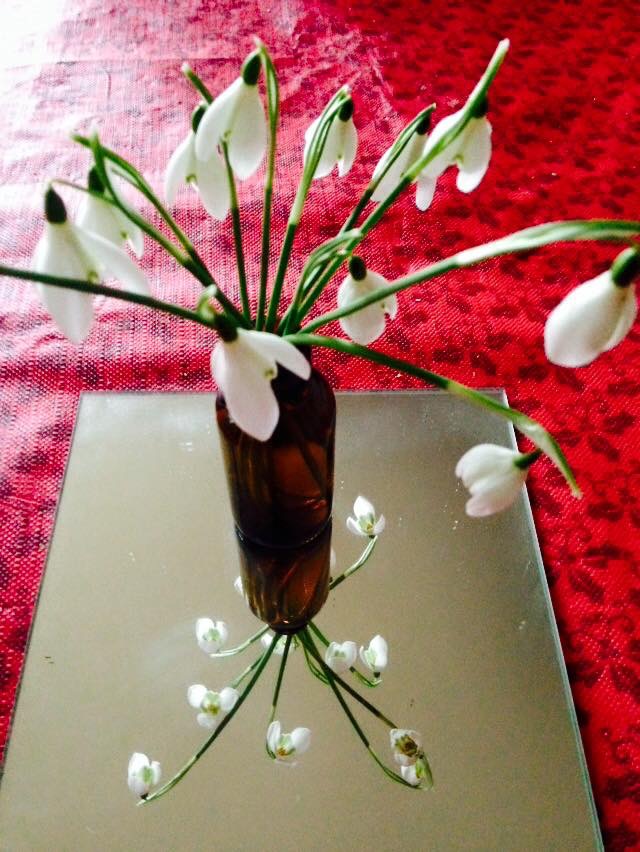
In fact the whole inside of the snowdrop is another level of ‘beauty’. They are incredibly modest the way they hang their heads so these beautiful bits aren’t seen. But if you display a small vase of snowdrops indoors on a mirror tile, you will also get to appreciate the interior in all its glory.
 Not only are snowdrops modest but they are incredibly clever and ‘tough’. The tips of the little leaves are designed to be sharp enough to push up though possible hard frosts and snow at this time of year. Often you will see an old autumn leaf pierced by the sharp snowdrop leaves as they push through a carpet of rotting autumn leaves.
Snowdrops are best divided and moved and planted in ‘the green’, so whilst they still have their foliage intact. They can be sown from seed, and will self-seed, but can take four or five years to bloom this way.
Monmouth Seed Swap
It’s time to start thinking about seeds and planning another season in your garden. To offer some encouragement, Monmouth Seed Swap and Potato Day is being held at the Bridges Centre in Monmouth on the 19th February from 10.00 am until midday.
Seed detective Adam Alexander will be championing local Welsh heirloom vegetable varieties and sharing all of the Welsh heirloom vegetables he grows, as well as invaluable knowledge and advice. Among the seeds Adam will be swapping’ will be a South Walian runner bean he was given called Yardstick and another Brecon Black, as well as a tomato and French bean from Cardiff and seeds of the famous Llanover pea.
Whilst the rare, endangered heritage and heirloom vegetable seeds are always the main characters on the seed swap stage, you are encouraged to take your own flower and vegetable seed along – including packets of commercial seed – to swap and barter with too.
 All proceeds from donations for seeds are in aid of the Heritage Seed Library towards their work conserving vegetable varieties that are not generally available. The library has made available dozens of different vegetable varieties for everyone who loves to grow their own.
There will also be seasonal organic vegetables available from Wye Organic, and Dean Meadows Group will offer meadow seed and plug plants. You will be able to chat to Friends of Lower Wye Valley, Transition Monmouth, the Monmouthshire Meadows Group and Repair Café Monmouth.
And my favourites, Tools For Self Reliance, will have a selection of ‘must-have’ renovated and recycled garden tools for sale as well as accepting old tools for renovation. They are also offering a tool sharpening service for everyone’s blunt hoes, shears and knives.
There will be refreshments available from the fabulously named Wye Weight and lots of freely exchanged chat and advice, including tips on no-dig gardening from Cherry Taylor. Do take notes – the pen is mightier than the spade!
For more details contact: susanyoung351@gmail.com or cherrytaylor@dynamicmarkets.co.uk
Heart of Grass
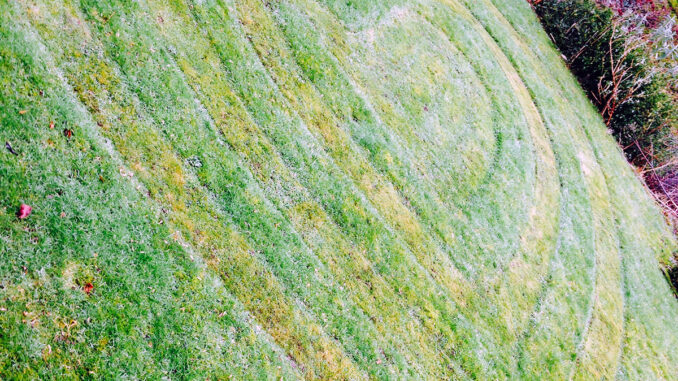
 I used to spend a lot of time creating labyrinths, including a huge double-entranced one where two people followed separate mirrored pathways and were reunited in the centre, for an RHS Show in Cardiff. That one, and most of my labyrinths, were mown, but more permanent ones were created with stones and gravel paths and some were planted with lavender. As well as the traditional circles, I experimented with a few different shapes too. The most elaborate being a dragonfly and the most popular being heart shaped.
Mowing a labyrinth into a lawn is about the easiest way to make one, and if you are new to labyrinths it’s best to sketch one out on paper first. Mistakes in the grass will grow out but it will take a while.
Alternatively you could use a landscaping spray marker. It will wash away in the rain but can be a quick and easy temporary option – of course you could mark out the labyrinth with the spray and then mow those lines to make it more permanent.
With regard to maintenance, simply raise the mower blades to mow over the entire labyrinth and then lower them to cut the path and keep it defined.
You can also draw a ‘finger labyrinth’ on paper and simply follow the ‘pathway’ with your finger. It is very meditative and can be used to ease anxiety and enhance mindfulness.
A labyrinth differs from a maze as it comprises of a single winding path from the ‘outside’ to the centre. It is designed to be meditative and encourage reflection as you journey to the centre – so there are no tricks, choices or dead ends in a labyrinth walk. The same path is used to return to the outside. It is said that the labyrinth represents the journey inward to our own true selves and back out into the everyday world. Many people ask a question whilst walking to the centre and are thought to receive the answer on the walk back out of the labyrinth.
Just as in life, each person’s journey thought a labyrinth is an individual and personal experience.
Leave a Reply