
Taken from Lynne’s weekly column ‘Green Scene’ for the Western Mail
16th November 2024

Plan To Veg Out
I am having to rethink my vegetable patch for next year. I had such a tough time with rabbits and pigeons this year, so will have to ‘up my game’ in order to beat them next season. I’ve been researching different methods and I think the way forward is a smaller area that will have to work harder – or smarter. It’s all about planning and a lot of that can be done during the quieter winter months – even with a pen and paper on the worse weather days.
I have revisited the Hugelkultur method of growing fruit and veg. Basically they are no-dig raised beds but with a twist. They hold moisture, build fertility and maximise surface volume which makes them great spaces for growing fruit, vegetables and herbs.
Hugelkultur, pronounced hoo-gul-culture, means hill culture or hill mound and the winter is a great time to start construction. Instead of getting rid of prunings, branches, leaves and grass clippings from the garden, they can all be recycled to build a hugel bed. At it’s most basic, you simply mound up logs, branches, leaves, grass clippings, straw, cardboard, petroleum-free newspaper, manure, compost or whatever other biomass you have available, top it all off with soil and compost and it will be ready for you to plant your veggies next year.
The advantages of a hugel bed include the gradual decay of wood being a consistent source of long-term nutrients for the plants. A large bed might give out a constant supply of nutrients for 20 years (or even longer if you use only hardwoods). The composting wood also generates heat, which should extend the growing season. Soil aeration increases as those branches and logs break down, which means the bed will be ‘no dig’, long term. The logs and branches also act like a sponge. Rainwater is stored and then released during drier times. It is even possible that you may never need to water your hugel bed again after the first year (except during long term droughts).
There are lots of tips and directions online and several good books available on the subject.
 The other thing I have been reading is the Otmar Diez way of producing produce. He has been involved in natural gardening and self-sufficiency for years and is the author of several gardening books and offers lectures, guided tours and seminars in his own Diez Nature School.
Otmar has just created a new planting plan for Fryd, the gardening app, that not only includes an integrated composter inside the raised bed, but also provides shelter for useful insects, healthy, humus-rich soil and sufficient space for all of his plants. The attraction for me is that it all fits in a small space of just 8.2ft x 3.3ft (2.5m x 1.0m). Small enough to keep rabbit and pigeon free I think.
Otmar starts his planting plan in March with carrots, lettuce, radishes, and spinach, followed by cabbage, tomatoes and a few chards with fennel and basil in the gaps between them. Additionally, he grows cucumbers and tumbling tomatoes over the sides of the beds. You can find out more at www.fryd.app
Leaf Law
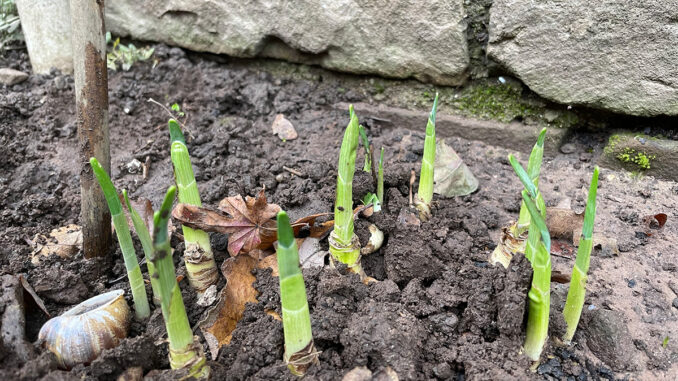
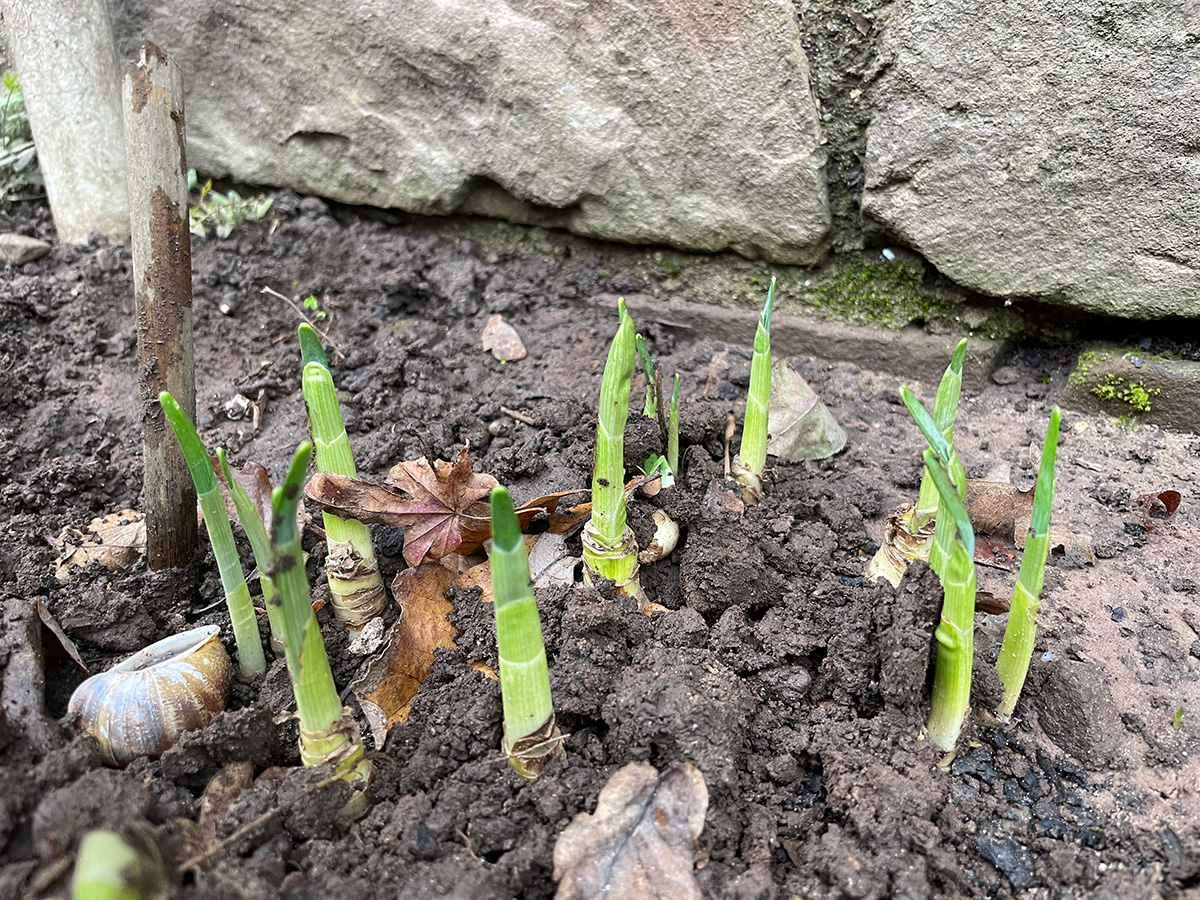 I’m sure all gardeners are having similar conversations about the unseasonably mild weather at the moment and noting all the flowers that are still in bloom or blooming for the second time this year. I have recently seen a foxglove in bloom, camellia’s, a clematis, numerous roses and even daffodil bulbs are already pushing up in some flowerbeds. If you are working in beds and borders, it is worth remembering that the bulbs are pushing up earlier than usual and to be careful where you are treading, especially as they may be hidden under a thick leafy carpet.
It is definitely ‘leaf time’ in the garden. They can drive the most patient gardener to distraction, as they blanket lawns, flowerbeds and pathways. I always try to keep lawns and paths clear – lawns because a thick layer of leaves left over the winter can weaken and even kill the grass underneath, and paths because they will get slippery when wet or frosted. You can leave fallen leaves in flower beds as they will just act as a warm duvet and mulch over the winter. If you are collecting leaves from under specimen trees, don’t pile the leaves around the base of the tree as it will encourage disease.
I always think of fallen leaves as ‘discarded tree clothes’, but most people look at me as though I’m deranged when I share that thought. It’s much better than another description I heard of ‘wounded leaves falling like tears’. However you see them, if you can make the effort to rake up and collect as many as possible, they make a fabulous leaf mould to put back on the beds when rotted down. If you can run a rotary mower over the leaves first it helps hugely in breaking them down so they rot quicker. Or you could use a shredder. If you use a leaf vac then they will be shredded as they are collected.
The even easier option for making leaf mould is to simply scoop leaves up into bin bags. Fill the bags three-quarters full, tie them closed at the top then puncture holes into the bottom and sides to allow its contents to breathe. Place the bags out of the way and forget about them for a year or so. Alternatively, you can make – or buy – large wire leaf composters.
Leaf blowers are like Marmite, you either love them or hate them. I think used properly they can be really useful but the key is to blow the leaves into a pile and then pick them up and dispose of, or make compost with, them. Don’t just blow them ‘out of sight out of mind’. And please remember that intentionally blowing or sweeping leaves onto verges, footpaths or other public areas constitutes fly tipping or littering which is actually a criminal offence.
The basic ‘rules’ are: fallen leaves on roads will be cleared by your District or Borough Council. Leaves on private land are the responsibility of the land owner with fallen leaves belonging to whoever owns the land that they fall onto.
Tree owners don’t have to collect leaves that have fallen from their tree onto someone else’s property. Nor do they have to take back leaves from their trees that have fallen on to, or been gathered from, neighbouring properties. It is also unlawful to return fallen leaves back to someone else’s land without their permission, which includes highway land such as the road and the paths and verges running alongside a property. Therefore, landowners or residents should never use a leaf blower (or other tool) to blow leaves from private land onto the road, pavements or grass verges where they could block drains and cause a hazard to road or pavement users. This also applies to other deposits including fallen blossom, catkins, fruit, nuts, berries and pine cones.
Winter Weather
We have had a lot of misty, foggy days so far this month and folklore warns us that for every foggy day we have in November, we will have a frosty day in February. I also love the widespread folklore-belief is that fog is ‘the work of the Devil’.
In fairytales and folk beliefs Fog is always a woman, often referred to as Granny Fog. In other stories she is a sorceress, who enchants and mesmerises people and then takes the fruit of their labour from the fields.
Other November weather folklore includes, ‘If the leaves of trees and grape vines don’t fall before November 11, (which is St Martins Day) you can expect a cold winter. If it’s fair, dry, and cold on November 11, the cold in winter won’t last long. That’s a bit confusing this year as the leaves are still on the trees (cold winter) but the 11th was dry and fair indicating a mild winter. I suppose one of them will be right.
Flowers in bloom late in autumn indicate a bad winter (oh no), but perhaps the ideal day to check the weather is Thursday as folklore states, ‘As November 21st, so the winter.’
As I write this, the forecast is dry and sunny but cold. That’ll do.
Leave a Reply