
Taken from Lynne’s weekly column ‘Green Scene’ for the Western Mail
9th November 2024

In Prose of Dry Stone Walling
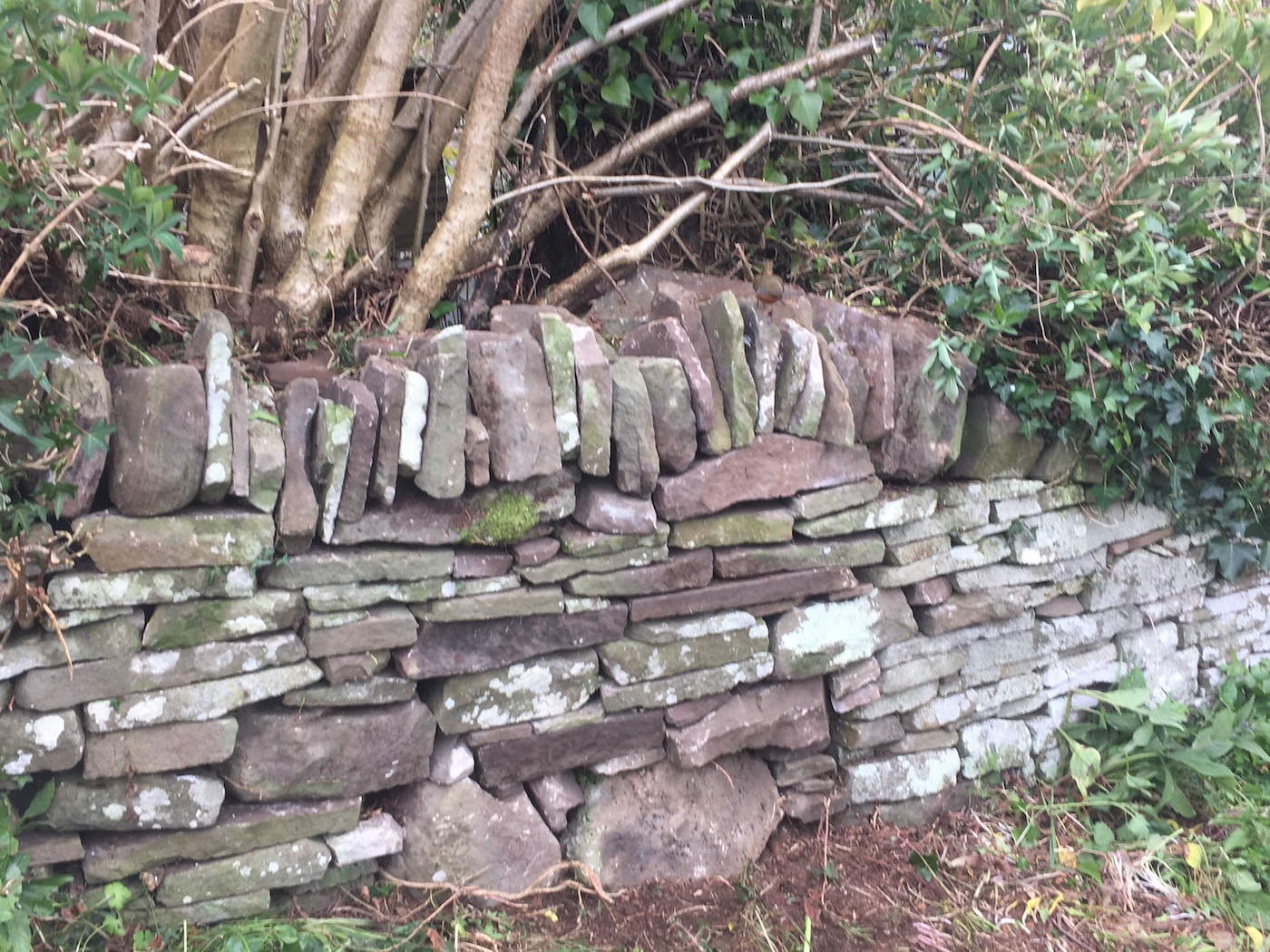
A few weeks ago I wrote about my passion for dry stone walling and my (slow) progress in pursuing certification in the skill. That prompted a plea from Dr Terry McCormick in Kendal who sent an email titled: ‘Desperately seeking’ poetry and/or fine prose from Wales for an anthology: ‘Dry Stone Walling: Written Treasures’.
Terry is compiling an anthology with the above provisional title and has already received work from France, Greece, Australia, Canada, Ireland, along with England and Scotland. He is now looking for organisations or individuals in Wales who would be interested in learning about this project with all contributions, if published, being acknowledged in a form agreeable to the donor/researcher, and, of course, writer.
The aim is to bring together and edit an anthology of the best inspiring, creative and informative writing on Dry Stone Walling and Stone in both poetry and prose. Terry is also interested in any examples of good quality writing and quotations from other writers in the past, which may well have been already published. The intended audience/readership, beyond the dry-stone community, is the many people who do not practice the skill but are interested in it and are potential supporters of this ‘traditional green craft’. The overall aim is to inspire, educate, inform, and convert.
You have until the 15th December 2024 to submit something, but do please get in touch with Terry with any queries and questions you may have on 01539739886 or 07716 287 999, or email terry.mccormick@cantab.net Do mention that you read it here! Thank you.
In The Pink
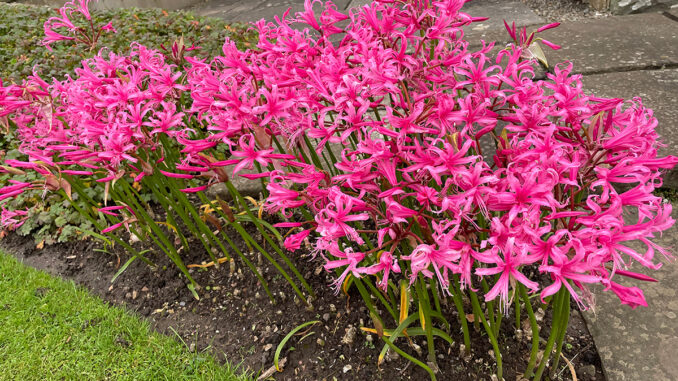
 I have been so heartened by the late autumn blooms, berries and leaf colour this year but I have noticed the colours in the garden are slowly fading. Every week I pick flowers or berries out of my garden to take to Mum and it won’t be long before I am having to work hard to find something suitable – although rosehips and ivy flowers are effective and will probably take me up until Christmas, when it will be holly and ivy!
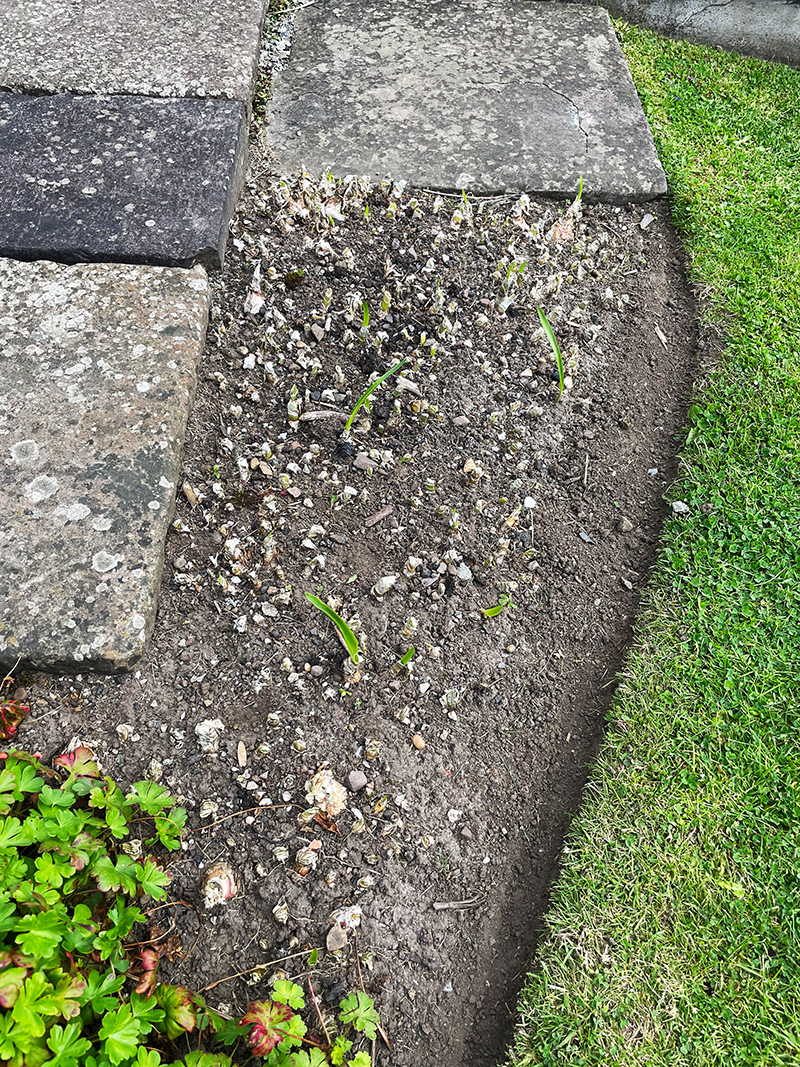
Last week I picked the stunning Nerines for her. Every year I worry that the bulbs haven’t survived as they do so little until the last minute! The ‘before’ photo was taken just at the end of August and the ‘after’ photo was taken in early October. That amount of growth in just 6 weeks or so never ceases to impress me.
Nerines have always been a favourite of mine – not so much the Barbie pink colour, although other colours are available – but the fact that they provide such fantastic colour in the garden so late in the season and aren’t too badly affected by wind and rain. They look exotic and as though they would require a lot of attention but are pretty fuss-free and look fabulous in the garden and a vase. Despite their common name of Guernsey Lily, they are native to South Africa.
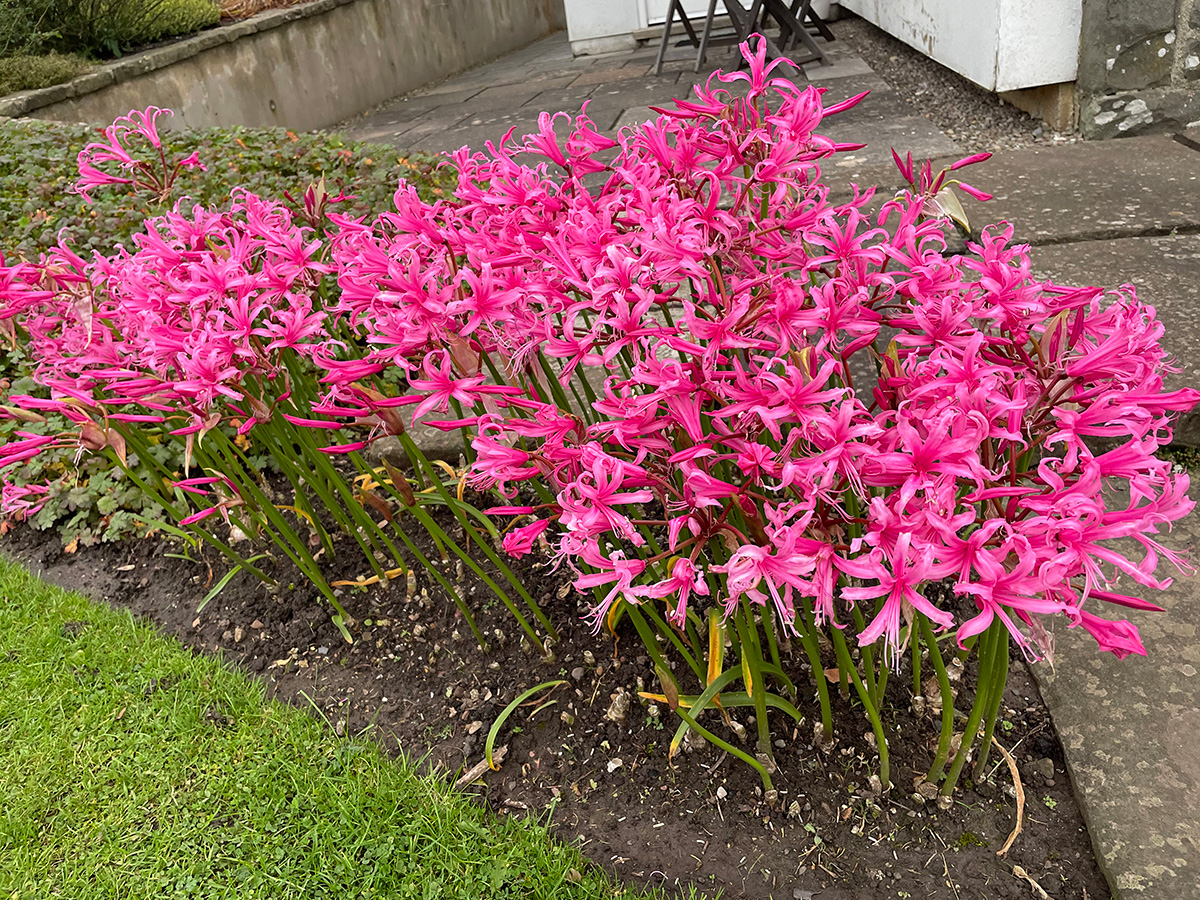 The four varieties you are likely to find are the classic Nerine bowdenii, which you will find in most garden centres, is easy to grow, reliable and has won a prestigious RHS Award of Garden Merit.
Nerine Mr John is a more vivid pink variety and Nerine sarniensis has beautiful red flowers and is ideal for growing in a sheltered location. It’s not frost hardy, so it does require protection during winter with a thick mulch and fleece. Alternatively, it can be lifted and stored for winter in a greenhouse. It is definitely worth the effort. Nerine bowdenii ‘Alba’ has tall stems topped with pure white flowers during autumn.
You may still be able to buy Nerines in bloom at the garden centre now (if you’re lucky) but otherwise, plant the bulbs in the spring. The most important thing to remember is, unlike most bulbs, they like to have their ‘nose’ just above ground, planting them too deep is the most common reason they will fail, and you will also need to let the foliage die back naturally to replenish the bulbs.
Traveller’s Joy, Gardener’s Nightmare
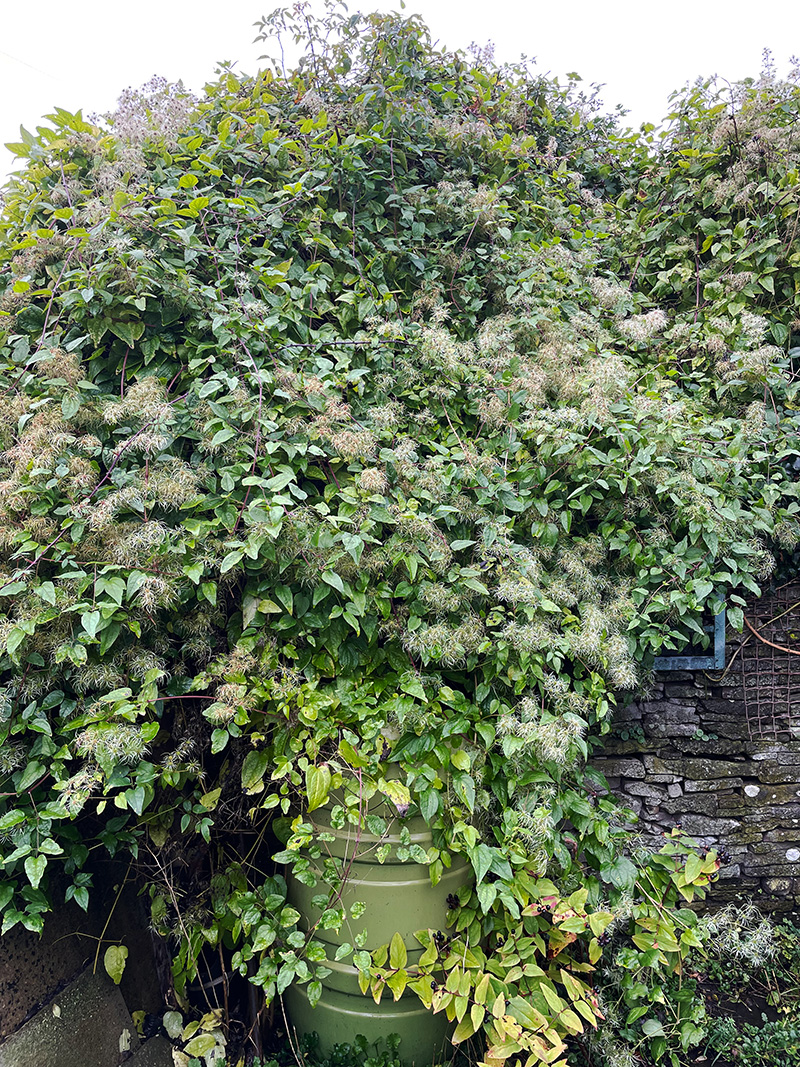 I’m not so impressed with the wild clematis (Clematis vitalba) that has taken over my front yard. In previous years I have regularly cut it back to keep it in check and as part of the hedge it covers during the year, but this year I thought I’d see what happened if it had it’s own way. Suffice to say it won’t be left to it’s own devices again next year. It has nearly suffocated several shrub roses and will take a while to untangle and cut back now. Much better to invest a bit of time each month during the summer and to prevent the ‘jungle’ effect.
Commonly known as Traveller’s Joy and Old Man’s Beard, the little white flowers are pretty much insignificant during late summer, which is another reason I don’t need to let it have it’s own way, and the seed clusters only make a mess and make me and Yogi sneeze a lot. It is these white-grey, feathered seed clusters that have earned it the name of Old Man’s Beard. Apparently the name ‘Traveller’s Joy’ came about as it adorns hedges and banks in the countryside ‘boasting billows of beautiful feathery seed heads in the grey months leading up to Christmas’. I’ve noted it’s not called Gardener’s Joy!
Whilst being referred to as ‘wild clematis’, it is actually a woody member of the buttercup family and is widely considered an invasive weed where it has spread outside its native range, as it can form dense thickets blanketing trees and shrubs. As I can verify.
Like any plant, in the right place it has it’s attributes and is loved by lots of pollinators. Birds, especially goldfinches, love the seed-heads too, which is why I will wait (and keep sneezing) before cutting my ‘monster’ back.
The incredibly strong twine-like stems of Traveller’s Joy were traditionally used to make baskets and parts of the plant are still used in various health treatments, as it is said to contain anti-inflammatory properties. Traditional recipes use the plant to treat various ailments, including skin irritations and stress – a little ironic considering the stress it has caused me this year.
Leave a Reply