
Taken from Lynne’s weekly column ‘Green Scene’ for the Western Mail
12th October 2024

Passion-ate
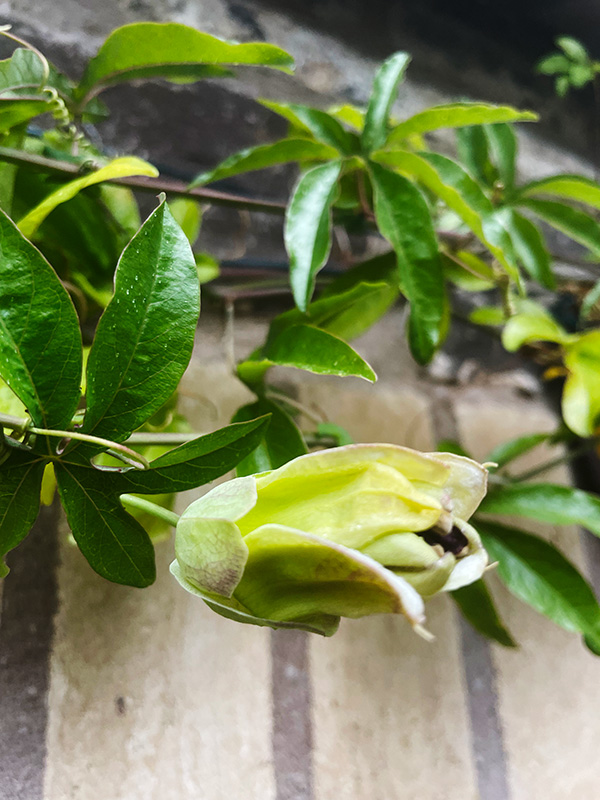
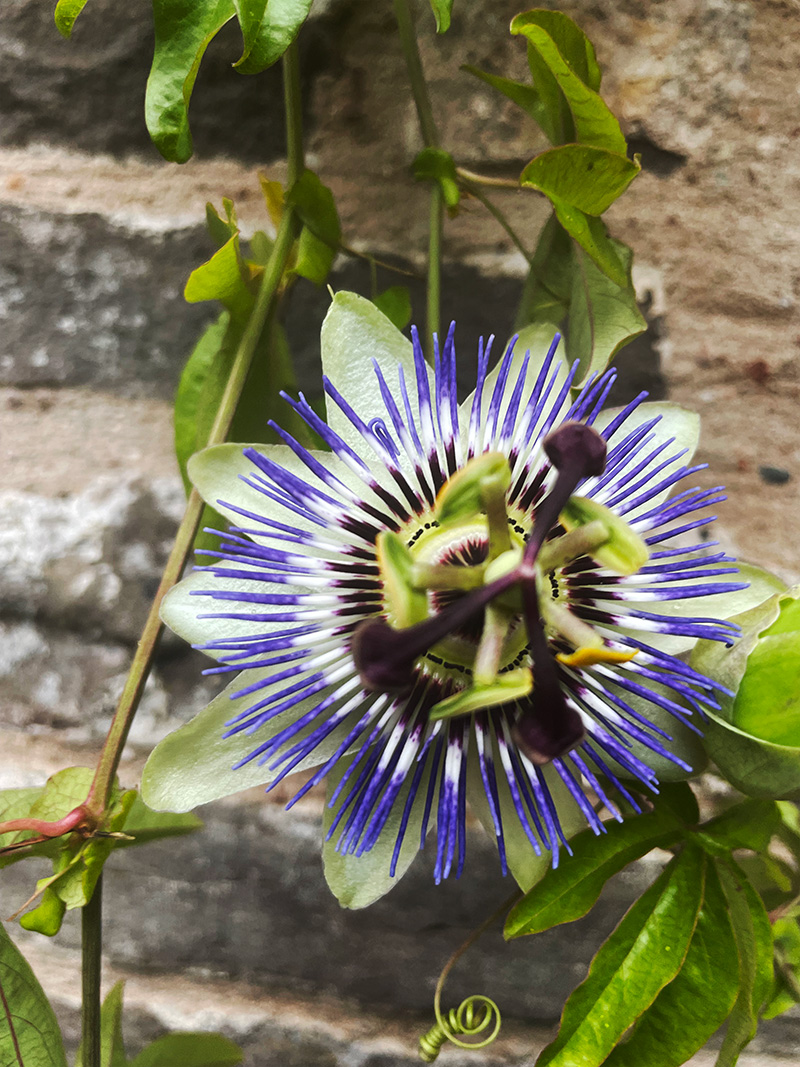 Despite having been gardening for over 40 years, the exquisite beauty of some flowers never fails to impress me.
Passionflowers are one of them.
How on earth does nature make something so intricate and just so beautiful.
This one was making the most of an hour of sunshine last week, but as soon as the clouds took over and the temperature dropped, it soon shut its petals and ‘cwtched up’ – I know how it feels.
Pawfect Dogwood
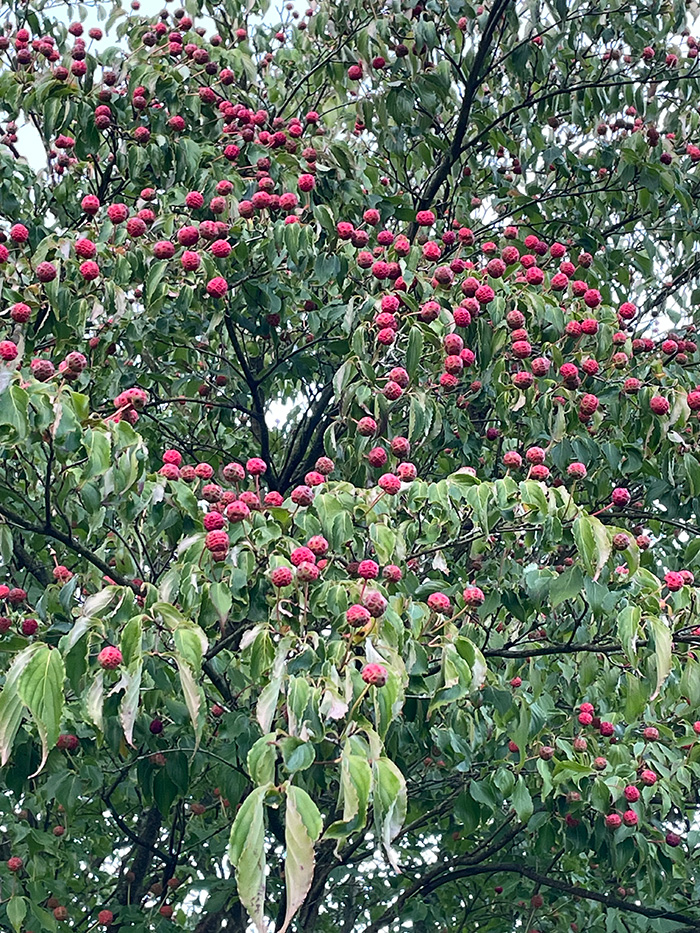 The Chinese Dogwood (Cornus kousa var. chinensis) is a wonderfully hard working tree and another favourite of mine. Reaching a height of around 20ft it is suitable for most small gardens.
It is a beautiful shape, hosts eye-catching, white flower bracts that take on a pinkish hue as they age through June to August. Following that beautiful display it then produces these amazing berries for another stunning display. The foliage also provides wonderfully vibrant autumn colours. It’s a tree that keeps on giving!
The National Trust have predicted that autumn leaf displays could last longer than normal this year in a ‘dazzling, drawn out show of colour’. The UK’s soggy spring and chilly summer mean trees should hang on to their leaves a little longer than usual, making for a vibrant autumn display.
Time to plan a trip to Westonbirt (or another) Arboretum.
Heart in the Clouds
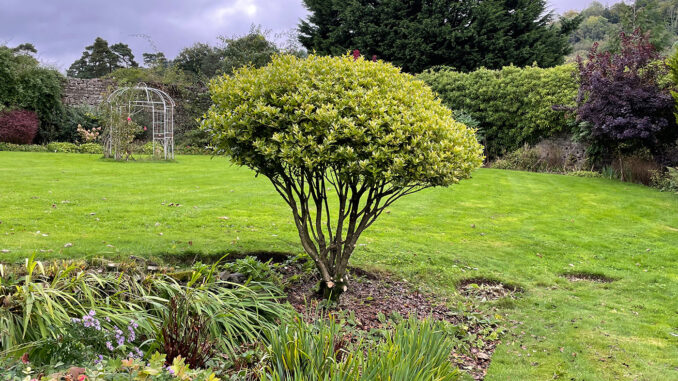
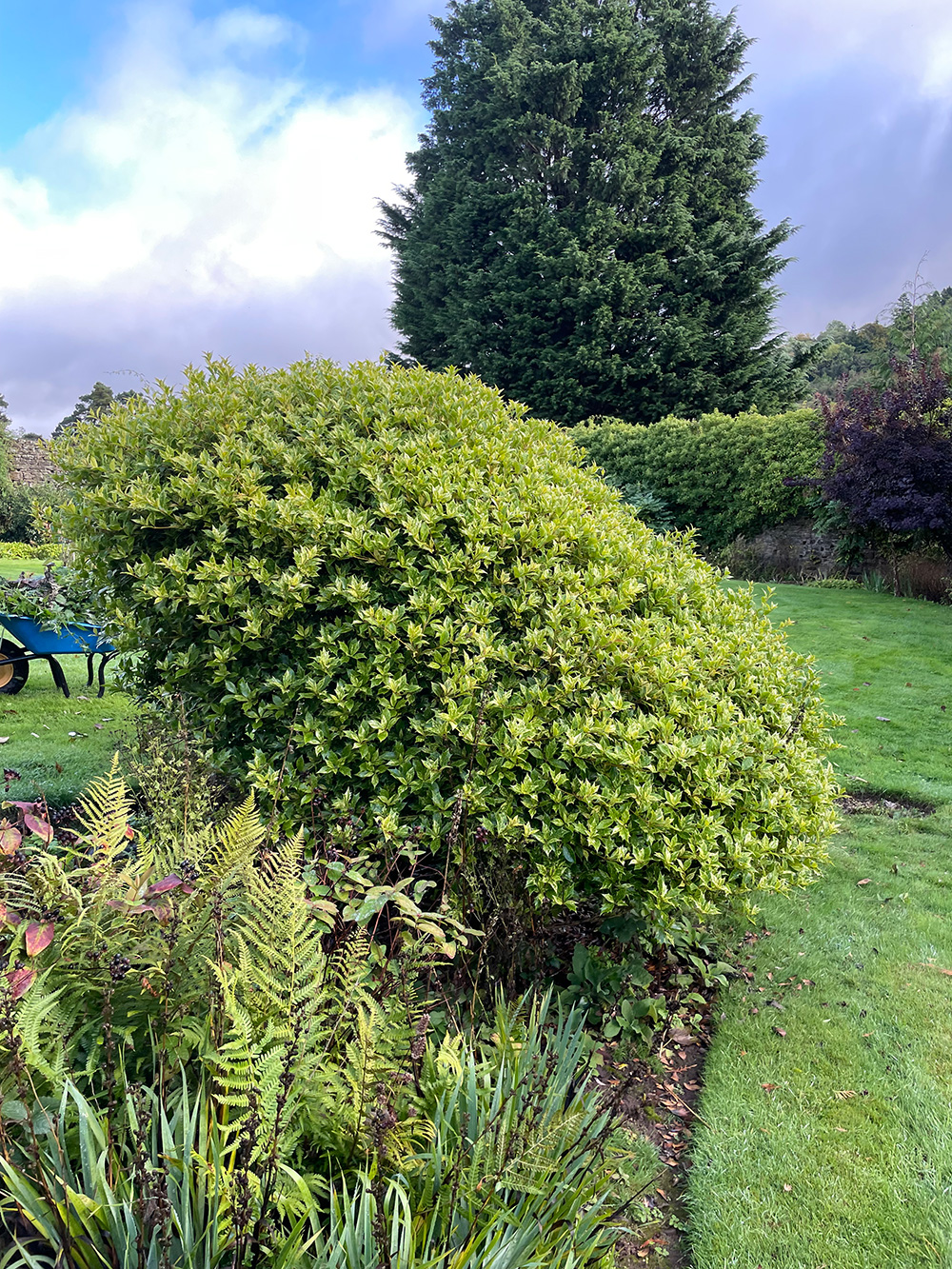 I felt like Gok Wan in the garden last week – as I gave this Osmanthus a make over. My client wanted to remove it, but it is another hard worker in the garden so I wanted to try and keep it. With evergreen holly-like leaves, fragrant flowers, which are often followed by striking black berries, Osmanthus heterophyllus ‘Goshiki’ is a slow-growing and compact evergreen shrub reaching about 1.5 metres. The spiky leaves are marbled and flecked with cream, and as an added bonus, are often tinged pink or bronze when young. The small, fragrant, tubular white flowers form in clusters, in late summer or autumn.
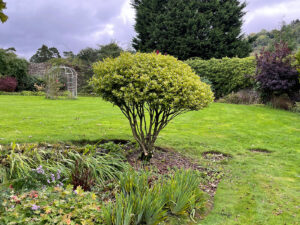
I often execute a severe pruning procedure in order to give a shrub a stay of execution. If the client still doesn’t like it, then at least I have given it a chance. They usually get to stay.
Enthused by ‘Gok Waning’ the Osmanthus, I then went on to cloud prune a ‘bloated’ old holly bush that another client wanted removed. Cloud pruning is a Japanese method of training trees and shrubs into shapes resembling clouds. It is known as ‘Niwaki’, which translates as ‘garden tree’. The style is said to depict the distilled essence of the tree and, whilst I love doing it, I’m not entirely sure that I’m sold on the concept. But it does give a lot of condemned shrubs a second chance and in the right spot can look fabulous. It definitely doesn’t have to be confined to Japanese style gardens. This holly tree is on the side of a mountain and I’m confident will soon become a feature in its own right.
Cloud pruned trees and shrubs will need to be trimmed annually with secateurs or shears in early or late summer to keep specimens in shape, and suckers removed regularly. If you have chosen a flowering shrub to be creative with, be aware that you will need to prune it after flowering, otherwise you could cut off flowering growth.
The most popular Cloud Tree tends to be the Ilex Crenata Cloud Trees (or Japanese Holly). Japanese privet and box-leaved holly also create stunning results when cloud pruned as does Buxus and more surprisingly, Pieris.
You may well recall that one of my favourite place to buy some of my tools is Niwaki – their secateurs and shears are simply the best. They are incredibly sharp and light as they have been designed for creating and maintaining Japanese inspired topiary.
Jake Hobson is the founder of Niwaki and a cloud-pruning guru. In 2000, the cloud-pruned trees and box hedges (you can also cloud prune some types of hedging) in Gardens Illustrated’s winning garden at Chelsea took the horticultural world by storm and suddenly everyone wanted what Jake had started calling ‘organic topiary’.
You can read his interesting story and discover more about ‘precision pruning’ in The Art of Creative Pruning (by Jake Hobson) for sale on www.niwaki.com
We Need Seed
 The autumn equinox is the official start of The Tree Council’s Seed Gathering Season, running from September to November, during which time many native trees, shrubs, and wildflowers produce ripe seeds ready for collection. It is promoted as ‘fun, free and easy. Wherever you live, whatever your age, you can get involved. You don’t need to be a tree expert or have any special equipment – just a love of trees and nature and lots of enthusiasm!’
Each Seed Gathering Season, the Tree Council runs free online talks, including a seed gathering master class, top tips, identification advice and an insight into the wonderful world of seeds. More details at www.treecouncil.org.uk
The Conservation Volunteers (I don’t know why I always type ‘conversation’ rather than ‘conservation’) also promote seed gathering, explaining, ‘This period is critical for the reproduction and dispersal of native plant species throughout the land. By gathering these seeds (which by means of pollination and natural selection are well adapted to the local environment), we can help maintain genetic diversity, ensuring the resilience of our natural environment. More details at www.tcv.org.uk
Seeds from your own flowerbeds (I’ve just collected lots of lovely Cosmos seeds) and veggie patch can also be harvested of course. It is important to collect ripe seeds on a dry day – just cut off the seed-heads and pop straight into a paper bag or on a tray and let them sit in a greenhouse or on a windowsill to dry out naturally. The seeds should just fall out of the pods, but you may sometimes need to gently crush them open to release the seeds. Store in a paper bag or envelope, not plastic, in a cool dry place and remember to note what they are!
Please remember to leave some seed-heads to develop on the plants and stay in situ throughout the autumn and winter. Things like poppies and angelica will look architecturally stunning in your garden, especially when catching the dew, or frost or snow, and they will feed birds and provide shelter for hibernating insects such as ladybirds. The seed-heads of teasels provide a rich food source for goldfinches, as well as providing nice focal points in the winter garden.
Leave a Reply