
Taken from Lynne’s weekly column ‘Green Scene’ for the Western Mail
19th October 2024

Chasing Rainbows
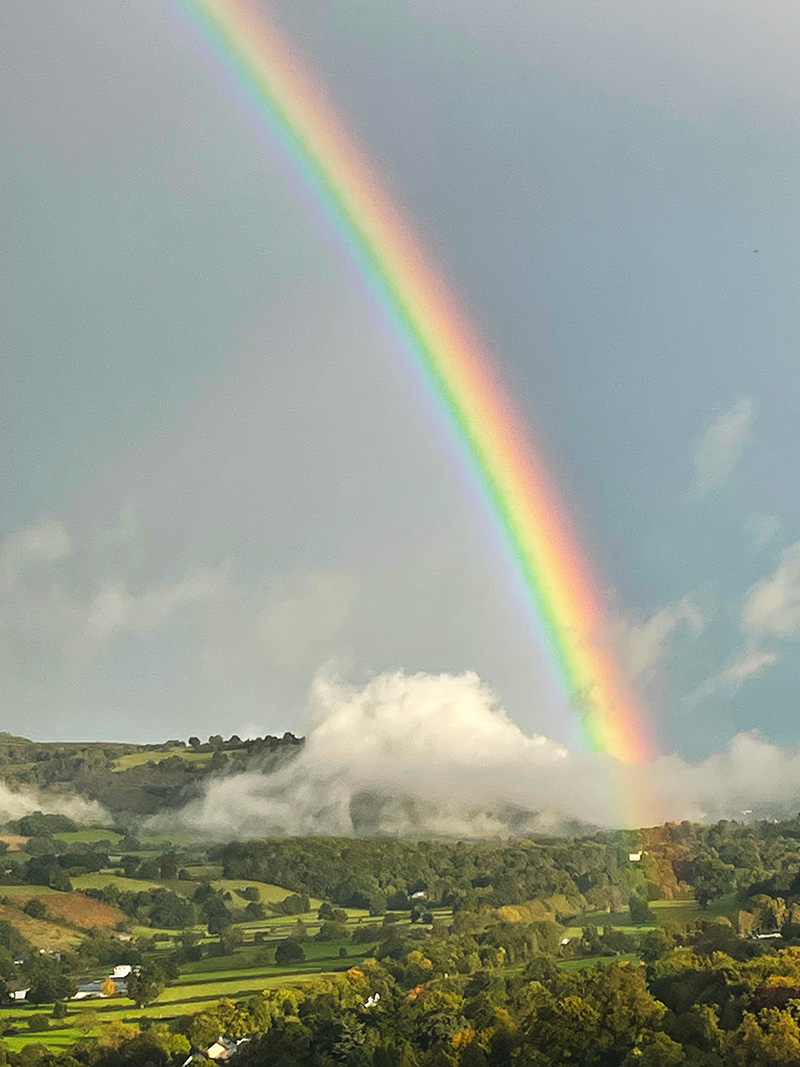 One of the wonderful things about short, sharp showers on sunny autumnal days has to be a rainbow and we have had some beauties lately.
Despite Wales being generous in providing the necessary rainy aspect, it’s the state of Hawaii which has the most rainbows on the planet. Although rainbows normally appear from the rain, they can also be seen in other places where water drops appear, such mist, fog, spray, waterfalls, and even early morning dew.
We are probably all familiar with the legend that says there is a pot of gold at the end of the rainbow, and some with the Irish version which claims the gold is guarded by a tricky leprechaun, but nobody can ever find him. It makes a good story but the real reason, rather than the elusive qualities of leprechauns, is of course, that you can never touch a rainbow or reach the end of a rainbow because it’s appearance is based on your location and the light source. It’s a tricky optical phenomenon – when you move, the rainbow will move, too.
Apparently the average rainbow is observable for less than an hour – a lot less in my experience, usually until just before I can find my phone to take a photo – but the world’s longest-observed rainbow was seen in the mountains of Taipei, Taiwan in 2017. It lasted for 8 hours and 58 minutes – plenty of time for photos.
The word “rainbow” comes from the Latin phrase ‘arcus pluvius’, meaning ‘rainy arch’, which, let’s face it, doesn’t really have the same magical ring about it as ‘rainbow’
As well as rainbows, nature has been creative, using other weather aspects too. A ‘fogbow’ is formed by cloud and fog droplets, appearing almost completely white with very faint colours. Fogbows are larger and wider than a rainbow.
A ‘moonbow’ is a rare lunar or night-time rainbow that is produced by light from the moon, rather than the sun. Interestingly, all of the colours are still present, but our eyes only see a moonbow as white.
‘Red Rainbows’ – also called monochrome rainbows – usually appear at sunrise or sunset when sunlight travels further in the atmosphere, and shorter wavelengths (blue and violet) have been scattered. Only the long-wavelength red colours are visible in this rainbow.
Making Rainbows
You can also make your own rainbow, which I have done inadvertently a few times – usually involving piercing a hosepipe with a garden fork!
All you need is a sunny day and a garden hose (a garden fork isn’t necessary). Stand with your back against the sun and turn on the water hose to provide your ‘rain droplets’. Put your other hand straight up in the air and spray water about halfway between the ground and your other hand. As the sun’s light shines through, you should see a mini-rainbow and all its beautiful colours.
Reassuring Rainbows
In ancient times, Greeks and Romans believed that rainbows were paths created by the goddess of the rainbow, Iris and possibly it is this idea that led to the wonderful but heart-wrenching Poem Rainbow Bridge, written to ease the grief of losing a beloved pet and to reassure that you will be reunited again one day.
Rainbow Bridge:
By the edge of a woods, at the foot of a hill,
Is a lush, green meadow where time stands still.
Where the friends of man and woman do run,
When their time on earth is over and done.
For here, between this world and the next,
Is a place where each beloved creature finds rest.
On this golden land, they wait and they play,
Till the Rainbow Bridge they cross over one day.
No more do they suffer, in pain or in sadness,
For here they are whole, their lives filled with gladness.
Their limbs are restored, their health renewed,
Their bodies have healed, with strength imbued.
They romp through the grass, without even a care,
Until one day they start, and sniff at the air.
All ears prick forward, eyes dart front and back,
Then all of a sudden, one breaks from the pack.
For just at that instant, their eyes have met;
Together again, both person and pet.
So they run to each other, these friends from long past,
The time of their parting is over at last.
The sadness they felt while they were apart,
Has turned into joy once more in each heart.
They embrace with a love that will last forever,
And then, side-by-side, they cross over together.
Author Known
Whilst most accounts state that the author is unknown, a little bit of research uncovers that Edna Clyne was 19 years old and living in Scotland in 1959, when her beloved Labrador Retriever, Major, died. She is said to have written the poem to express her grief, and only showed her mother, who suggested she neaten her writing and amend the spelling mistakes. Edna didn’t want to and kept the poem to herself.
Later she married Jack Rekhy, adding his last name to hers, and she showed Rainbow Bridge to him. Jack thought it was wonderful and suggested she publish it. But again she didn’t want to, telling him it was something private between herself and Major. However, she did decide to share it with a few friends and typed it out to share, without adding her name to it. People were touched by her words and many shared them with others, but as Edna’s name wasn’t on the poem, and as more and more people shared the Rainbow Bridge, it became cut off from its source.
Luke’s Like Good Weather
Folklore has it that St Luke was a bit put out that his feast day, on 18th October, did not get the same sort of attention that other Saints’ Days received, so in order to keep his reputation in good order he ‘arranged for’ a welcomed, unexpected spell of summer weather in late autumn and before the arrival of winter.
It is interesting that records show the time around the 18th of this month does indeed often herald a brief period of fine, sunny weather. Weather folklore has labelled this as St Luke’s Little Summer. As I write this, it’s not looking too promising for this year, but as the weather changes more quickly than a woman’s mind, who knows?
Leave a Reply