
Taken from Lynne’s weekly column ‘Green Scene’ for the Western Mail
5th October 2024

Autumnal Cutbacks
As one lovely reader pointed out, my onomatopoeia-ic description of the ‘crackle of autumn’ has been more of a ‘squelch of autumn’ so far. Never fear, there is always time for a bit of crackle and hopefully, dry weather!
There’s always lots to do in the garden, whatever the weather.
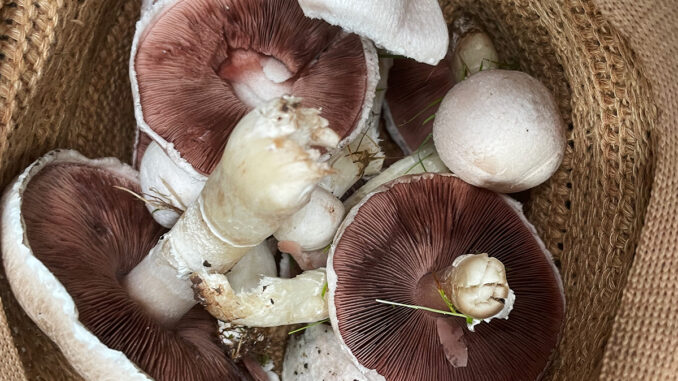
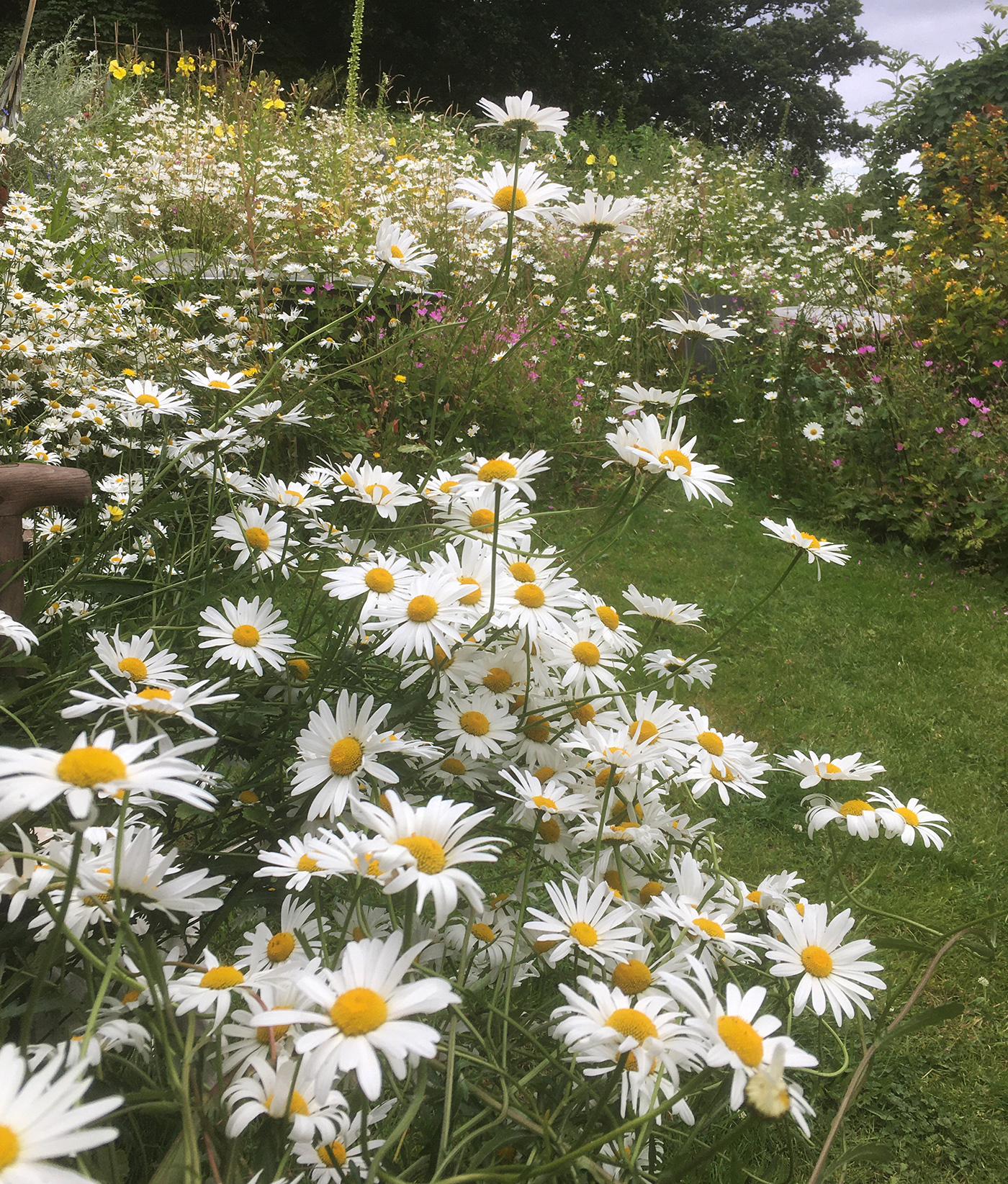
I have started cutting spent herbaceous plants back, but instead of cutting them back to the ground as I used to when young and enthusiastic and in the desire for a ‘neat winter garden’. I now have far more compassion and empathy for the wildlife. I now just cut the spent flower-heads off and leave the rest of the foliage and plant to die back over winter, providing accommodation for lots of insects and other wildlife throughout the colder months. It is often only the spent flower-heads that make a plant look ‘messy’ anyway. I have cut all the ox-eyed daisies back to half their height, for example, and they look neat enough, satisfying even my more-OCD tendencies.
There are a few things that are better not cut back until the spring anyway – crocosmia being one of them. It will test your OCD, or garden-neatness nerve, but if you cut them back too early then you won’t have a good display of flowers (or any flowers at all) next year. The goodness and energy needs to go back into the bulbs or corms for next year’s displays. Lilies and peonies are the same, as are most bulbs, corms and rhizomes – it’s the same principle as leaving daffodils to die back naturally after flowering in the spring.
So you now have permission not to go too bonkers in the beds and borders or to have too neat a garden for the winter. We used to call it ‘putting the garden to bed’ but now it’s more like letting it have a nap in the chair. Something I am becoming more familiar with myself.
Bless Those Pets
 Something else I am very familiar with and love at this time of year is the annual Blessing of Pets at St Michaels Church in Llanvihangel Crucorney near Abergavenny on the 6th of October (next Sunday). Sian Lloyd tells me that the new Vicar has recently acquired a very lively puppy, which will no doubt be providing lots of entertainment as well as receiving individual blessings, fusses and treats, along with all the other pets that attend.
You can take any pet along – from reptiles to rats, birds to bunnies and anything in between – and Sebastian, the retired Ambassador to the former Society For The Welfare of Horses and Ponies, will come out of retirement again for his annual Church Blessing – at the grand old age of 25. A very good advert for an annual blessing, I think!
Yogi took me along for the blessing for several years but sadly she is now a bit too ‘fragile’ to enjoy the afternoon. She does highly recommend it – though I think maybe she recalls the treats and all the friendly fuss she had rather than the blessing.
The service starts at 3pm, refreshments will be served and there is an easy access path to the Church, which is located adjacent The Skirrid Inn off the A465 Hereford Road. NP7 8DH For further information please call or text Sian on 07889 581181.
Fun-gi Facts
 Today (Saturday 5th) is UK Fungus Day, where we are all encouraged to celebrate the many different types of fungi and the important roles most of them play within our eco system.
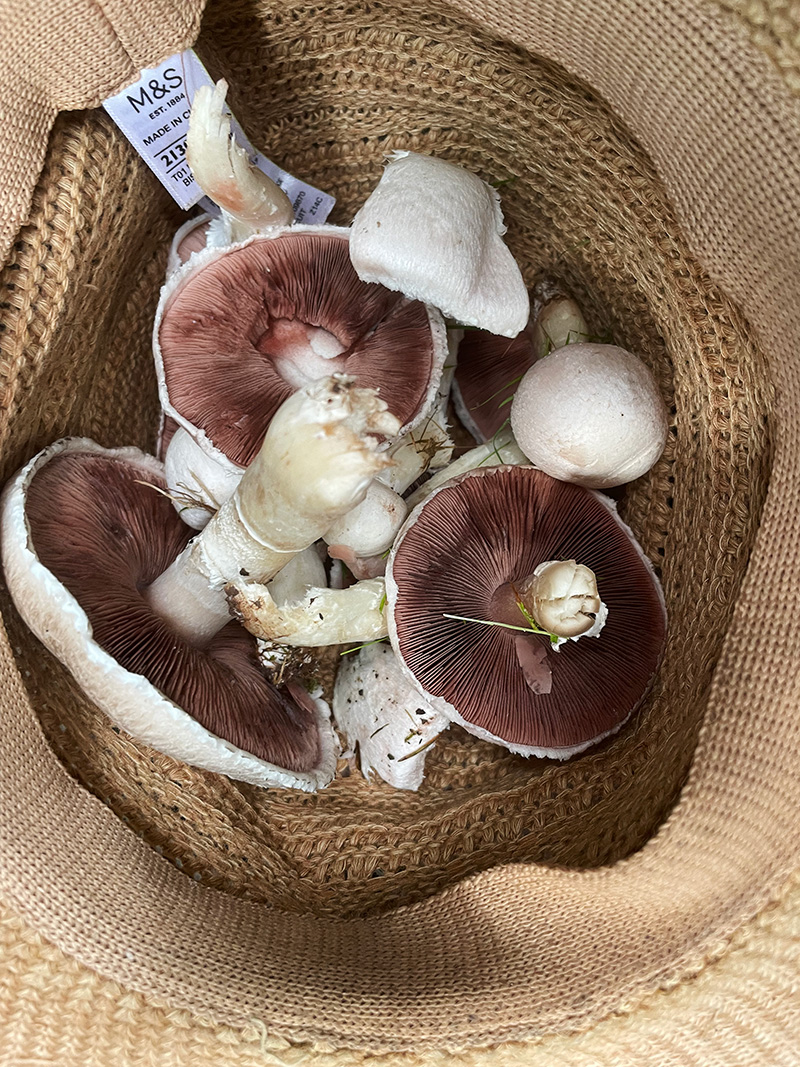
I was celebrating earlier in the week when I found a nice group of field mushrooms on a client’s lawn. Field mushrooms used to provide a reliable haul years ago in fields (as the name suggests), lawns and even roadside verges, but it’s becoming harder to find them due to loss of natural habitat and the chemical sprays used. Field mushrooms have a white, sometimes discoloured grey/brown, cap which can be scaly or smooth and which start out spherical on a young mushroom and then opens out flat. The cuticle often hangs down over the edge of the cap and is a good indicator of a Field Mushroom. The flesh is white, bruising slightly pink and the gills start deep pink and soon turn to dark brown with maturity. It also smells mushroomy – which is more important than you may think.
Unfortunately, as I have mentioned in the past, nature has a very bizarre sense of humour and has produced another mushroom that is very similar to the field mushroom in appearance, but it is highly toxic. The Yellow Stainer (Agaricus xanthodermus), looks exactly the same as a field mushroom at first glance, but it stains yellow (not pink) when bruised or cut and smells of Indian ink, hospitals or iodine (not mushrooms).
The saying may be, ‘Know your onions’ but please make sure you ‘know your fungi’ before picking and, more importantly, eating any of them.
As one wise forager reminded me, “Every mushroom is edible, but some only once.”
Fungi are not actually plants – or animals – but are their very own kingdom. If you wonder why I mentioned animals in that last sentence, it’s because fungi are more closely related to animals than plants because they share the chemical ‘chitin’ in their cell walls, which is also found in insect exoskeletons.
While they are hugely misunderstood – or not understood at all – fungi are vital to life on earth and without the recycling activities of fungi, the world’s ecosystems would soon run out of nutrients. They also play a key role in the planet’s ecosystem, from breaking down plant cell walls to producing enzymes that help clean the planet.
As well as the more familiar culinary ways to use fungi, they can be included in many products, including bread, wine, beer, solvents, flavourings, vitamins, and enzymes.
But despite their many uses in consumable products, some types of fungi are less desirable and even downright dangerous. Some are hallucinogenic, while others are just plain deadly. The Death Cap and Destroying Angel mushrooms – as the names suggest (nature does give you a bit of a clue, but only if you know the names) – are easily mistaken for several edible fungi, but they contain some of the most deadly substances known to humans. And have been used to this end in several dubious circumstances.
The largest organism in the world (by area) is a fungus, called Honey Fungus. It was discovered around twenty five years ago in a forest in Oregan, USA and has been estimated to cover roughly 2,384 acres, or almost 4 square miles. The fungus has survived for over 2,500 years, surviving on an unenviable diet of living and dead wood.
Proper Fun
On a brighter note than deadly fungi – and for all those pet and animal lovers amongst us – do have a look at this website www.comedywildlifephoto.com – it is just the best tonic for these squelchy autumn days.
And finally, thank you to Wayne Davies at the Western Mail for bestowing the title, ‘Stone Ranger’ on me in the wake of my dry stone walling endeavors. What he didn’t realise is that my neatly-mown-grass-obsessed brother is already nicknamed the Lawn Ranger.
Leave a Reply