
Taken from Lynne’s weekly column ‘Green Scene’ for the Western Mail
4th March 2023

Need A Leek?
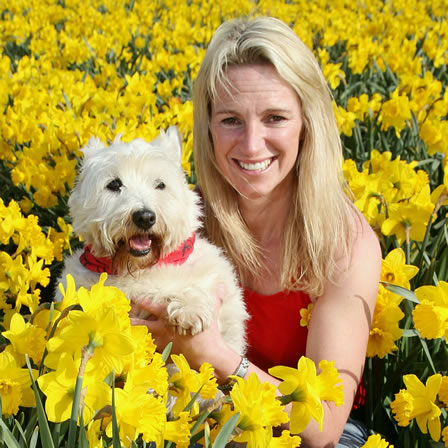
This daffodil photo has been dusted off for each St David’s Day for quite a while now. Taken ‘years ago’, with Tippy, Yogi’s predecessor, it was originally used to promote The Really Welsh Company. They grew Welsh daffodils (and were also responsible for the Duffy-dil) and leeks commercially near Cowbridge and acres and acres of their brilliant yellow daffodils is a sight I will never forget.
As familiar as the photo is to some, so will the story that dad always told us at this time of year. When he was at primary school, it was unusual to be able to find a daffodil in flower for the beginning of March so he would be sent off to school with one of his dad’s huge and very strong-smelling leeks. He said it was often almost as tall as he was and had to return home at the end of the day for the ‘cawl pot’.
Anyway, fast forward 75 years from my dad being in primary school (that hardly seems possible) and this year it was predicted to be difficult to find a British grown leek to commemorate or to make cawl with on St David’s Day.
It is apparently the ‘most difficult season ever’ for British grown leeks due to last year’s unhelpful weather patterns. Leeks are usually sown in spring and harvested from early autumn through to late winter and last summers high temperatures and a lack of rain, followed by a period of cold weather put the crops on a ‘knife’s veg’.
Whilst I haven’t been affected by being rationed to three packs of tomatoes or three cucumbers (who on earth buys three cucumbers in one go anyway?) I do use a lot of leeks as they make a great base for heartening soups and stews in the cold weather and crispy leeks will enhance most dishes.
Many British leek growers are also fearing another drought this summer and are therefore reducing the size of their commercial crops, so it might be a good idea to start to grow your own. They are a relatively easy crop to grow and take up little room compared to other root veg. They can also be grown in deep containers like barrels.
Traditionally, leeks are sown into a seed bed, off the main vegetable plot, and transplanted in early summer, only because otherwise they would take up valuable space for fast maturing crops like lettuce. Don’t get too caught up in the technical stuff though. I always say seeds are better in the ground than the packet – which is where they stay if you stress about it all too much.
This month sow leek seeds thinly, ½in deep, in rows 6in apart, or you can sow in small individual ‘cells’ in a seed tray indoors. Sow one seed per module/cell and the seedlings can be transplanted into the veg bed with minimal root disturbance later.
Delicious Daphne
 The amount of colour in most gardens is increasing all the time now. From spring flowering bulbs and hellebores to the spring flowering shrubs like Forsythia and Ribes. I think spring colour is probably the most appreciated of all the seasons as it fills us all with the anticipation of warmer days and light evenings. If you are not confident about your plants, a good way to get colour into your garden all year round is to visit the garden centres every three or four weeks and buy something suitable that’s in bloom, or offering evergreen interest. That way you will have a succession of flowering plants and colour throughout the year.
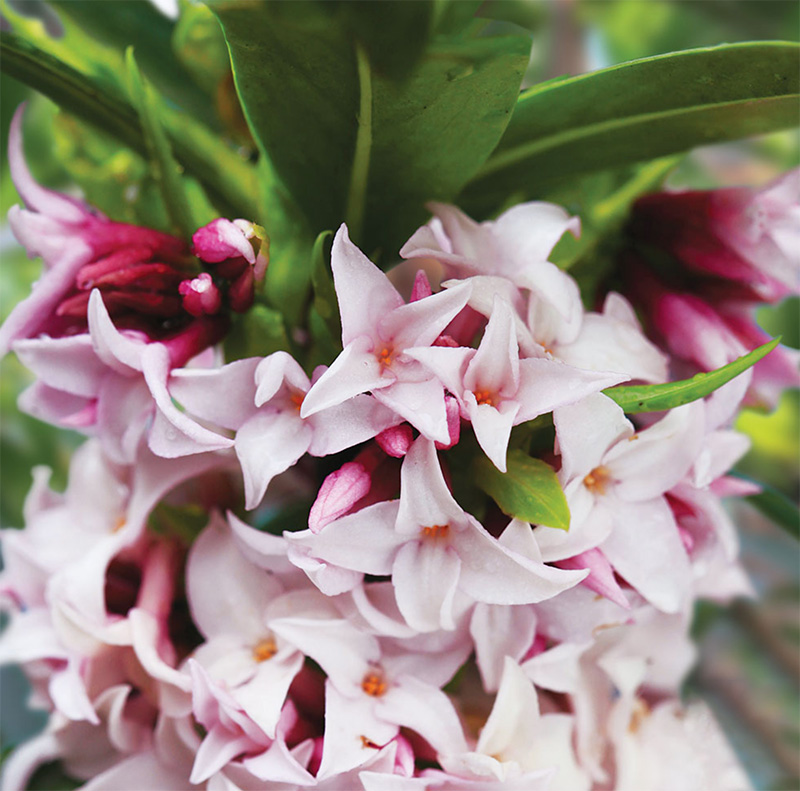
One of my favourites – actually, I can’t say that, they are all my favourites – at this time of year are the fragrant Daphnes. There are a few varieties to choose from but the Daphne ‘Perfume Princess’ claims to be the most fragrant Daphne ever and even more impressive, ‘probably the most fragrant shrub in the world.’
With the largest, earliest flowers of any Daphne, the purple buds open to gorgeous pink flowers that fade to white and have an intoxicating, sweetly spicy scent.
The superb hardy evergreen will flower throughout the whole of March and reaching an overall height and spread of around 4ft means it is the perfect size for growing in a container as well as in borders. Growing in a pot or suitable container means you can place it on a patio, next to a favourite bench or by a front or back door when in bloom to get the most from the scent. It’s a hard working shrub – and I like that about a plant.
Meteorological Spring Has Sprung
As well as being St David’s Day, last Wednesday was also the first day of spring – meteorologically speaking. The definition of meteorological seasons is that they are ‘based on the annual temperature cycle and measure the meteorological state, as well as coinciding with the calendar to determine a clear transition between the seasons’.
The meteorological seasons therefore consist of four periods each made up of three months and which are the same every year. That makes it easier for meteorological observations and forecasts to compare seasonal and monthly statistics. Going by the meteorological calendar, spring will always start on 1st March and the spring months are always March, April and May.
Astronomical seasons, on the other hand, refer to the position of Earth’s orbit in relation to the Sun, taking into account equinoxes and solstices. Since the seasons vary in length this way, the start of a new season can differ each year. Although astronomical spring is traditionally celebrated on the 21st of March, this year it actually falls on the 20th. Apparently the March equinox can in fact happen on the 19th, 20th, or 21st and the last time the March equinox was actually on March 21st was in 2007. Records show it will happen again in 2101 but it’s all a bit too complicated for me – I’ll stick to celebrating on the 21stevery year.
I still favour a leek over a daf for St David’s day even now
Love that picture!
I have never heard of crispy leeks before, so I must try them. It will make a change from stews and creamed leeks.
Enjoy the new season (once the temperature drop this week goes away).