

Taken from Lynne’s weekly column ‘Green Scene’ for the Western Mail
11th March 2023

To Dig or Not To Dig
I’ll be largely ‘no digging’ in my veggie patch again this year and whilst that statement leaves a bit to be desired grammatically, the no dig method itself is very satisfying.
Although it does reduce work and effort eventually, it can take a bit of research, patience and graft to get going. Don’t be put off. I am a subscriber to the Charles Dowding blogs and it is always reassuring to read that things don’t always go to plan for him either. Admittedly his biggest ‘enemy’ is the weather, as he knows his craft inside out, but it’s worth remembering that ‘growing your own’ quite often results in ‘groaning alone.’
For the last couple of years I have been battling against various ‘competitors’ for my harvests – from rabbits, pigeons, voles and even pheasants. The most confusing puzzle for me were the crops that failed with no apparent reason. It transpired that the ‘runs’ – made by rabbits, moles and voles – that developed under my veggie beds produced voids that the roots would grow into and cause crop failure.
Oh, and then there was the fact the moles seem to have eaten all the worms – last year I was almost wormless.
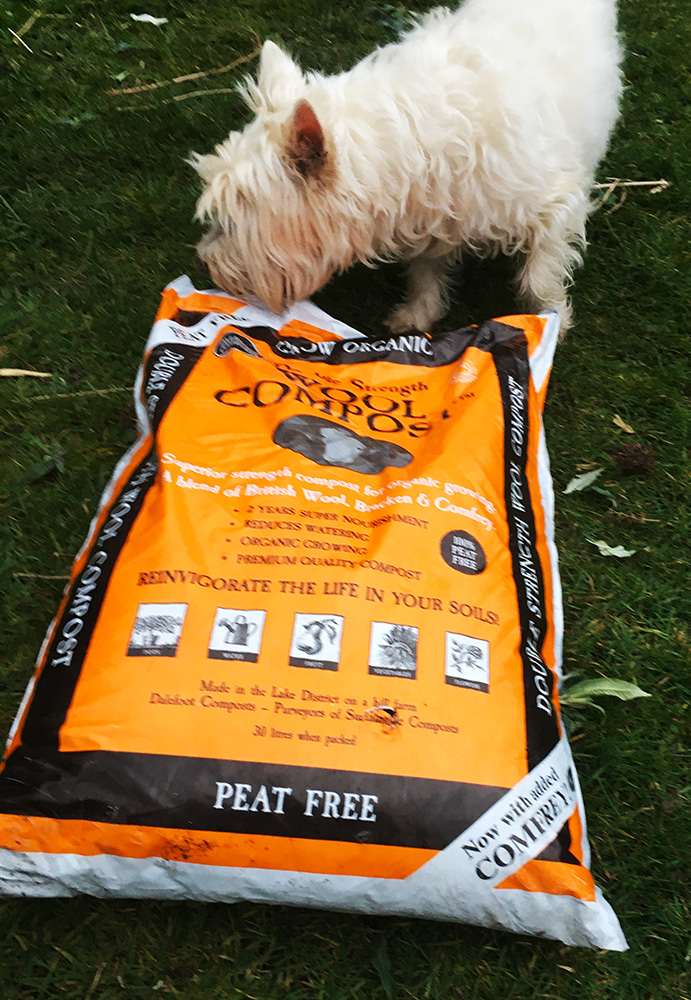
So at this time of year, it all starts again. Having got rid of the labyrinth of tunnels under the veg patch I have recently given some of the beds a good top dressing with Dalefoot Wool Compost Double Strength. I have heard such good things about the ‘wool range’, which is approved for organic growing and completely peat-free. Sheep’s wool is being used in horticulture for a number of things recently – even mulching under vines where it improved the crops substantially. It is thought that as well as repelling pests and warming the ground, it reflected the sunlight up to the grapes and encouraged ripening.
The Dalefoot Wool range of compost not only feeds plants for a whole season with a ‘magic-mix’ of natural ingredients including comfrey, bracken and sheep’s wool, but, cleverly, the wool retains moisture and so less watering is required. That might be very useful if we have a repeat of last year’s summer.
I am also trying their Wool Compost for Seeds. Last year I had a few trays of seeds fail, and the common opinion amongst ‘traditional gardeners’ was that the quality of most compost is far inferior to what it used to be. Obviously seeds need the best start you can give them and I am hopeful that Dalefoot’s compost will do that.
Instead of being made from recycled green waste, potash rich bracken forms the base for all our composts and there are some helpful options to choose from, ensuring there’s something that will benefit every garden.
The Lakeland Gold, for example, is sold as a ‘Traditional Claybuster and ‘Gold-standard’ Spring/Autumn Mulch, encouraging worms and enriching your soil.
It’s ideal for mulching into your beds in spring and autumn, improving nutrition and soil structure, and for top dress plants ‘greedy feeders’ such as potatoes, fruit trees, asparagus and flowering shrubs, especially roses.
It is also highly recommended for ‘No-Dig’ gardening and has great reviews claiming to have ‘dissolved clay’.
Delivery can be made direct to your door and they also offer a great Bulk Buy Scheme, which is perfect for gardening projects, communities, allotment holders, and liaising with friends and family to save money in the cost-of-living-crisis. More information and products at www.dalefootcomposts.co.uk
If you are interested in learning more about the No-Dig method, have a look at www.charlesdowding.co.uk (his book is also very much worth investing in, especially if, like me, you still prefer to turn pages than read screens).
With regenerative gardening predicted to be one of the ‘hot horti-trends’ for this year, I highly recommend having a look at the Soil Regen online summit, 13th-15th March. A number of experts will be offering exceptional information on regenerative techniques, including no dig, as well as other aspects of soil care and relevant topics. www.soilregensummitcollection.com
Snow Joke
 Weather folklore tells us that, ‘If March roars in like a lion, it’ll go out like a lamb.’ And it certainly roared in with the white stuff last week.
March weather is notoriously fickle as it is on the cusp of winter and spring. This weekend in 1891, a snowstorm raged so severely in the West Country that a new word was created to describe it. It is thought that ‘blizzard’ was taken from the German expression, ‘Der Sturm kommt blitzartig’ meaning ‘the storm comes lightening like’. A blizzard is described by the Met Office as ‘a violent snowstorm with winds of a minimum of 35 mph and a visibility of less than quarter of a mile for three hours’. It was certainly blizzard-like when I fed my chickens on Wednesday!
In 1978 blizzards tore across Wales for five days dumping an average of 2ft of powdery snow with strong winds whipping it into drifts up to 30ft. The whole of the South West suffered badly with hundreds of uprooted trees, and the loss of lives of people and animals. Even the Scillies, the mildest part of the UK, had snow.
Although the Scillies had snow again at the beginning of March in 2018, when Wales was also brought to a standstill by the Beast from the East and Storm Emma. In 2006, again in the South East, and due to a lack of rainfall, six water companies imposed a hosepipe ban at the beginning of March. Yes, March, ‘we see you’.
All these facts – and many, many more – are in one of my favourite books, The Wrong Kind of Snow – The Complete Daily Companion to the British Weather – by Antony Woodward and Robert Penn.
Breath Practice
I have recently been re-reading my books on breathing and concentrating on ‘breath work’ again. It is fascinating. As something that we all do every day (if we are lucky) you would think we would be quite good at it, but apparently that’s not the case. Most of us just ‘breathe to get by’.
Improving your breathing can improve your health in numerous ways and you don’t need any special equipment or fancy clothes to do it. I first learned about the benefits of various types of breathing several years ago – before the world discovered Wim Hof – and became quite a convert to some of the methods. But, like a lot of things, I let the practice slip. The good news is that you can always pick it up again and I am now incorporating ‘breath work’ into my days again. It’s an effective way to support physical and mental health and has become a beneficial addition to my Pilates, stretching and Zuu workouts.
The majority of us are ‘mouth breathers’ – breathing through our mouths during the day, and often the night. That can have detrimental effects on our health. When you breathe through your nose, you absorb more nitric oxide, and can absorb 18 percent more oxygen than by mouth breathing. The amount of nitric oxide in your body influences your weight, immune function, concentration, blood circulation and mood.
I have found two things really doable and effective and suggest you look them up if you are interested in improving your own health with breath work. The first is the 5.5 breath (the optimal breathing rate) and the second is taping your mouth shut whilst sleeping. Please do your own thorough research – it’s really not as bad as it sounds and only involves a small piece of Micropore surgical tape … although when I explained it to my brother he suggested maybe I should extend it to the daytime too.
Leave a Reply