

Taken from Lynne’s weekly column ‘Green Scene’ for the Western Mail
25th February 2023

Catkins and Cat’s Paws

After cutting back some goat willow in a garden last week, I took some of the stems back to put in a vase indoors. I think they are beautiful. Better known as ‘pussy willow’, they earned their common name as the male catkins of the goat willow look like a cat’s paws. They’re actually flowers just before they fully bloom, with the soft coating of hairs acting as insulation to protect these early bloomers from cold temperatures.
Only male plants produce the fuzzy flowers. You may be disappointed if you end up with a female tree, but the flowers on female plants are equally funky—they just look more like hairy green caterpillars. Look for both flowers blooming over the coming season.
If you keep fresh-cut pussy willow stems hydrated – like displaying in a vase – you can usually witness the whole flowering cycle and even watch the new leaves unfurl. When the flowers mature from the catkins, you will see lots of yellow stamens emerge to cover each ‘paw’. Tiny amounts of pollen will be the end of each stamen and it’s not a bad idea to put the vase outside then so the bees can benefit from the pollen – on a balcony or near a window is ideal so you can watch them visit their ‘treat’.
A while after, you may also see pale green leaves unfurl from the leaf buds and you can then push your pussy willow cuttings into the soil, or a pot of compost, where they will hopefully take root. As they will be in full spring growth, there is a good chance you will have some new pussy willow additions. Does that make them kitten willows, I wonder?
There are some lovely varieties available for your garden. Salix gracilistyla ‘Mount Aso’ – Japanese pink pussy willow – as the name suggests, has eye-catching fluffy pink catkins followed by blueish green leaves. It grows into a rounded bush about 6ft high and the same width.
Salix caprea ‘Kilmarnock’ is the only pussy willow that forms a small weeping tree. We used to plant a lot of these when I was first gardening – it was a bit like the Black Forest Gateau or Prawn Cocktail of the gardening world back then. Ideal for a small garden, it will reach around 5 ft. And funnily enough, we always used to under plant with spring flowering bulbs.
Other willows grown for their decorative catkins include Salix daphnoides (violet willow) which has purple-coloured stems that contrast with the silvery catkins. It is quite vigorous and should be cut back annually in late winter. If you want a dwarf option, then Salix hastata Wehrhahnii will only reach a maximum of a 3ft height and spread and has silvery catkins on purple-brown stems.
But whilst they are all eye catching at this time of year, I must admit to preferring nature’s natural option.
Crocus Carpets
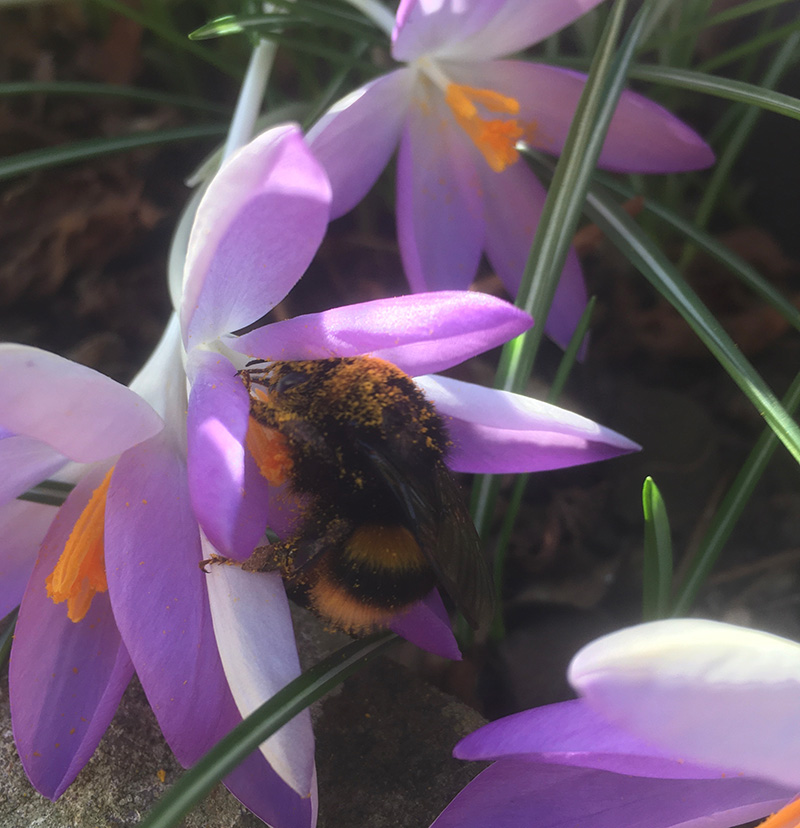 As well as the stunning white carpets of snowdrops blooming now, there are some beautiful crocus carpets about too. Both of these bulbs are so much more effective if left to develop into these carpets, or drifts, and it is helpful for the bees too. It’s much less tiring for them to visit an expanse of pollen producing plants rather than have to visit individual flowers which are spread out – especially at this time of year.
Snow crocuses (Crocus chrysanthus) are one of the first flowers to emerge in the garden, blooming well before the fat Dutch Crocus (Crocus vernus), and bees love them. They provide a very valuable food source for early insects when not many other plants are in flower and naturalise very well in lawns and borders. Usually thanks to busy mice, crocuses will often spread from beds and borders and naturalise organically in surrounding lawn areas. Similarly they will often pop up in random spots but it’s impossible to chastise something so pretty and hard-working.
Lots of crocuses are suitable for naturalising, from spring-flowering bulbs Crocus tommasinianus and Crocus sieberi to autumn-flowering  Crocus speciosus. If you are enjoying the crocus carpets now, remember that you can plant the autumn flowering bulbs in July and August to provide beautiful drifts in September through to November.
If you are planning to plant these lovely little flowers, DeWit have a beautiful little bulb planter suitable for snowdrops and crocuses. Available from www.crocus.co.uk which as the name suggests also offer a great selection of bulbs and other garden paraphernalia.
Crocuses are also really effective when planted or layered in tubs or containers with other spring bulbs – a bit like a bulb lasagne. They will make their debut before or with daffodils and definitely before tulips, which means you can get extended colour from your containers.
I am a great fan of planting bulbs that have different flowering periods in nice containers and then placing them in a focal point when they are in bloom. With a bit of planning it means you can easily swap the pots around for continuous colour in a specific spot, like outside the front door or a well-frequented window!
Folklore Forecasts
Despite some cold snaps, I have been working in a t-shirt occasionally during the latter part of February with temperatures reaching the balmy early teens. But according to Folklore, that doesn’t bode well. Not that my ‘wardrobe choices’ feature but it is said that, “When the cat lies out in the sun in February, she will sleep in front of the stove in March.” I wonder if that applies to gardeners.
And although it has been a blessing to work out in fairly clement weather for most of the month, the warning goes, “Of all the months of the year, curse a fair February”.
Whatever the outcome, I’m sure it won’t be too long before I’m cursing the weather again.
Just to confirm that Monmouth Seed Swap is being held today – Saturday the 25th (and not the 19th as I mentioned in a recent column). Apologies for the mistake – but they do happen – it’s why they put a rubber on the end of pencils.
Leave a Reply