
Taken from Lynne’s weekly column ‘Green Scene’ for the Western Mail
16th January 2021

N-ice Idea
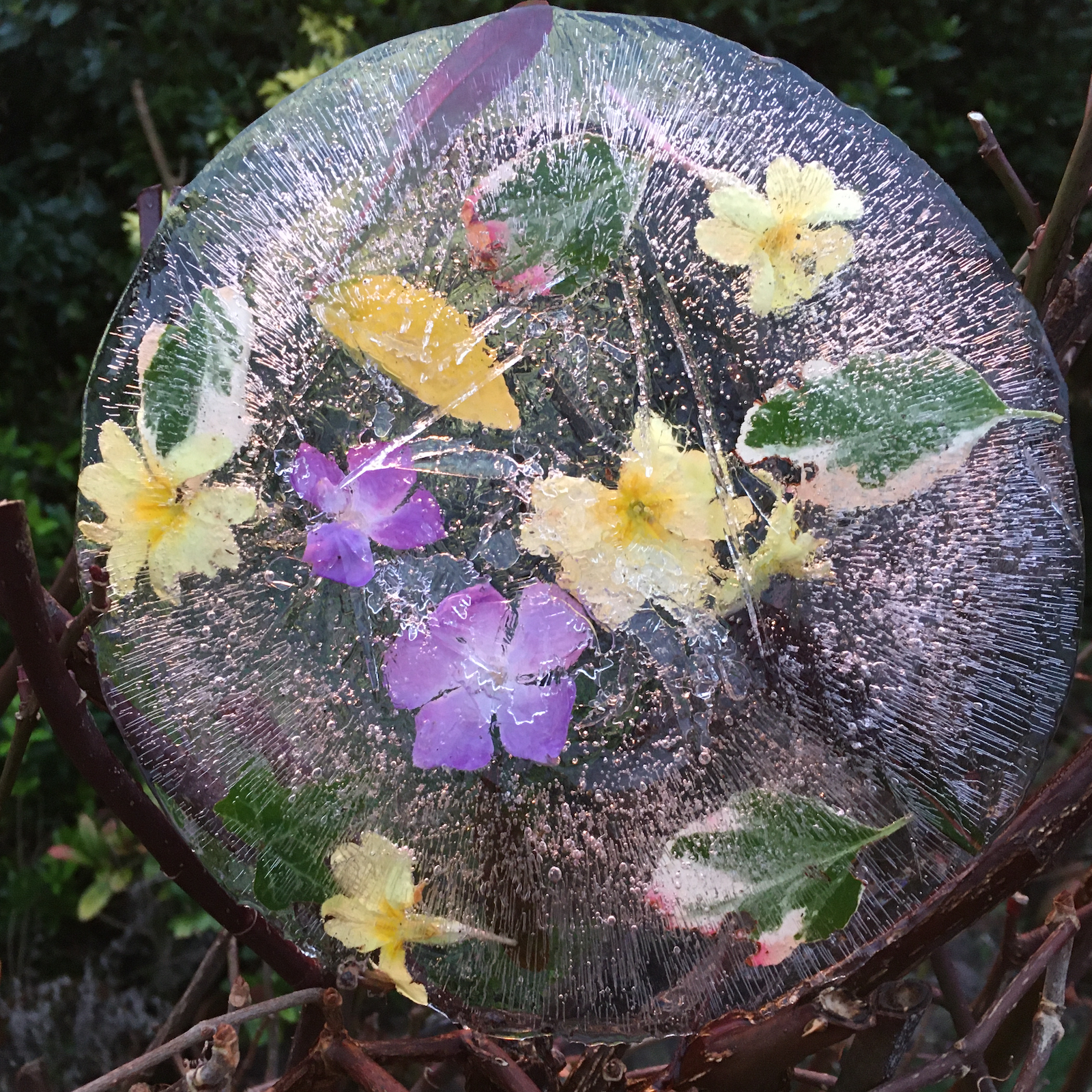
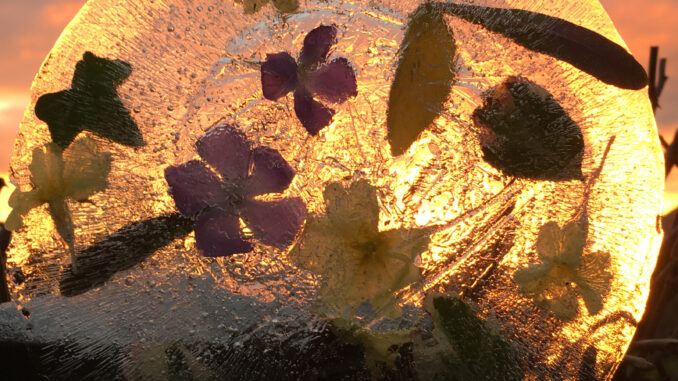
My latest creative endeavor during the recent ‘ice-stage’ was to make little floral ice decorations. Simply put a little water into a shallow dish and float flower heads and leaves on the surface. You could use shells, berries and a whole lot of other things too. Don’t get too bent out of shape about a design, as the flowers and leaves will naturally float about. Then leave to freeze outside overnight.
You can add a long piece of string if you want to hang your decorations from a tree and I suppose you could freeze the dishes in the freezer if outdoor temperatures aren’t cold enough.
I also floated some foliage and seed heads on top of a bucket of water one night, and as it melted slightly in the morning the arty ice disc on the surface just shrank enough to remove from the bucket easily. I remembered to experiment but forgot to take a photo.
Apart from being a great creative project for kids (and adults, obviously) I think it’s an invaluable way of teaching that just because something doesn’t last long, it doesn’t mean it isn’t worth the effort. And that some things, no matter how beautiful (or not), don’t last long.
Apple Of My Ice
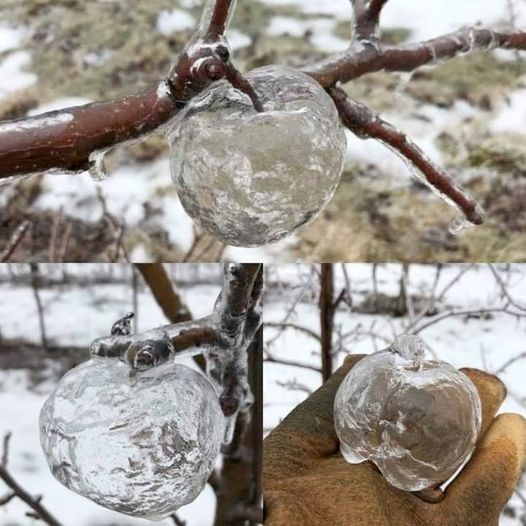 Of course, nature creates her own ice decorations.
The little icicle drops on these frozen reeds (see photo) were just stunning and freezing rain falling on rotting apples that were still on the tree, covered them in an ice coat.
The apples inside turn to mush as they have a lower freezing point than water, and that mush and apple skin fall to the ground, leaving behind these amazing “ghost apples”.
Isn’t nature just amazing?
Code Breakers
As a result of not being able to drive anywhere to exercise at the moment, dog owners are having to find local routes to exercise their furry friends. Not surprisingly, some of these less-trodden footpaths are not quite as user friendly as the more popular beauty spot walks. Most stiles will have ‘pop holes’ for dogs to access but on some of the footpaths I use, one or two haven’t. Luckily, as Yogi is a ‘size portable’, I can hoist her over stiles easily but obviously if you have a big dog, or a bad back, you might not be able to. If this is the case, please turn around and find another route. Do not cut the wire stock fence.
That is something that I never imagined writing in my column – simply because I credit people with more sense. But whilst walking a local route through farmer’s fields last week, I saw that someone had actually cut a large hole – large enough for the farmer’s sheep to get through, incidentally – in the fence next to a stile.
Whilst we are lucky to have Public Rights of Way and footpaths through the most beautiful countryside in Wales, please remember that this land that we are privileged to access belongs to someone and will be farmed or managed in some way. Cutting a hole in a stock-proof fence is akin to someone cutting a hole in your garden fence or hedge.
I am still hoping that most dog walkers don’t actually carry wire cutters with them and therefore assume that the perpetrator had to return at some point with wire cutters. Canadian wire is not easy to cut. It beggars belief.
I’m not sure if it is a generational thing. As kids we were probably taught to leave gates as we found them, not to climb over fences (we didn’t have to be told not to cut them) and not to pick wild flowers before we were taught how to use a knife and fork.
I am always extolling the virtues of nature and our beautiful countryside. Whilst I can understand someone not knowing that it is not acceptable to climb over a fence (or gate), I struggle to believe anyone could think that it is okay to actually cut a wire fence.
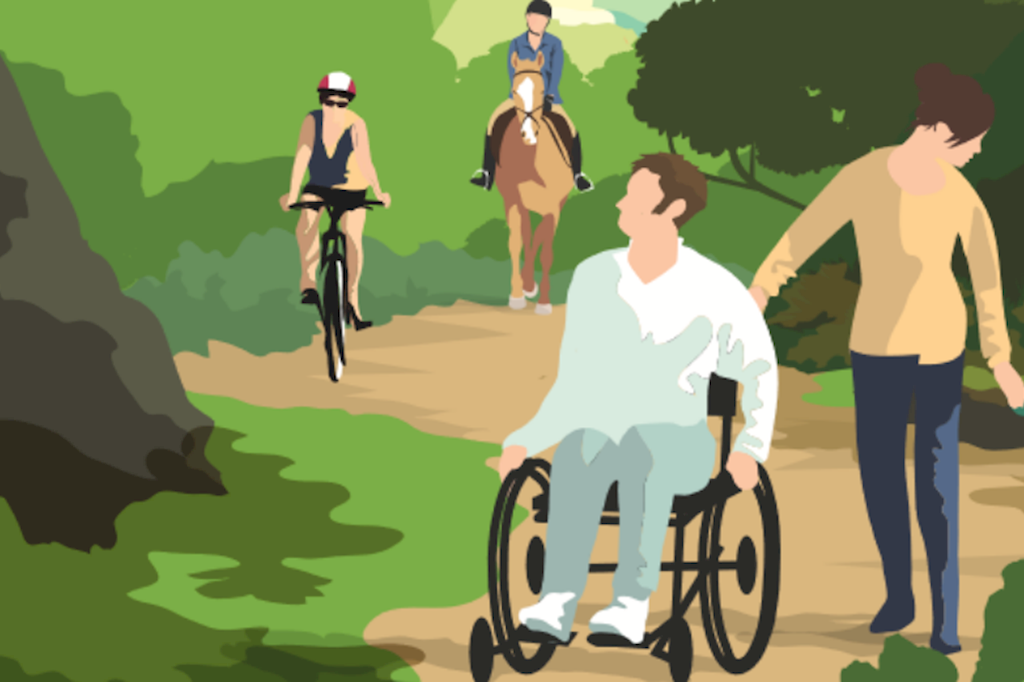 But I am trying to be kind and magnanimous, so I politely remind readers about the Countryside Code and it’s aim to “help everyone respect, protect and enjoy the countryside’. Ironically, people who read a column called Green Scene will probably be familiar with using common sense in the countryside, but maybe you could pass it onto people who aren’t.
You can read the Countryside Code here and Natural Resources Wales also have excellent guidelines on the Dog Walkers Code, Trail Users Code, Waterside Code and even the Canoeing, Angling and Wild Swimming Code, for when we can move about more freely again.
Since Yogi ruptured both her cruciate ligaments two years ago, I have always kept her on an extendable lead for all of our walks. It was initially to stop her chasing squirrels and doing even more damage to her joints, and the transition was challenging as the lead got wrapped around legs, saplings and even long, tufty grass. But it has been for the best and our walks are much more relaxed with me knowing she is safe at all times. Yogi is also much more confident on a lead and a dog behaviourist friend explained that they often will associate being on a lead with security. Surely the most important thing for a dog owner is to know their dog is safe.
A friend on social media disagreed with keeping dogs on a lead, arguing that as long as they were under control that would suffice. That’s a lot to expect from your dog – especially if there is the word ‘terrier’ in the title or the genes. Putting your dog in a situation where they could end up chasing farm animals is, at best irresponsible and, at worst, devastating.
The RSPCA advises, “As a last resort, a farmer is legally allowed to shoot a dog who is threatening their animals.” Trying to explain that your dog was chasing a rabbit which ran through the flock of sheep, would be of little compensation in that tragic scenario.
Interestingly, the second point on the Dog Walkers Code reads, “Prevent your dog from approaching horse riders, cyclists, or other people and their dogs uninvited.” It is annoying for those of us with nervous or anti-social pets and not made any less so by the owner shouting, “He’s okay.” ‘He’ may be but I’m not; I’m furious when Yogi is bowled over by an over-enthusiastic dog weighing more than me.
For those home schooling, maybe it is worth including these Countryside Codes in your curriculum and integrating aspects of them on local walks. Thank you.
Leave a Reply