

Taken from Lynne’s weekly column ‘Green Scene’ for the Western Mail
2nd May 2026

Hello May
The fifth month already. Nearly half way through the year. Crikey.
One Flew Over …
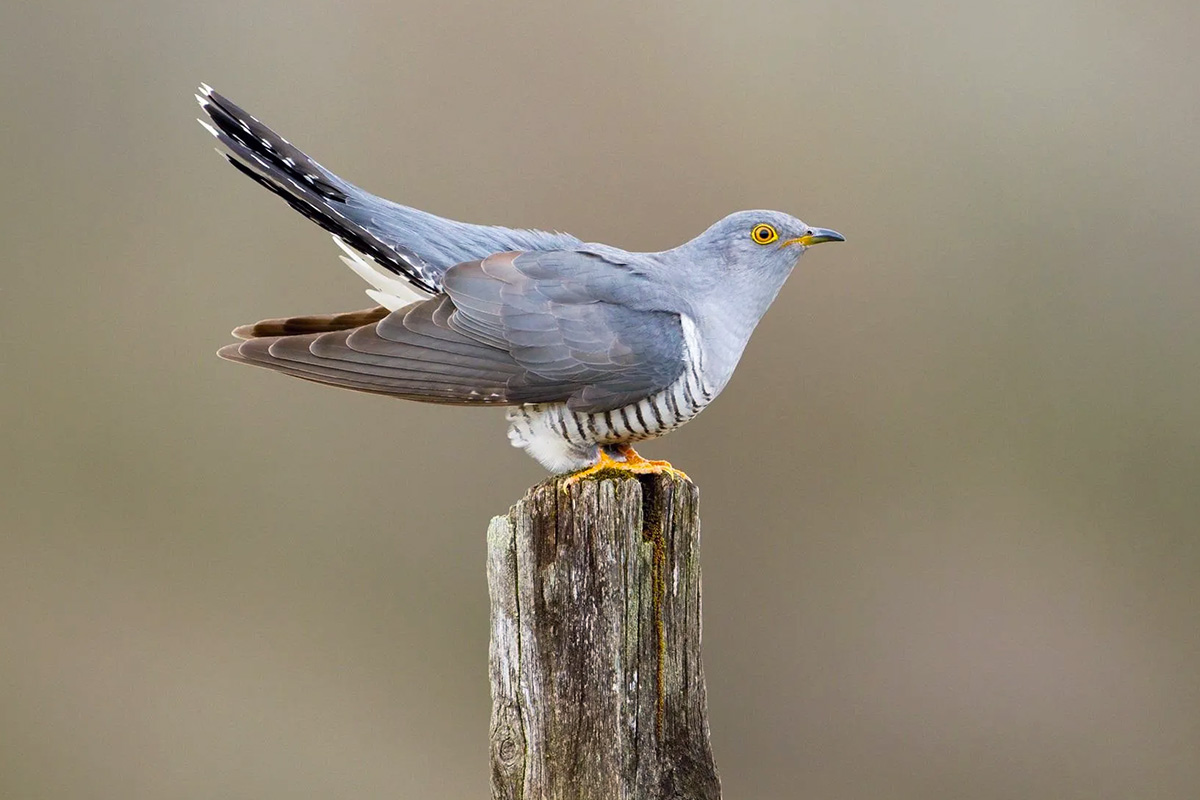 As well as letting you know we have ‘gone on a month’, (in case you didn’t know), I’m delighted to report, I’ve heard the cuckoo. I first heard him about three weeks ago but wasn’t 100% sure but now am hearing him on a regular basis – or ‘them’ I should say as they’re in many different locations. And I say ‘him’ as it’s only the males that make the ‘cuck-oo’ sound. Female cuckoos make a more ‘bubbling’ sound.
Renowned for marking spring, the cuckoo flies all the way back from Africa each spring to spend the summer in the UK and to breed. They are famous for laying their eggs in other birds’ nests, fooling them into raising their young.
Over a season, the female cuckoo will lay between 12 and 22 eggs, and all in different nests, though interestingly, they tend to opt for the nests of the very same species that reared them.
It’s all incredibly clever, as once the female finds a suitable nest, she actually removes one of the unwitting host’s eggs – can birds count, I wonder? – and lays hers in its place. And all within 10 seconds, to avoid being detected. Cuckoo eggs hatch quickly – after just 12 days – and once hatched, the baby cuckoo’s cry sounds just like an entire clutch of hungry baby birds, overriding any parental suspicion. They soon take over the nest, developing quicker than their host’s offspring, and therefore taking all the food brought by the host bird.
By the time the fledgling cuckoo leaves the nest, it is far bigger than even it’s ‘step parents’, but the adoptive parents continue to feed the young cuckoo for a further two weeks. With their young being raised by another bird, adult cuckoos are free to leave the UK much earlier, often heading back to Africa in June, where they spend winter. The young cuckoos will fledge long after their parents have left.
A lot of people will know the scant details of this process, but when you really think about it in any depth, it really is quite incredible. But there’s more:
Our cuckoos winter in the forests of the Congo after their epic journey, crossing the Sahara in one 50-60 hour continuous flight. Curiously, it has been revealed by tracking, that they take just one of two routes to reach their destination. One is southeast through Italy, where food reserves seem to be good, and the other is southwest through Spain.
Unfortunately increasing droughts in southwest Europe have made it difficult for these cuckoos to put on sufficient fat reserves and more recently, only half of the tracked birds are surviving the long desert crossing. This is obviously having a serious knock-on effect on cuckoo populations in the UK.
Cuckoos are sometimes mistaken for sparrowhawks due to their markings: blue-grey backs and heads, with striped, dark grey and white undersides. They have long tails and pointed wings and a hawk-like shape when in flight. Despite hearing a cuckoo every year for nearly 60 years – there used to be one at the back of my nan and granddads orchard which ‘came to stay’ every year – I have only ever seen one three times. They are really hard to spot and seem to be able to throw their ‘voice’, to conceal their location.
Track and Trace
 Sadly, but unsurprisingly, cuckoo populations in the UK have declined sharply in recent decades, making tracking their movements increasingly important.
The BTO is a registered charity, ‘harnessing the power of science and a shared passion for the natural world to secure a better future for birds and nature’, and amongst other things, offer the most brilliant, and original gift – to yourself or another.
Not only can you help track cuckoos and watch their epic migration on their Cuckoo Migration Map – and read the latest updates on how the cuckoos are managing their amazing migration from Britain and Ireland to Africa and back again, but you can actually sponsor a cuckoo as well.
All you need to do please, is set up a Direct Debit for your chosen cuckoo – there are several to choose from, a client of mine has chosen ‘Jim’ as that’s her husbands name. As a sponsor, you’ll get regular updates about your chosen cuckoo and where they are in the world, and your support will fund the ongoing research into these fascinating and iconic birds. Plus – you can choose the amount you want to sponsor each month. I think it’s just brilliant.
Details at: www.bto.org/get-involved/volunteer/projects/cuckoo-tracking
And if you just want to help to track the cuckoos, then no technical skills are required to support the Cuckoo Tracking Project – just a love of cuckoos. Perfect.
It is this tracking process that recently revealed one of the cuckoos, Ashok, (available to sponsor), who recently returned to the UK after its winter migration, chose to leave again just 36 hours later.
He had flown back all the way from Africa, landed in Suffolk and then just decided to turn around and go back to France. If only we could ask him why.
What’s in a Name?
The European Cuckoo often repeats its call incessantly throughout the day, which is how the name of the bird became used with someone who speaks senselessly and pointlessly, making them seem a bit ‘mad’.
The term ‘cuckold’ has its origins in the cuckoo bird and its unique behaviour during the nesting season. As the cuckoo is known to abandon its eggs in the safety of another bird’s nest, leaving other parents to care for these eggs until they hatch, historically the word was used to describe a man who raised children fathered by another man, supposedly because he could not sexually satisfy his partner—resulting in her straying to be satisfied elsewhere.
But – as seems to be the case with so many things – it seems that the terminology has escalated and now ‘cuckold’ is used as a noun describing someone whose partner engages in sexual activity with others. As a verb, it refers to the act of consensual non-monogamy where a partner is intimate with someone else.
And if that’s not ‘itchy’ enough, Merriam-Webster now lists a ‘cuck’ as: ‘informal, disparaging + often offensive : a weak or submissive man —often used as an insulting and contemptuous term for a man who has politically progressive or moderate views.’
 I’m really out of my depth in this territory – back to the cuckoos I am familiar with – the feathered type!
There are more than 125 different types of cuckoos found throughout the world, including the common cuckoo, the yellow-billed cuckoo, and even the birds known as ‘roadrunners’. Now this is territory I’m more comfortable with – remember the cartoon ‘neep, neep’? And the fact that despite being ‘speedy’, the unlucky bird always got squished by a randomly falling ACME 2 ton weight.
Roadrunner actually made his first appearance with Bugs Bunny in 1958, in a cartoon book. And there is also a film called the ‘Bugs Bunny/Roadrunner Movie’, which came out in 1979 and is basically a compilation of the cartoon shorts. It is guaranteed to life the spirits – almost as much as sponsoring and tracking a cuckoo will.
Leave a Reply