
Taken from Lynne’s weekly column ‘Green Scene’ for the Western Mail
17th August 2024

Healthy Nettle
I recently wrote about the benefits – culinary and medicinal – of nettles and their seeds. And, as a healthy nettle fan I am in good company, with food journalist Elisabeth Luard singing their praises too. She agrees, “Nettles are the ‘perfect summer greens’. We are virtually their only predators – hence the protective sting – meaning there are always plenty to be found. You ideally want leaves from young nettles, or at least the leaves from the top of fully-grown plants, about 500g or so per person. Pack them in a lidded pot with a little salt and water, then drain as soon as the leaves collapse. Once it’s cooked, chop and dress as you would spinach – the texture and flavour are much the same – with lashings of butter and a splash of olive oil. Use it for soup (with bacon hock and barley is a classic), or folded into a creamy white sauce, or as a dressing for pasta.”
And if you want proof that there’s ‘nowt as queer as folk’, I think the World Nettle Eating Championship provides it. This year a new record was set by Tom Wheeler from London who ate the leaves from 116 ft (35.4m) of nettle stalks to claim the men’s trophy.
Welsh wonder-woman Beth Hodges from Barry Island retained her title and beat her own record set last year by eating a whopping 64 ft of nettles. Beth admitted, “I did really sting the inside of my mouth and your tongue goes a really funny colour but I was concentrating more on the pain in my hands, so I probably forgot about my mouth. The dryness is the tricky thing, and chewing them. I think it depends what the weather has been doing – this year they have been a bit hard to chew.
More than 30 people, from as far afield as America and the Netherlands, took part in this year’s nettle eating contest which was held at the Dorset Nectar Cider Farm, near Bridport, in June.
As Nessa would say, ‘Tidy’.
Jaws v Lawns
And whilst on the subject of ‘strange ways to die’, (rather than ‘dine’), did you know that although sharks are quite rightly feared by humans, with there being no shortage of gory stores to back up that fear, sharks only kill between five and 10 people a year.
I say ‘only’ but to keep it in perspective, you are more actually more likely to die in a lawn mower accident. I’m guessing it’s a numbers game as more people mow their lawn than swim in shark-infested waters but it’s probably worth remembering when you cut your grass.
Although, I still wouldn’t get too blasé when swimming in sharky-seas either.
Bloomin Good Art
 This week’s column seems to be focussing on ‘all things niche’.
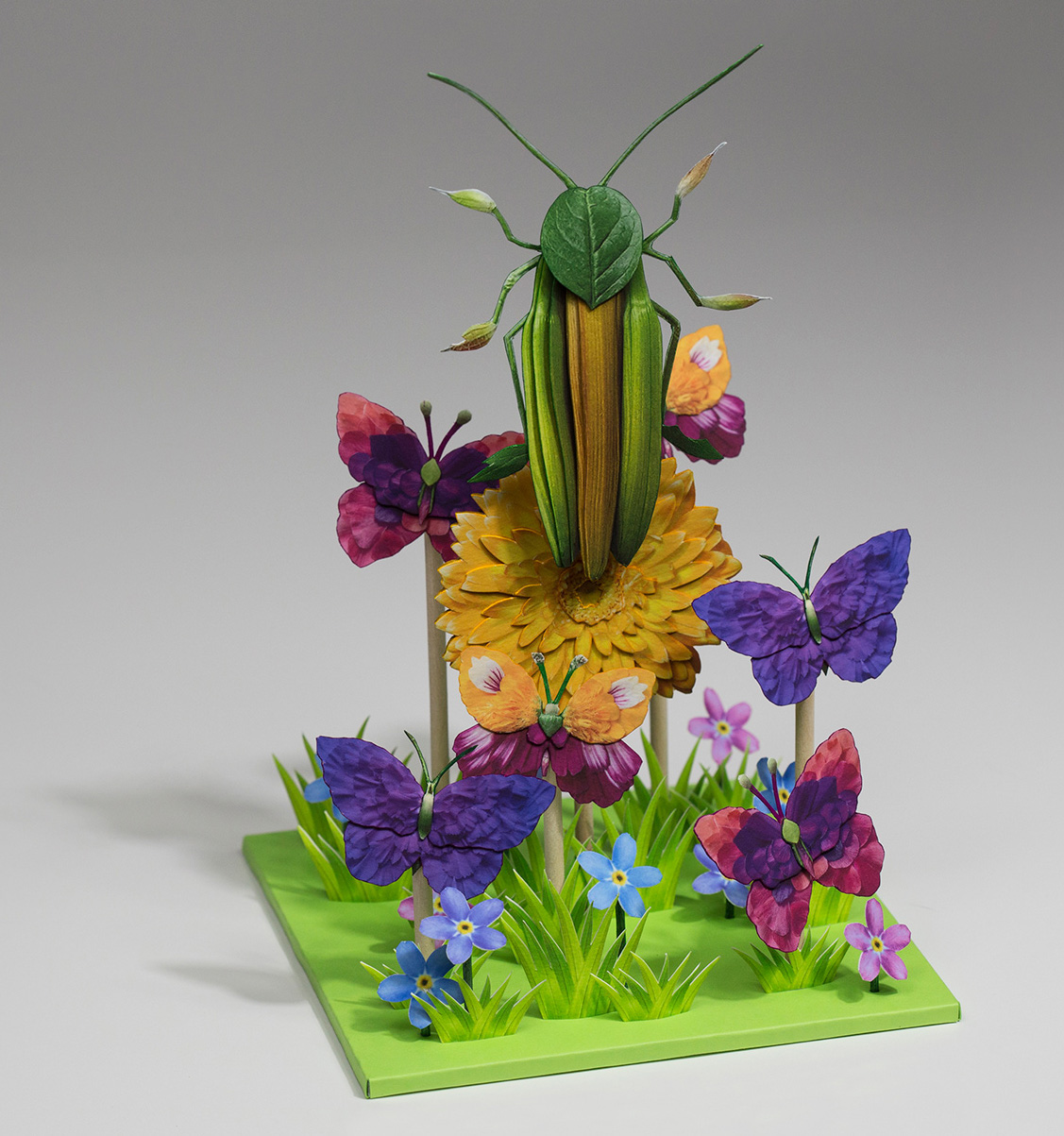
I recently saw Japanese artist Raku Inoue ‘bloomin’ lovely artwork, which is made entirely out of flowers and their component parts.
His work is just stunning and all made from delicate flower petals, blossoms, sticks, and leaves and with the most incredible detail.
Whilst you may not quite reach his level of excellence, I think it would be a great concept for little green fingers to try during the summer holidays.
You can see more of Inoue’s work, and be inspired, at www.reikancreations.com
Hair Today, (Slugs) Gone Tomorrow
It’s been a good year for slugs and snails – as any gardener will tell you. My favourite way of dealing with them was witnessed at an organic nursery where they used to let their three ducks out into the veggie garden every morning to carry out ‘slug patrol’ – it was very effective and also a joy to watch. Whilst I appreciate that’s not feasible for most gardeners, I was talking to an ‘older and wiser’ gardener last week, and they shared their own slug-swerving secret.
Hair. Cut hair – human or dog. Sprinkled throughout beds and borders, or just around vulnerable plants, slugs and snails will apparently avoid the area as the hair sticks to them. So the next time you go for a haircut or get your dog trimmed, bag the hair and spread it around the veggie patch.
Just make sure you wash the veg thoroughly – nothing worse than finding hair in your dinner.
My Green Man
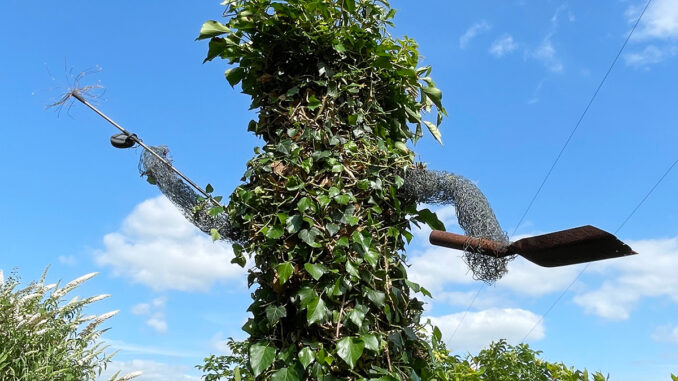
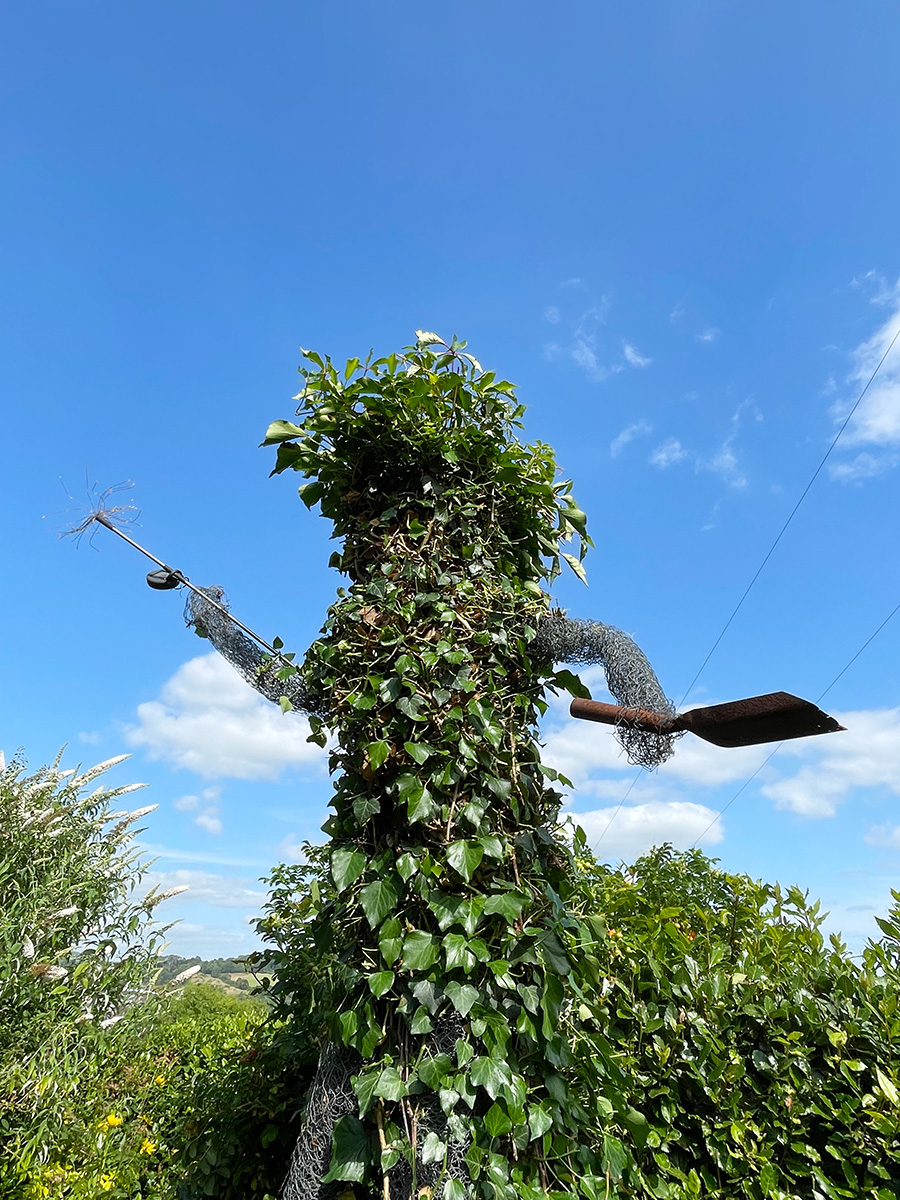 The Green Man Festival is on at Glanusk Park, just outside of Crickhowell, this weekend and I have had a topical and ‘happy accident’ in my own garden in it’s honour. I made a life-size wire sculpture of a person holding a solar lamp and a small shovel for a bird feeder (I told you I was in a ‘niche mood’) last year and secured it to a timber upright where it provided a little light in the evening and breakfast for the birds in the morning. Slowly but surely, as it does, the Parthenocissus and ivy crept up and through the wire frame and, although I was aware of it, I didn’t do anything about it – until last weekend. I gave it quite a severe clipping and ended up with my very own Green Man. Whereas a lot of things in the garden are planned, it is often these ‘happy accidents’ – like bird-sown seeds, or unexpectedly getting a plant combination right – which are the most rewarding.
There are numerous theories about the Green Man, with one of them being that while the idea of ‘Mother Nature’ has remained prominent in Western culture, there has long been a lack of a positive male image of connection to the natural world – a gap filled by the Green Man. He is also believed to symbolise the cycle of life, death and re-birth, featuring strongly in many mythologies, folk tales and even sacred teachings.
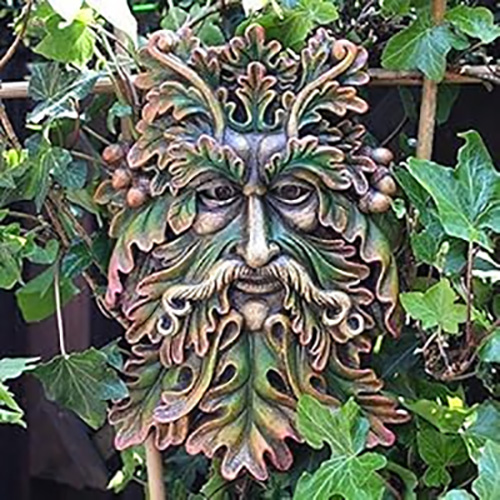 ‘Green Man’ is also a term frequently applied to images of a man’s head, surrounded by leaves, or disgorging leaves and vegetation from its mouth. These figures are also, less emotively, referred to as ‘foliate heads’ and are a common feature of British churches and cathedrals, medieval manuscripts, and stained glass.
Whether at the Festival or just feeling creative, you can make your own Green Man mask by making a basic mask template out of cardboard and sticking fresh green (preferably evergreen) leaves onto it with glue. There are some fabulous examples on the Internet – but remember, as Oscar Wilde said, “A mask tells us more than a face.”
Leave a Reply