
Taken from Lynne’s weekly column ‘Green Scene’ for the Western Mail
27th September 2025

Last weekend I passed my DWSA level 2 dry stone walling exam, and will now be registered as a Professional Waller with the Dry Stone Walling Association. I’m thrilled. After hours and hours and hours of practise in all weathers, and fitting it all in with work and ‘life in general’, it’s been a solid summer. But it’s been worth it and I am going to take the liberty of sharing my musings and analogies between building a good, solid dry stone wall and a good solid life. You have lots of time to muse when walling.
My ‘wonder of walling’ is nothing new. In February 2018, I wrote this column, www.lynneallbutt.co.uk/one-day-life-will-stack-up-not-out-of-the-winter-yet-digging-no-dig/
So here’s an update:
Foundation Stage
It’s not much of a stretch to see the similarities between establishing good foundations for a dry stone wall and for life itself. They are what the wall, and life, are built on. And just because they are at the bottom of the wall and ‘never seen again’ once the wall is up (just like life) time and energy should be well spent to get them right. In fact the only time you may see them again is if the wall collapses and they are revealed – as in life.
For my test wall I had to dig my foundations stones into the mud – it was like a quagmire. They weren’t just ‘on the ground’, they were dug in by half the height of the stones – big, unwieldy stones weighing as much as me. They also need to be placed so that the tops are as level as possible in order to give yourself the ‘best chance’ for level courses as you continue to build. Building on an uneven foundation stone will only cause you problems with the following courses and stones as you build the wall. As in life.
I’ve had to dig and re-dig my foundations in life. And as a result of not ‘levelling tops’, have made many things harder than they need to have been – possibly the best analogy of the lot. Believe me.
First Lift
The first lift is the section of wall that sits on the foundations and, being at the base of the wall, provides a lot of stability for the wall. It’s important that stones are placed lengthways into the wall for added strength and not ‘traced’ or run long ways along the wall for a quick, cosmetic option. The former takes more time and dedication – as in life. Quick fixes, short-cuts and ‘hoping it’ll do’ seldom works out well and will be a weak point of the wall and life.
We always seem to be rushing to ‘get over’ or ‘past’ something – or be on the other side of some event, in the same way a dog always wants to be ‘the other side of a door’. I was guilty of it for my exam – I just wanted it to be over, and my head was often on the other side of the test date. Most of us are fixated on the time after the exam, interview, challenge or unwanted appointment, but it’s the time before these events which is important – that’s when the work is needed, lessons learned or earned, and progress made. Don’t rush to get it out the way, give it the time it deserves for maximum rewards and results that you will look back on positively as a memory. It is alarming just how quickly something transitions from a drama, event and even celebration, to a memory.
Throughs
 And then we get to the ‘through stones’.
These are large, long stones that go right through the wall, effectively tying the two sides together and giving it strength and longevity. They are essential.
Whereas I couldn’t stop at this stage for a whiff whilst on the test, I do see a ‘through’ as a chance to pause a bit – on a walling contract or in life. It’s a good place to review your previous work and make any adjustments. Throughs are a commitment or the commitment stage.
Incidentally, if they stick out either side of the wall (as is often the case depending on the area) then they also make a good place to rest your cup of coffee. I am convinced that this is an essential part of the build.
Hearting
All the time you are building your wall of two sides, or faces, there is of course ‘the middle’ – also filled with stone, and given the wonderful name of ‘hearting’ (although a lot of the fellas refer to it as ‘fill’. Just saying). It is the heart of the wall, not, as many people assume, a place for dumping the ‘spoil’ or getting rid of dodgy stones, tea bags and cigarette butts. This ‘middle wall’ is just as important as the sides that people will see.
The stones need to be fitted together in coherence adding maximum strength and stability by tying the two faces in. It is all too easy to adopt the out-of-sight-out-of-mind attitude, but get the hearting wrong and your wall is vulnerable. I don’t think I need to explain the analogy of ‘hearting’ in life. The interchangeable phrases like ‘good heart’ and ‘heart of the matter’ are surely indicative of this.
Second Lift
After the throughs are walled in we start our second lift. As a good wall gets narrower as it gets higher for added stability, it organically goes up more quickly. The waller can stand up and the stones and size of hearting gets much more manageable.
This reminds me of heading towards 60 years old. Not only is life indisputably speeding up, but it is also getting less confusing and complicated – much more manageable. Not necessarily easier, but there is a certain familiarity with any issues that arise and a confidence that enough work has been done previously for me to be able to cope with whatever’s to come.
And take this as you choose, but, by this stage, I am also more confident and discerning with my choice of stone.
Coping Stones
And last but definitely not least, are the coping stones or ‘copes’ which are placed vertically on top of the wall. The style of these will vary hugely from area to area but the reason is the same. To protect the wall. I see these like the ‘head’ of the wall. They need to be secure, solid and confidently placed in order to do their job. If insecure they are more susceptible to being dislodged, rendering the wall vulnerable. As in life.
Step Back
Throughout the build, you need to regularly step back and assess your wall, looking for aspects and errors that will weaken it, and then rectify them. If you think ‘that’ll do’ then it won’t. For my exam I chose to dismantle and rebuild part of my wall, even though the test was tightly timed. It’s not about not making mistakes, but knowing how to remedy them and being brave enough to do so. As in life.
Footnote
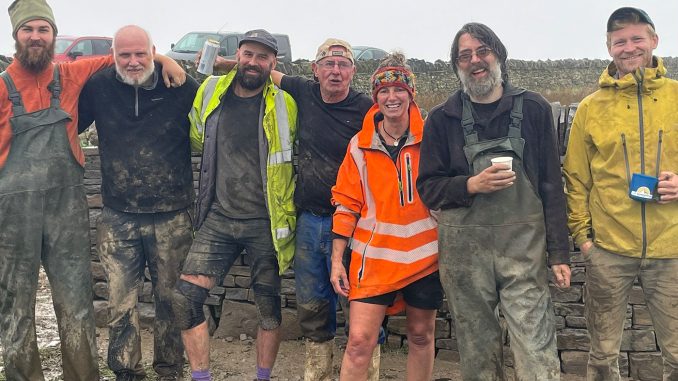
And I have found my tribe. The south Wales branch of the DSWA, fellow wallers, assessors (and even the examiner) have all been ‘bloody brilliant’. Too many to name, but they know who they are. Thank you. And to all those who have enabled me to dedicate the time needed, my understanding clients and people who sent messages of encouragement. There has been some lovely cheer-leading behind the scenes, and Yogi has much-enjoyed her Angela-visits in my absence.
Finally, another thing I have noticed since I have been yakking non-stop about my walling and love of it, is the amount of people from all walks of life who appreciate and admit to adoring a beautiful dry stone wall. And even some of the more dishevelled ones. It’s as though there is something primal or innate in us all that connects with dry stone walling at some level.
So whether you are a builder, or an admirer, of a traditional dry stone wall – may all your walls stand strong and sincere, withstand all weather, provide shelter for those who need it, and leave a lasting legacy to life.
Congratulations on achieving your dry wall certification! In my younger days, before I was reduced to sticks and wheelchairs for progress, I have clambered over many a stone wall. I’m several years ahead of you and on the wrong side of an emergency operation, which took away most of my mobility. Enjoy your freedom of movement while you can, because you never know when that could be taken from you. Best wishes. C
Congrats sweetheart xxxx
Hugest love
Ruth xxxx