
Taken from Lynne’s weekly column ‘Green Scene’ for the Western Mail
1st July 2023

Coronation Gardens

Farewell flamin’ June – you ‘dried’ your best, fair play. Welcome July – let’s see what you have for us. The month is ‘kicking off’ with a new ‘green’ initiative – ‘Coronation Gardens for Food and Nature’.
Described as ‘a celebration of The King’s vision for treasuring nature and living sustainably’, and organised by The Wildlife Trust in partnership with Incredible Edible, Garden Organic and the National Federation of Women’s Institutes, the scheme will encourage people and communities across the UK to use their gardens and green spaces to facilitate wildlife and edible produce’.
The Wildlife Trust explains, “Coronation Gardens for Food and Nature is a three-year programme, which hopes to enthuse millions of people to grow their own food in wildlife-friendly gardens by providing advice and an opportunity to pledge their garden on a map. The initiative will be kick-started by a grant of £247,834 from The National Lottery Heritage Fund.
In pledging to take part in Coronation Gardens for Food and Nature, people would be encouraged to:
- Grow healthy food to eat – this could range from herbs and salads, through to vegetables and fruit trees depending on the space you have
- Plant pollinator-friendly blooms – butterflies, moths, bees and hoverflies all need sources of nectar and pollen to thrive. As they travel from flower to flower, they also pollinate them, enabling plants to set seed or bear fruit
- Create a water feature, which could be as simple as a submerged dish or as involved as digging a pond, lining it and oxygenating it using native plants such as hornwort
- Leave a patch of long grass or pile of logs to create shelter for wildlife and natural predators such as hedgehogs and frogs
- Go chemical and peat-free – avoid using pesticides, weedkillers and peat.”
Of course, all of the above has been encouraged for some time – with most of the points being ‘naturally’ and respectfully adhered to by the generations before us – but I think the ‘plot twist’ is that you can now ‘pledge’ to make a difference. As psychologists tell us, writing down, or sharing a promise or agreement, means it is far more likely to be upheld. 52% more likely, in fact.
It is worth remembering that you don’t have to pledge to grow enough food to keep a family of four fed for 10 months of the year – even growing sprouting seeds on a windowsill is going to contribute. As Van Gogh said, “Great things are done by a series of small things brought together.” Little drops make up the mighty ocean.
Talking about water, I am always a little hesitant about ponds and think they do have the potential to cause more problems than benefits, so I would suggest creating or investing in a good bird bath and making sure that clean, fresh water is always available for wildlife to drink (or bathe in) is a good alternative for ‘creating a water feature’.
And of course it’s not always about what you do, but what you don’t do, that can make the most significant difference. Don’t leave hazards around the garden or countryside that may harm wildlife. Netting can be a nightmare for hedgehogs and irresponsibly discarding litter won’t benefit anything or anyone.
The initiative will evolve as the partnership grows. Initial ideas, inspiration and help for communities and individuals to get started – plus the pledge that people can make by registering their garden on a map – are at www.mycoronationgarden.org.
Gall Prone
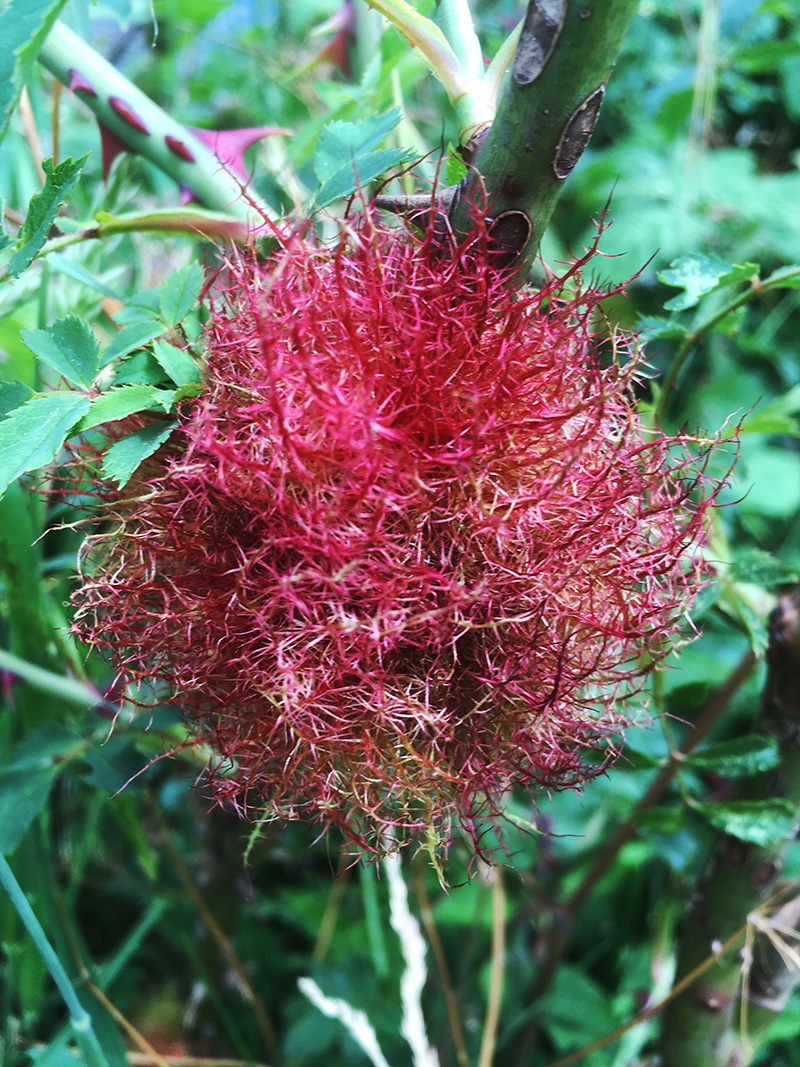 Yogi’s walks got slower and slower in the recent heatwave and morphed into slow daily ‘sniffari’s’, which we both had to adapt to. Whilst not so good for calorie-burning, it is however, a great way to be able to take more notice of what’s around us, especially in the hedgerows. Last week we spotted this ‘gall’ on the stem of a dog rose (see pic). The Bedeguar Gall is more commonly referred to as ‘Robin’s pincushion’ and is caused by the larvae of a tiny gall wasp, Dipoloepis rosae. The galls are quite commonly found on the stems of dog-roses during the summer, getting redder as they mature.
The adult wasp lays eggs in the buds or developing leaves during the early summer and they hatch out into small white larvae that secrete chemicals which cause the abnormal growth. The internal part of the gall contains a number of chambers in which the grubs develop by early autumn. The insects are then sensible enough to overwinter inside the galls as pupae. The galls can occasionally be found on garden roses but they’re harmless and should be left to their own devices.
Flying Flowers
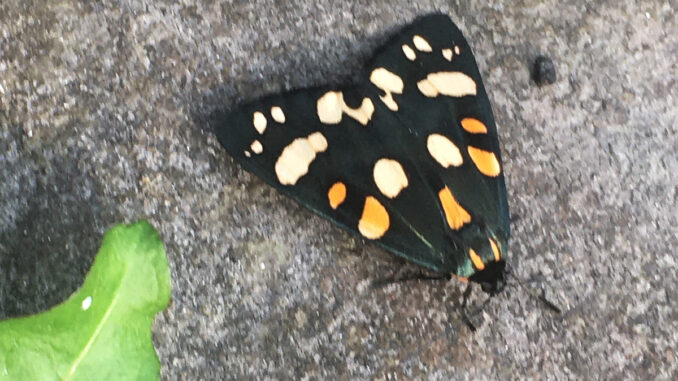
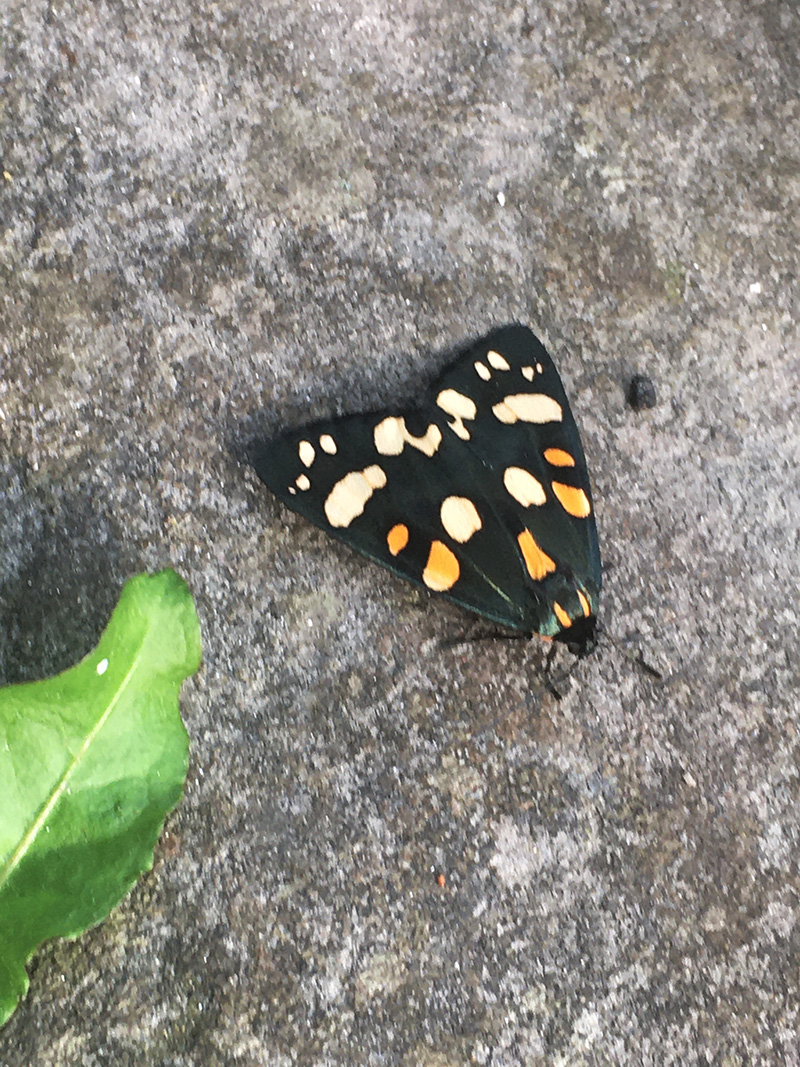 Based on nothing more than observation, I think there are more butterflies and moths around this year. Despite looking more like a butterfly (no offence, moths) I have had a number of the Scarlet Tiger Moths in the garden. With their wings closed, you can’t see the scarlet bit, but when ‘open’ they are really quite eye catching. They often rest in the day, which is possibly why they are easier to spot, and the caterpillars love honeysuckle, meadowsweet, nettles and brambles, which is probably what makes my garden so popular – every cloud and all that.
An ultra-rare beautiful white butterfly with black veins has recently been spotted several times in southeast London. The butterfly is striking and whilst not very imaginative, it’s easy to see how it was named ‘Black-veined White butterfly.
The species was first listed in lepidopterology (the branch of zoology dealing with butterflies and moth) records during the reign of King Charles II, but since 1925 it has been considered extinct in Britain. According to the charity ‘Butterfly Conservation’, Winston Churchill attempted to reintroduce the imperilled (great word, not-so-good meaning) insects in the 1940s by breeding them at his country home, but failed. The recently-spotted returner will have more likely been released by an enthusiast rather than spontaneously travelled to the UK, and as such is sadly unlikely to survive in the wild to breed.
And I never see or think about butterflies without recalling King (then Prince) Charles telling me that he sees them as ‘flying flowers’.
Ear! Ear! To your Van Gogh quote!
Very thought provoking, the part about growing your own vegetables, even if only on a windowsill.
I have never noticed a gall on a dog rose before, so now I will be searching to find one!
Have a great Sunday.