
Taken from Lynne’s weekly column ‘Green Scene’ for the Western Mail
26th October 2024

Berry Beautiful
I seem to be appreciating the autumn berries more than I did the spring and summer flowers this year – I have no idea why. Maybe it’s something to do with getting older and preferring the cool, calmness and resignation of autumn as opposed to the fizz, heat and expectancy of summer – although there was more expectation than heat this year.
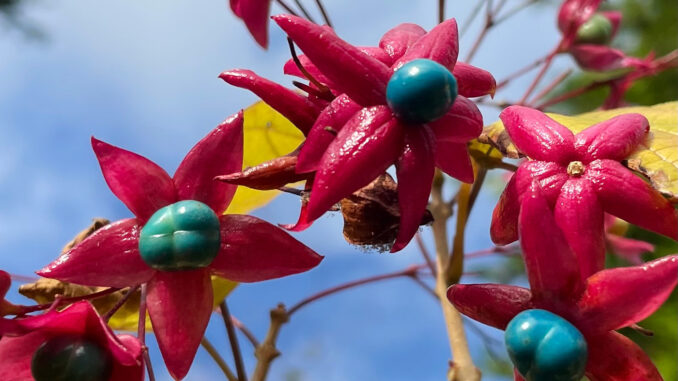
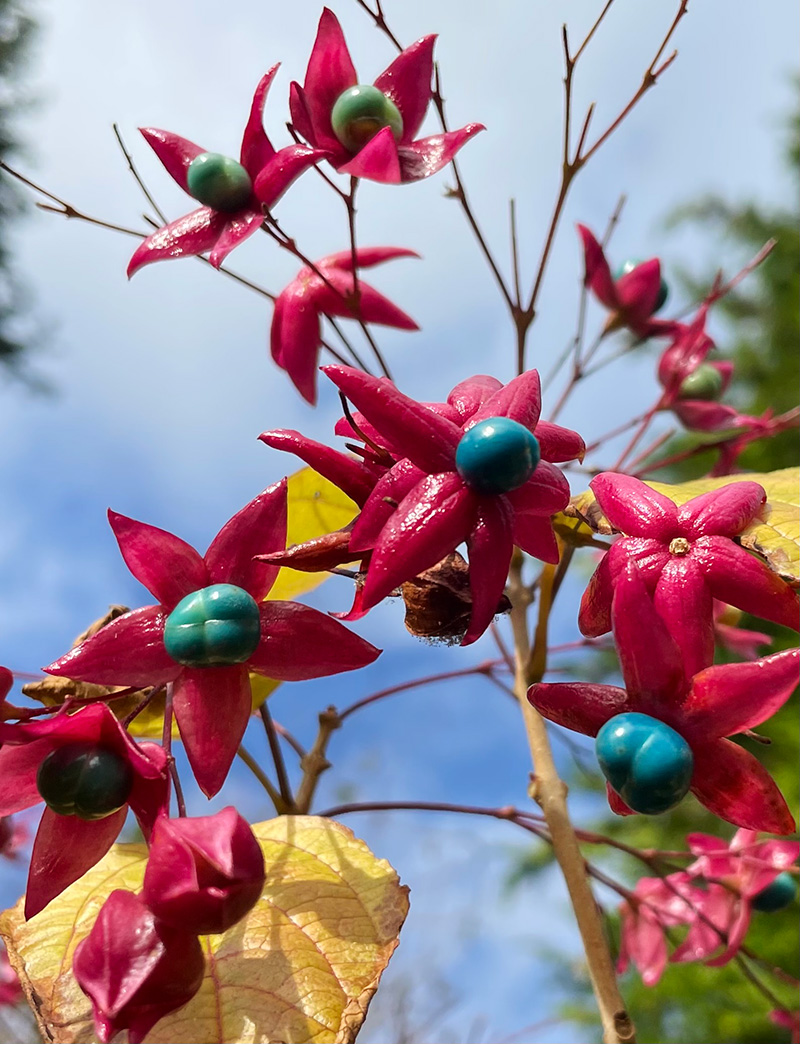
I mentioned the berries of the Chinese dogwood a couple of weeks ago and how hard that little tree works throughout the seasons. This week I have been smitten with the berries of the Clerodendrum trichotomum ‘Harlequin Glorybower’ which is definitely not receiving the attention that it deserves nestled in a quiet border of a client’s garden.
The berries are like costume jewellery. As always, I am in complete and utter awe of nature and just what she creates, but these berries are up there with the magic of hidden red flamenco-style petals of the oriental poppies hidden in their furry, green poppy buds. Just staggering.
There are several varieties of the Clereodendron trichotmum, all with magnificent attributes. The Harlequin Gloryblower, also known as the Glory Tree, is a large deciduous shrub or small tree, reaching 10-15ft, with tremendous ornamental interest and an asset to most gardens. From midsummer to autumn large, loose clusters of fragrant flowers with balloon-like pink centres attract bees and butterflies – and apparently even hummingbirds in the right area. The delicious-smelling blossoms are then followed by stunning small, metallic bright blue fruits set in contrasting, star-shaped ‘husks’. It is these berries that remind me of costume jewellery. And if the scented flowers and jewellery-like berries aren’t enough, it has another incredible trick up it’s sleeve – if you crush the dark green leaves they smell like peanut butter. And that’s what gives it it’s other common name of the ‘Peanut Butter Tree’. It likes – and deserves – plenty of space and is easy to grow.
Mosquito Repellent
Another berry-laden shrub catching my eye recently is the Callicarpa, earning its common name of ‘Beauty Berry’. The Callicarpsa come into its own in autumn, bearing dense clusters of small, jewel-like, purple-blue berries, which are shown off against bare stems. Its dark green foliage also puts on a good show in autumn, turning golden and red before falling. There are several varieties but most Callicarpas are medium-sized shrubs and look good in a mixed border, or planted as a specimen near a path or window. The bare stems of purple berries make an excellent addition to autumn flower arrangements.
Callicarpas can be evergreen or deciduous shrubs, with tiny white pink or purple flowers in clusters, followed by small, usually colourful fruits. Several shrubs grown together ensures pollination for successful fruiting or berries.
Callicarpa Bodinieri ‘Profusion’ is a bushy, deciduous shrub which has long, green leaves which in the autumn months turn a wonderful rosy red and pink colour creating fantastic interest themselves. In July the Callicarpa Bodinieri Profusion will lovely small lilac coloured flowers, however it saves it’s grand finale for the autumn with the strong, purple berries which are produced in large clusters covering the plant in colour, even when the leaves have fallen.

Callicarpa Americana is also a bushy, deciduous shrub with freely-fruiting clusters of purplish-mauve to magenta berries borne along the stems during autumn and often into winter. But the clever ‘trick’ of this particular Callicarpa is that the crushed leaves act as a great deterrent against mosquitoes.
Greenhouse Effect
I think most people, other than dedicated gardeners, shut their greenhouses up for the winter but you could make wonderful use of the space to grow some vegetables in there during the quieter winter months. Things like endives and chicory, salad leaves, herbs, specialty salads (such as winter postelein) and spinach will usually do well under glass. Even when unheated, the main advantage is that the greenhouse protects the plants from damaging winter wind and moisture (or saturation if you’re in Wales).

Fryd, the gardening app, advises that suitable greens for your winter greenhouse include arugula, winter purslane, lamb’s lettuce, endive, Asian greens, chicory, radicchio, and some garden lettuces.
You can also plant or sow kohlrabi, broccoli, tatsoi, carrots, radish, celeriac, bulb fennel, turnips, beetroot, spinach, peas, Swiss chard, and herbs like coriander, parsley, dill, and chives. More ideas and inspiration from www.fryd.app
Go Ruck
 Readers may recall that a couple of years ago I retrained in fitness at Usk College, qualifying in teaching Pilates, Personal Training, Sports Massage (and since, Tai Chi) – mainly for my own training and benefits, if I’m honest. These days it’s not so much that gardening keeps me fit but that I have to keep fit to be able to keep gardening.
I am always interested in new ways to keep fit and active as it helps me stay interested and engaged and recently read about Rucking. Rucking is basically walking, but with added weight on your back, and as the name suggests, in a rucksack. Although it is based on how the Special Forces train, it has been ‘upcycled’ nicely to reach a wider audience. I was a little bit ‘sniffy’ about it initially as I have been carrying Yogi, who now has arthritis, in an especially converted child carrier for our longer hikes. That makes me a Rucker. In fact, in theory, anyone who has ever carried anything in a rucksack on a walk or hike, or even to work or school, has ‘rucked.’ But further reading into the subject revealed that there is in fact more to it – and far more benefits to be gained – than first meets the eye.
The great thing is that you don’t actually need specialist gear to start – simply put a rucksack on, with a suitable weight inside and walk. ‘Ruckers’ without a suitable, or willing, dog, can use any suitable weights to begin with, or you can buy bespoke weights to put into a bespoke rucksack. Far from being a gimmick, this does enable a superior and far more comfortable work out.
The fact that rucking is an outdoor activity obviously adds to the health benefits and overall it is a low impact form of cardio exercise that will also build strength and stamina. Done ‘diligently’ it is possible to burn up to 3 times more calories than walking without weight. A lesser obvious benefit is the fact that it improves posture by encouraging our shoulders back and out of the habitual forward posture encouraged by phones and laptops.
The website www.goruck.com states encouragingly, ‘You only need 3 things to get started: a back pack, weight and to get walking’, but they also have lots of extra information and products that will help your fitness journey be far more effective and enjoyable.
Have a look at the fabulously-named ‘Ruck Shuffle’ – a specific gait to get the best out of your exercise – I love it. It’s all so simple and yet elevated enough to be interesting and to keep me engaged – and that’s the secret to keeping up any fitness regime.
Leave a Reply