
Taken from Lynne’s weekly column ‘Green Scene’ for the Western Mail
8th November 2025

Yappy Birthday

Well, it’s Yogi’s 16th birthday on Monday. It’s such a privilege to have a dog in the ‘Old Dog Arena’, even with all the challenges it brings. I have bought her ‘new pyjamas’ and was chuffed to find a dog-fleece with a D ring sewn in, so we can go for a little sniffari without her having to change. I suppose it’s the canine equivalent of going to a supermarket in your pyjamas.
I have been putting her harness over her old fleece but it’s a bit tight – a prerogative of getting older. The new fleece/pyjamas will work well for Yogi but they are only suitable for dogs up to about 12 kg as the D ring wouldn’t be safe enough to hold a big dog back. Yogi’s wearing a size XL, believe it or not.
And I know she has had her present early, but at her age you can pretty much do what you want. Although to be honest, the terrier in her has meant that she has done that for all of her 16 years.
Hot Off The Press
 Sticking with presents, this week’s suggested Christmas present is a bit niche but brilliant. My brother had to get some new glass for his wood-burner last week and whilst he was waiting at the stove shop, he checked out some wood-burner ‘accessories’. He was quite excited to see a Potato Baker. Apparently you just rub a bit of oil on your spud, pop it (or two or three or four) in the cast iron Potato Baker and put it on top of the lit wood-burner. It will cook a jacket potato in about 2 hours and is best turned over halfway through. Being a typical fella, my bother bought himself one – so I can’t even buy him one for Christmas – and he said it works really well. Being cast iron, I’m convinced it will work in a bonfire too – but we have yet to test that.
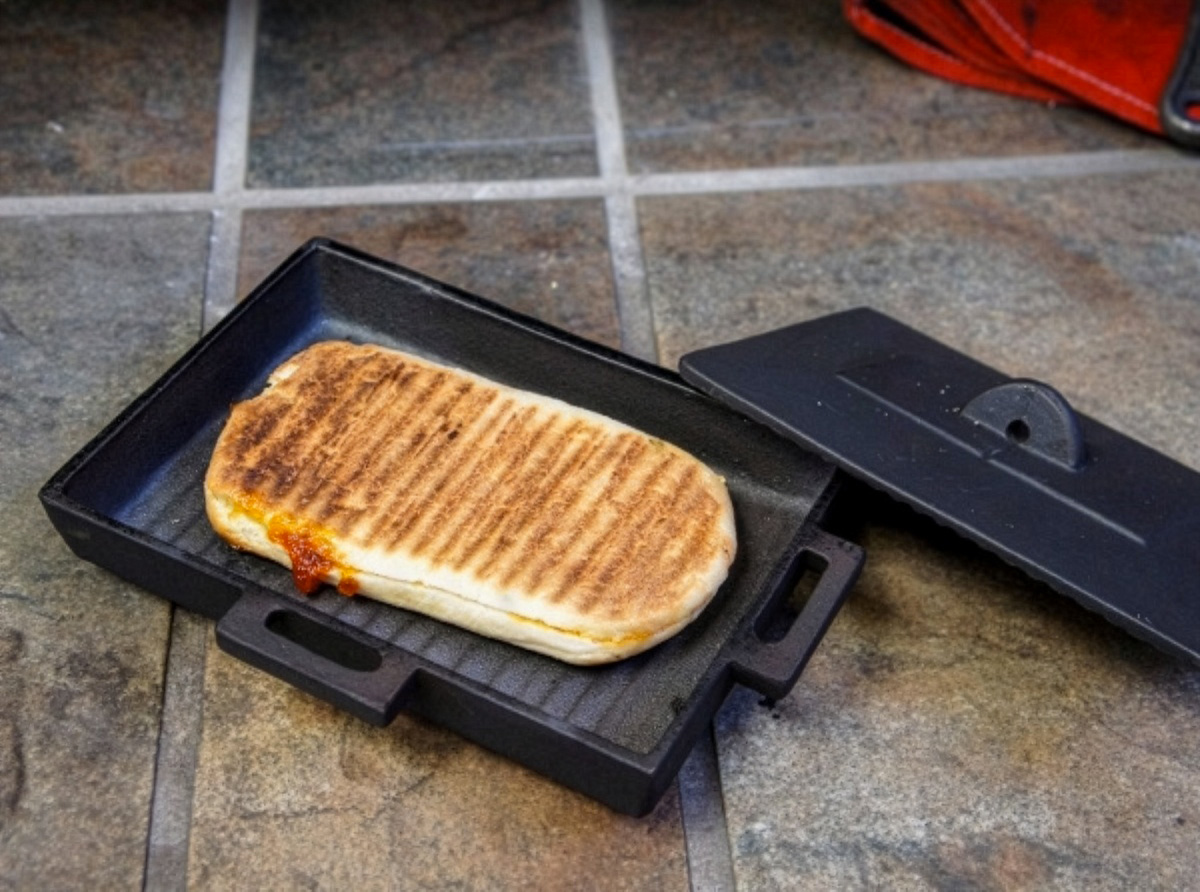
A bit of research has revealed that you can also get a cast iron Panini Press, which can be used to cook a variety of other things, from veggies to fish as well. Interestingly, the Panini Press is put into the wood-burner (and comes with a special tool to remove it) and apparently it can be used for open fires and bonfires too.
More details from www.naturalheating.co.uk
Fungus (is) the Bogeyman
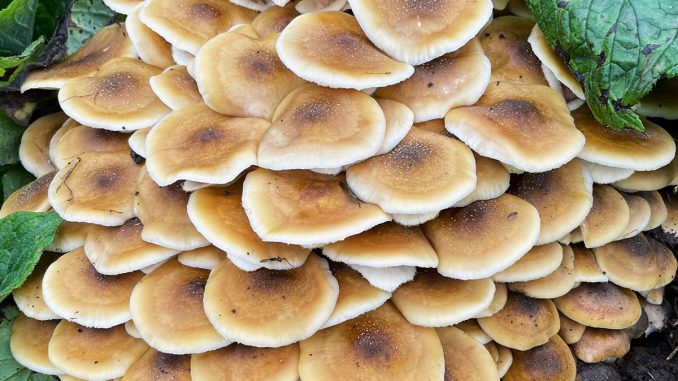
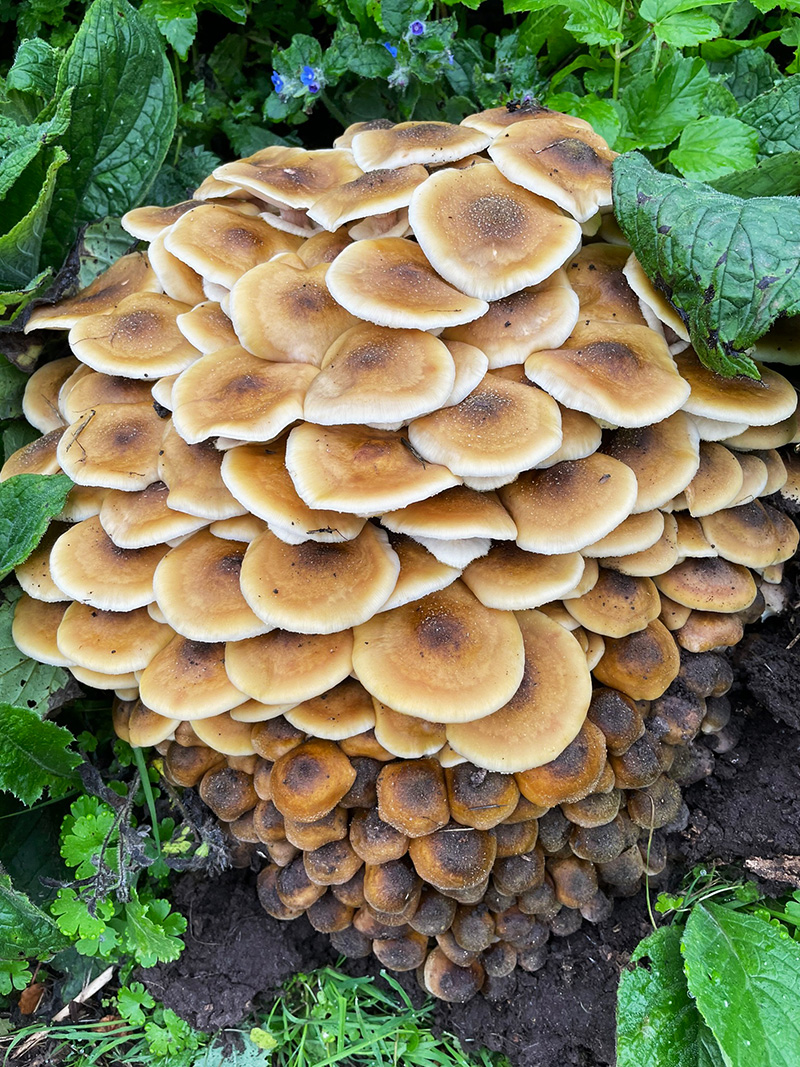 I’ve been shocked by the amount of honey fungus I’ve seen this year. I remember Dad showing me what it was about 40 years ago and it was reasonably uncommon then.
We always identified it by the black bootlace-looking rhizomorphs in the soil around, or under the bark of, an affected tree. They look very much like black roots and are the ‘super highway’ within the mycelium network. They are tough to break too, making them a dab-hand at invading tree roots and getting under bark to wreak havoc. Honey fungus is not actually a single species of fungi but a group of closely related ones, which means the fruiting bodies, or the clusters of mushrooms that give away its presence, can vary hugely in appearance.
As their name suggests, the mushroomy bits are a honey-brown colour and are actually quite often really eye-catching. But as ‘good looking’ as they may be, you certainly don’t want them in your garden. Whilst honey fungus is generally the UK’s most reported disease, a spokesperson for the RHS said that they had received photos of the honey fungus mushrooms, for them to identify, much earlier than usual this year. To date, reported sightings are up by 200% on this time last year.
It’s a bit of a double whammy really because the fungi is far more dangerous to stressed plants and trees – like those suffering from drought. And it’s those drought conditions – followed by a damp, humid autumn – which have made honey fungus so prevalent. I often wonder what nature is up to when I see things like this. It’s like a sort of self-sabotage. The role of the honey fungus mushrooms is to release spores and spread them to new areas, so, as well using the bootlace-like rhizomorphs to spread their ‘doom’, they can also multiply by spores – which wasn’t really given any importance until recently.
Honey fungus can totally devastate trees and shrubs, and different species (which can’t be distinguished by the mushrooms they produce as they are so varied), pose different degrees of danger to plants. It is safe, however, to assume that an aggressive species is present if honey fungus has killed off otherwise healthy plants, and action needs to be taken to prevent spread of that fungus. There is no chemical treatment for the disease, and when dad was alive, we used to dig out trenches around healthy plants and bury a barrier like heavy duty plastic sheets or butyl rubber to prevent the spread of the ‘bootlaces’. It will be interesting to see the effects of such an increase in honey fungus this year – healthy plants and trees should be able to fend off the disease and I am (ever) hopeful that nature will right itself. Honey fungus is definitely one ‘fun-guy’ you don’t want around.
Window on the Weather
 Early last week Derek the Weatherman told us that ‘this October in Wales had been the second dullest October on record’. Good job a month can’t take offence – you wouldn’t get away with calling a person ‘the dullest’ any more. And of course my brother had a quick quip – ‘None of my October’s have ever been very interesting.’ Of course Derek meant that we had fewer hours of sunshine than usual last month, seeing only around 52% of the usual October sunshine.
Martinmas Day is a popular marker for a lot of weather folklore this month. Celebrated on the 11th November each year, (the same day as Remembrance Day or Armistice Day, commemorating the end of World War I), Martinmas is the feast day of St. Martin of Tours. This day historically marked the end of the harvest and the beginning of winter – and as such was also referred to as Old Halloween. Not surprisingly, it involved traditional big feasts and lantern parades.
Weather wise, predictions include, ‘If ice before Martinmas is enough to bear a duck, then the rest of winter is sure to be nothing but muck.’
And, ‘If the leaves of the trees and grape vines do not fall before Martinmas, a cold winter may be expected.’
I must admit that the weather app is probably the most used app on my phone and, as one of my clever clients pointed out, ‘the pre-cursor to the weather app was a window.’
Leave a Reply