

Taken from Lynne’s weekly column ‘Green Scene’ for the Western Mail
25th July 2026

 The Vole Truth
So many readers have been in touch since I wrote about the problem I am having with voles. It seems I’m not the only one by a long way. Frustratingly, there doesn’t seem to be much that will deter them and as they breed so prolifically, ‘dented numbers’ are almost impossible to obtain and sustain. Voles can have as many as five litters of young each year, and they can breed in any season, although litters are most common in the spring and summer. And whilst the average size of each litter is between four and six young, they can have as many as eleven. Baby voles are weaned at about 3 weeks old, and females can begin reproducing when they are between 35 and 40 days old. That’s the way to keep a population sustained, for sure.
Both the field vole and the bank vole will make shallow runs just below the surface of the ground, and it’s often the perfectly round little holes in the lawn or soil that will confirm that they have moved in. They also use old mole runs and they can also be seen to make little runs on top of the ground through long grass. As they are active day and night, it doesn’t take them long to decimate plants – young juicy top growth and the roots.
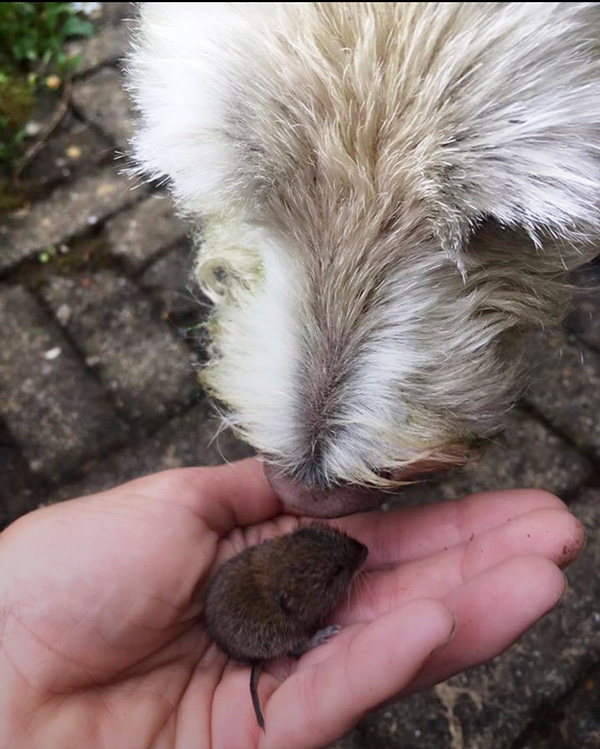
The big worry at the cottage is that they seem to becoming tame – as the photo with Yogi shows. But then again, why wouldn’t they? After all, I provide excellent ‘food and accommodation’ for them all.
How Was Your Day?
 The plus side of ‘hosting’ so many voles and their extended families, is that I also have several owls around the cottage each night, as they organically attempt to reduce the vole population. I have two tawny owls that sit in a tree just outside my bedroom window ‘chatting’ to each other until the early hours of the morning. The beautiful twit twoo’s are the conversation between a male and a female. The female makes the “twit” (a sharp, high-pitched kee-wick) to let other owls know where she is. The male replies with the “twoo” (a wavering hoo-hoo) to respond to her and to claim his territory. As I eavesdrop I am always endeared to realise that there is far more ‘kee-wicks’, or ‘twitting’ than there is ‘twooing’, suggesting the females have far more to say about their day than the males do.
And I can’t resist sharing something a builder told me a few years ago, whilst working on site, and which still makes me laugh.
One of my hens had just hatched several chicks and he asked (with a very straight face) if I knew how to tell if they were male or female. I didn’t.
He continued, ‘You pick one up and you ask, “How was your day?” If it replies, “OK thanks,” then it’s a male chick.
If it screams, “My day? My day? I’ll tell you exactly how my day was …… “ – then it’s a female.
And that, Ladies and Gentlemen, is good old fashioned building site banter.
Magical Berries
 Every year I am super-impressed by the hypericum berries in a client’s garden. This particular variety flower with the usual yellow flowers of the more common hypericums but then they put on the show to end all shows with a huge profusion of the most spectacular berries. I’m pretty sure they are a bit earlier than usual this year.
They are fabulous for flower arranging and were much appreciated at a friend’s wedding a few years ago. I have planted them in several other gardens since, including my own but they are slow to develop. Well worth the wait, though. The varieties to choose from are the Hypericum Magical Collection – which includes Hypericum Magical Universe, Hypericum Magical Lightning, Hypericum Magical White and H. Magical Impression. All of which have the most beautiful berries.
Wet Bulb = Wet Floor
I have recently solved a bit of a puzzle, which happened during the really humid week that we had recently. You may well have worked it out already, but in case you haven’t …
I have Terrazzo tiles on my bathroom floor and on walking into the bathroom one very humid day – in bare feet – slipped and nearly ended up head first in the bath. The floor was inexplicably wet. After consoling Yogi and telling her ‘not to worry, accidents happen’, I mopped the floor and that was that. Until the next day when the floor was wet again – and Yogi had not been near the bathroom. In ‘catastrophising mode’, I assumed I had a leak. Being unable to find it, I went on to worry about something else.
About the same time I heard about the Wet Bulb Theory and, after incorrectly assuming it was something to do with damp garden bulbs, learned that it is used to measure humidity levels. Whilst talking about my ‘new-found fact’, my brother recounted a similar ‘wet floor’ story that he’d had (and also put it down to his black lab, Fidget), that we both realised the wet floors were a result of the high or ‘unprecedented’ humidity levels. I have since spoken to numerous people about it, all of who had similar experience with tiled floors. And most put it down to a ‘hot dog’. There are definitely some apologies to be made and some making up to do.
I’ll do my best to explain it, but you may want to check it out for yourself. It’s fascinating. The Wet-bulb temperature is the lowest temperature to which air can be cooled by the evaporation of water. It is measured using a thermometer wrapped in a water-soaked cloth. As water evaporates, it cools the thermometer. Because the human body cools itself in the same way – through sweating – it is a key method for measuring heat stress and human survivability.
The rate of evaporation depends on the air’s humidity. In dry air water evaporates quickly, causing a large temperature drop. In humid air water evaporates slowly, and the wet-bulb temperature will be close to the actual air temperature.
The human body cools itself by evaporating sweat. When the wet-bulb temperature rises, this cooling process becomes less effective. The human survival limit is a wet-bulb temperature of 35^{\circ}C (95^{\circ}F) – not that you’ll have anything to measure it with – but beyond this threshold, even a healthy person resting in the shade cannot cool down. This can lead to potentially fatal heatstroke.
Interestingly, I had already noticed that some days I sweat far more than others – attractive, I know! But working outside, it is noticeable. And it turns out that it is dependant on the humidity levels. I love learning. The trouble now is that whilst I try to learn something new every day, I seem to forget three or four other things.
But I do remember this old adage, ‘Don’t sweat the petty things and don’t pet the sweaty things.’
Leave a Reply