
Taken from Lynne’s weekly column ‘Green Scene’ for the Western Mail
7th September 2024

The Sun ‘Rose’
Forever ‘checking the weather’, I have had a quick look at the BBC forecast for September, which reads, ‘The overall trend towards above-average temperatures with some sharper ups and downs continues, although changeable conditions are likely to return soon. However, calmer and drier conditions could set in later.’
That just about covers all bases then.
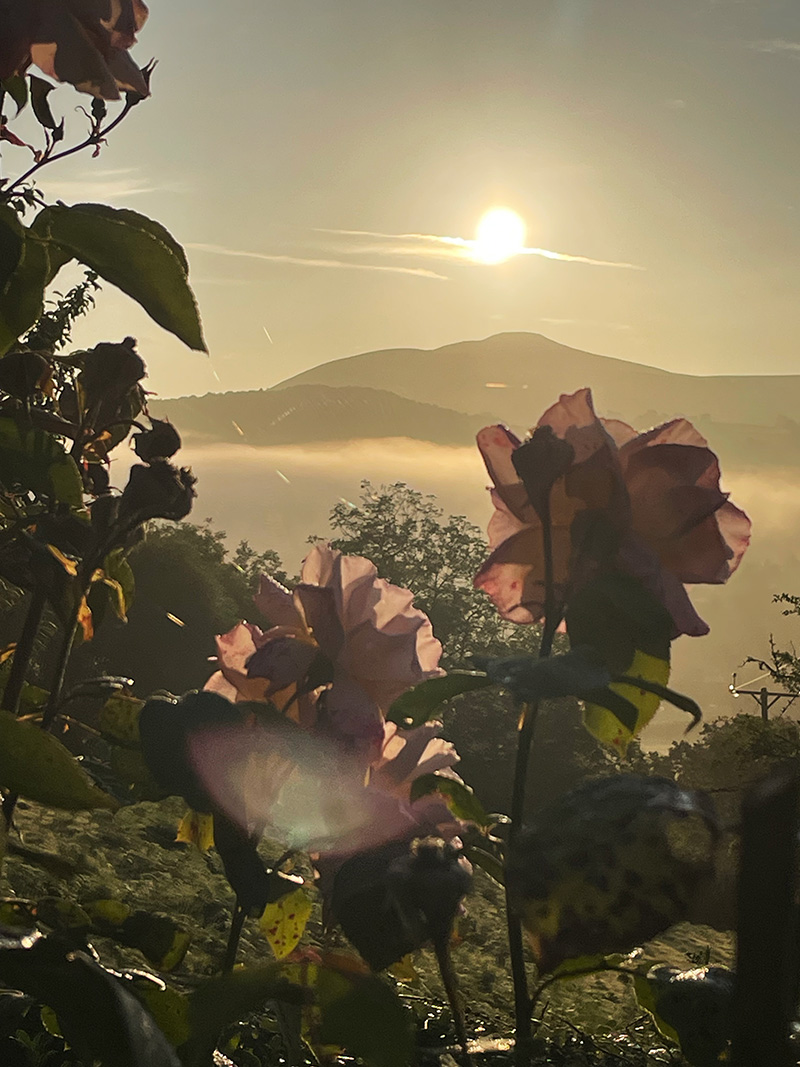
Traditionally, September is a nice month, and there have already been some lovely autumnal sunrises (see photo), but keep an eye on a few dates in particular, as they are said to predict future weather. These include:
As the weather is on September 6th, so it will be for the next four weeks.
As the weather is on the day of Mary’s birth (September 8), so it will be for four weeks.
If the weather is fine on St. Gorgonius’ Day (September 9), it will continue fine for forty days. If it rains, there will be a lot of bad October weather.
No rain on the Holy Cross (September 14), no rain for six weeks.
If on September 19 there is a storm from the south, a mild winter may be expected.
If there is clear weather on St. Maurice’s Day (September 22), heavy winds will rage in the following winter.
On Michaelmas Day (September 29), the heat leaves us. If St. Michael brings many acorns, Christmas will cover the fields with snow.
And there are of course a few more generalised folklore forecasts:
When September has been rainy, the following May is generally dry. When May is dry, September is apt to be wet.
Thunder in September indicates a good crop of grains and fruits the next year.
The first snowfall comes six weeks after the last thunderstorm in September.
As September, so the coming March.
Whatever July and August do not boil, September cannot fry. Although this last quote sounds more like advice for a cook than a gardener.
Lettuce Sow
 Whatever the weather, there is always lots to do in the garden, and this week I’m going to sow some winter lettuce. I’m going to sow them in large pots and tubs that I can move in and out of the ‘sort-of-greenhouse’ if I have to. I say ‘sort-of’ as it’s not officially a greenhouse but will provide protection from frosts and even Biblical rains.
I want to keep and grow the winter crops outside as much as possible to see if they will actually cope outdoors throughout the winter, but without condemning them to death in the more brutal conditions.
Some winter head lettuces can be sown outdoors now, depending on the variety. Popular frost-hardy varieties include Baquieu and Wintermarie. Lamb’s lettuce is probably one of the best-known winter salads. If sown now, you can harvest it right through until January or February. Sugar loaf lettuce (nothing to do with our beautiful mountain) can also be sown now and harvested from late November. Other winter lettuces include the ‘All The Year Rounders’ like mizuna and mibuna.
All the seed companies will have a winter salad section and there are some hardy salad leaves mixes – like Wicked Winter.
Coriander, chervil, parsley, dill, and mustards can also be sown now but will stand much more chance in a greenhouse or cold frame than outside. Although if you have a nice sheltered spot in the garden (and no greenhouse or cold frame) then give them a go ‘al fresco’.
Of course, if you have a conservatory or even a light-filled porch then you could utilise them for a few winter salad crops and/or herbs too. I’m a great believer in trial and error – or should that be ‘trowel and error’.
Beautiful Bark
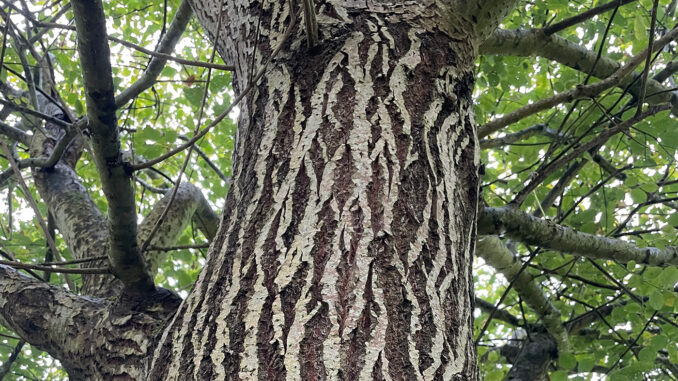
 I have noticed some beautifully marked tree bark in a few of the gardens I look after – and they are all willow trees. Two of the artistically marked trees are ‘crack willow’ and one is a white willow. The two varieties are very similar with the main differences being the white willow has fine silky white hairs on the underside of it’s leaves, which are also not as long as the leaves of the crack willow. The crack willow gets it’s name from named after its habit of splitting with cracks and fissures, and how noisy its branches are when they break. I have heard the crack willow described as ‘scruffy and loud’, and whilst one of the most famous willow quotes is ‘We should be more like the willow – bending in the breeze and not breaking’, I think most of my friends are more like the crack willow – ‘scruffy and loud!’ One client also refers to the crack willow as the ‘dirty tree’ because after pollination by bees, the female catkins transform into woolly white seeds, which are dispersed by wind. Together with the ‘cracked twigs’ it drops, they do make quite a mess on the adjacent patio.
Crack willow – whose common name is Salix fragilis – often hybridises with white willow (Salix alba) too, making identification even trickier.
The bark of white willow (and also of the black willow, Salix Nigra) contains salicin, which is a chemical similar to aspirin (acetylsalicylic acid). In combination with the trees powerful anti-inflammatory plant compounds, or flavonoids, salicin is thought to be responsible for the pain-relieving and anti-inflammatory effects of the bark.
Willow bark can be bought in capsule form or in a distilled tincture form. Taking a drop or two of the tincture per day for pain relief can work as a natural substitute for aspirin.
Some health food stores also sell willow bark tea, advertising it as a pain reliever and anti-inflammatory. Simply steep willow bark tea for two to three minutes in hot water, as you would any other tea.
Heaven Scent
Britain’s rarest orchid has been spotted for the first time in 15 years. Creatively named the ‘ghost orchid’, it lacks chlorophyll and strangely doesn’t need sunlight to grow. It is considered the ‘holy grail’ by botanists, and was declared extinct in 2009. This made it all the more exciting when dental surgeon and part-time botanist Richard Bate came across one of the ivory-white flowers growing in the middle of woodland.
Apparently the ghost orchid has a lovely fruity fragrance resembling that of an apple, with the most intense scent being early in the morning. Unsurprisingly, the exact location of the extraordinary orchid is being kept top secret – so let’s hope it doesn’t get ‘sniffed out’.
Leave a Reply