
Taken from Lynne’s weekly column ‘Green Scene’ for the Western Mail
14th September 2024

OUCH!
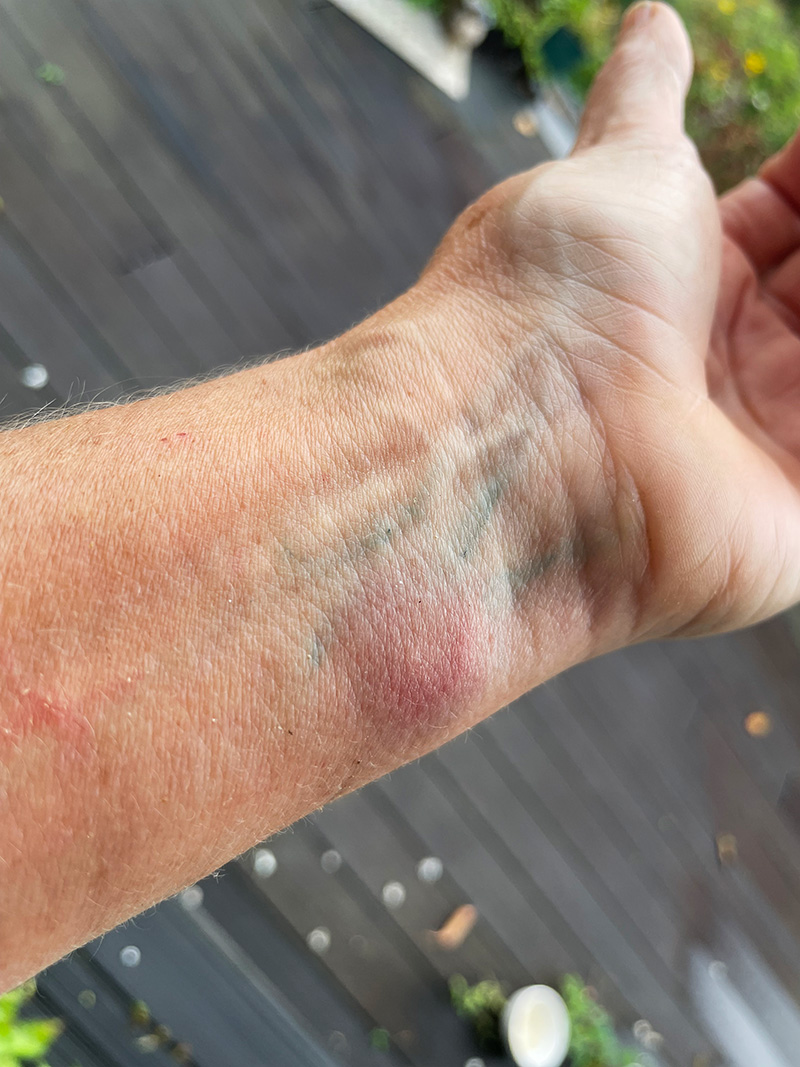
Whilst cutting back a very large eleaegnus last week to find a hidden set of steps, I punctured my wrist on one of the thorns and was instantly and painfully reminded of the hazards of gardening. My wrist instantly swelled up like a balloon, became stiff and hurt. A lot. Six days later, it is still very brightly bruised but much better. Eleaegnus thorns are not considered to be toxic and many people won’t even realise that eleagnus even has thorns – it’s one of those sneaky shrubs – like the Robinia tree. I knew, and was careful – respectful even – but was still caught out.
Thorns can cause serious infections and tissue reactions, especially if they penetrate a joint or tendon sheath, which the larger thorns like eleaegnus and blackthorn can do. The thorns are long, strong, very sharp and have a habit of breaking off under the skin and then going septic. Any such puncture wound allows bacteria to invade and produce a potentially serious infection. This produces obvious pain and swelling because of the inflammatory reaction within the synovial cavity.
Blackthorns are often the worst offenders – and lots of first-time foragers don’t realise the risks they are taking when picking sloes at this time of year. Blackthorn (Prunus spinosa) is not considered to be poisonous either but Monty Don describes it as being twice as dangerous as Yew or Laburnum, with regard to hazardous plants.
It is considered to be bad luck to even bring the blackthorn blossom indoors, because the Crown of Thorns was said to be made from blackthorn. Apparently Black Rod, who is responsible for the door-knocking in Parliament, is so called because he carries a knocking rod made from blackthorn.
Like other thorny plants, the blackthorn can cause something called ‘plant thorn arthritis’ if a thorn penetrates the skin at a joint – like a/my wrist! Plant thorn arthritis is the inflammation of a joint caused by a thorn leaving residual matter under the skin, causing swelling, stiffness, pain and sometimes a loss of range of motion. Whilst having experienced and witnessed numerous ‘plant stabbings’, I haven’t heard it being referred to his before but apparently it is a thing. And I have been a victim.
It’s possible for the symptoms to only become apparent days after the initial puncture, even after the immediate removal of the thorn that caused it – as small fragments left behind by the thorn can cause inflammation to develop days or weeks after. If this is the case, you will need to see a nurse or doctor.
During my own treatment, I was told that blackthorn injury can give rise to a wide variety of manifestations ranging from mechanical dermatitis, cellulitis, abscess, foreign body granuloma, peritendinitis, tendinitis, pericapsulitis, synovitis to acute septic arthritis. Synovial tissue is very prone to react to organic substances like the bacteria that is on the tips of thorns like elaeagnus and blackthorn – the tips that are likely to get broken off and stay in the skin or joint.
Now that the hedges are being cut in lanes and along many popular dog walking routes, please be careful when walking your dog too – they can easily pick up thorns, including blackthorns, on their walks and the same symptoms and treatment applies.
Pariah Plants
There are also numerous other ‘hidden horrors’ in the garden, or ‘potentially harmful plants’ as they are more technically known as, whilst we are on the subject. It is worth making yourself familiar with them, with the help of Google or a good book.
Ruta, or common Rue, is a pretty, bushy evergreen shrub with aromatic, broad, blue-grey leaves, reaching a height of 3 ft and is very useful plant. It has numerous medicinal qualities hence being known as Countryman’s Treacle. But it is also extremely toxic to skin in sunlight – and that includes the skin of pets. Monty Don totally eradicated it from his garden after falling foul of it’s traits. Euphorbia and Hogweed (the common type, as well as Giant Hogweed which should be reported) have the same sinister capabilities.
Hemlock, Yew, and Laburnum can actually cause death if ingested (for humans and animals) as can – as the name suggests – Deadly Nightshade. All of these plants, and a few more, have the potential to spoil a day’s gardening – or far worse. You can find out more at www.rhs.org.uk/prevention-protection/potentially-harmful-garden-plants
There’s no reason to completely shun these plants, just be aware of their properties and treat them accordingly. Some plants, like people, are just more anti-social than others.
Flower Power
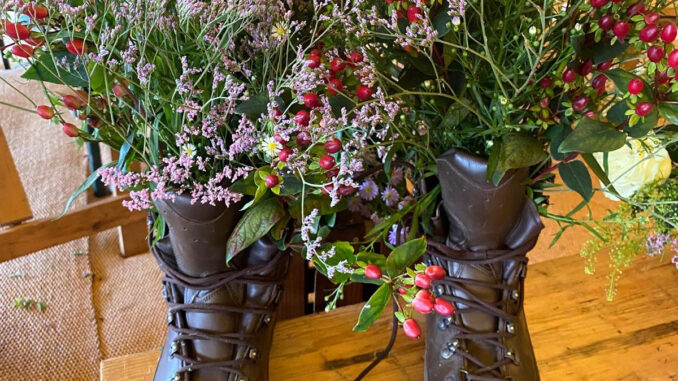
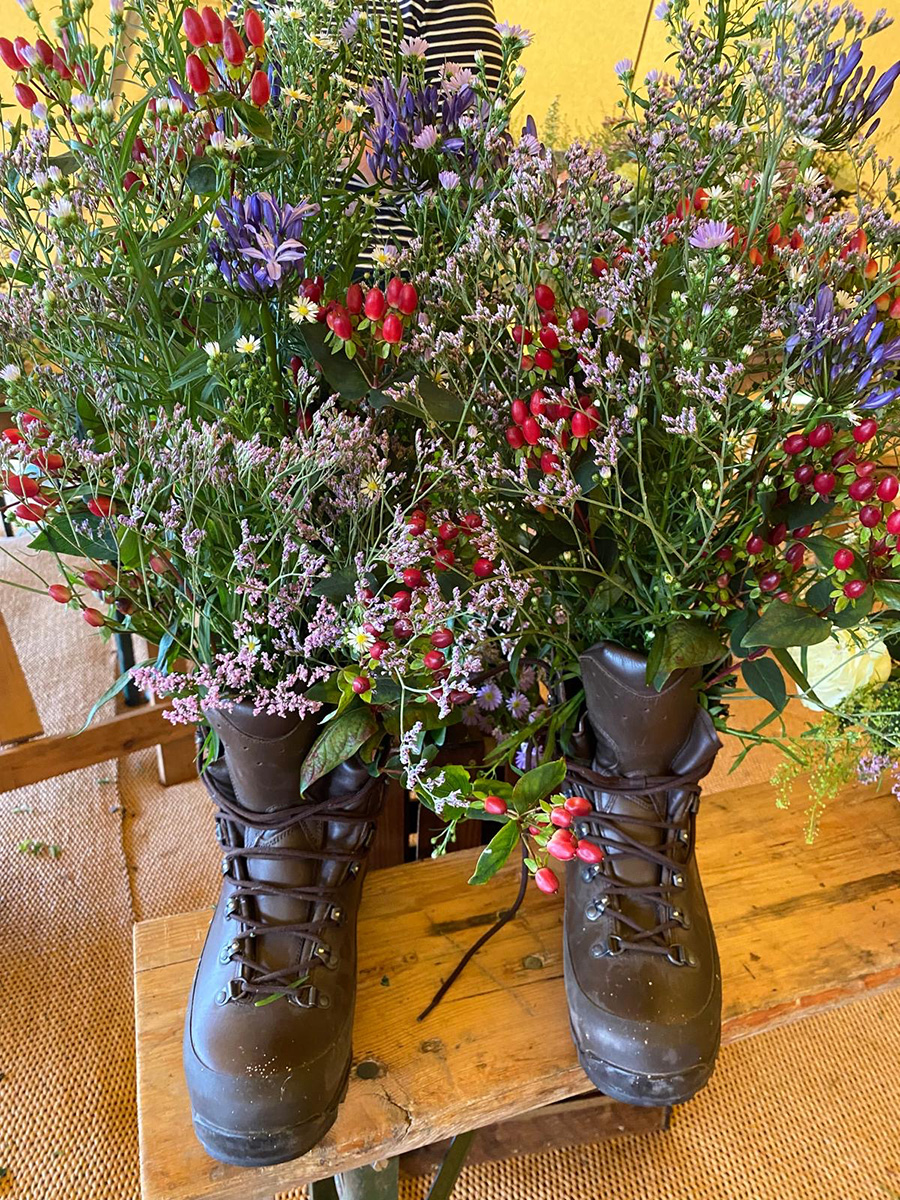 On a much more cheerful note, I recently helped out with the flower arrangements for a friend’s wedding and had a great time being creative – and staying clean and dry for a few days, which is always a novelty. It was a military wedding so as well as using numerous bits of relevant – and quirky – paraphanalia to display flowers in, I also used a pair of boots (see photo) for a conversation-starting floral display too.
Almost anything can be used as a container for floral arrangements, as long as you can incorporate floral oasis (put in a plastic bag or cling film to protect the ‘container’) or a small jar or vase to be able to keep the flowers well hydrated. Of course you don’t even need that for dried flowers.
We also used lots of flowers and foliage from the bride’s parents’ garden (and the gardens of a few friends, and family, including my own), which made it all even more meaningful and personal. Flowers – and plants – have such amazing powers. As the American botanist Luther Burbank noted, ‘Flowers always make people better, happier, and more helpful; they are sunshine, food and medicine for the soul.’
It’s so true, and seeing all the beautiful wedding flowers and the wonderful effect they had reminded me to keep a little vase of flowers next to my computer, just for that little uplift I need whilst tapping on the keyboard.
Crackle of Autumn
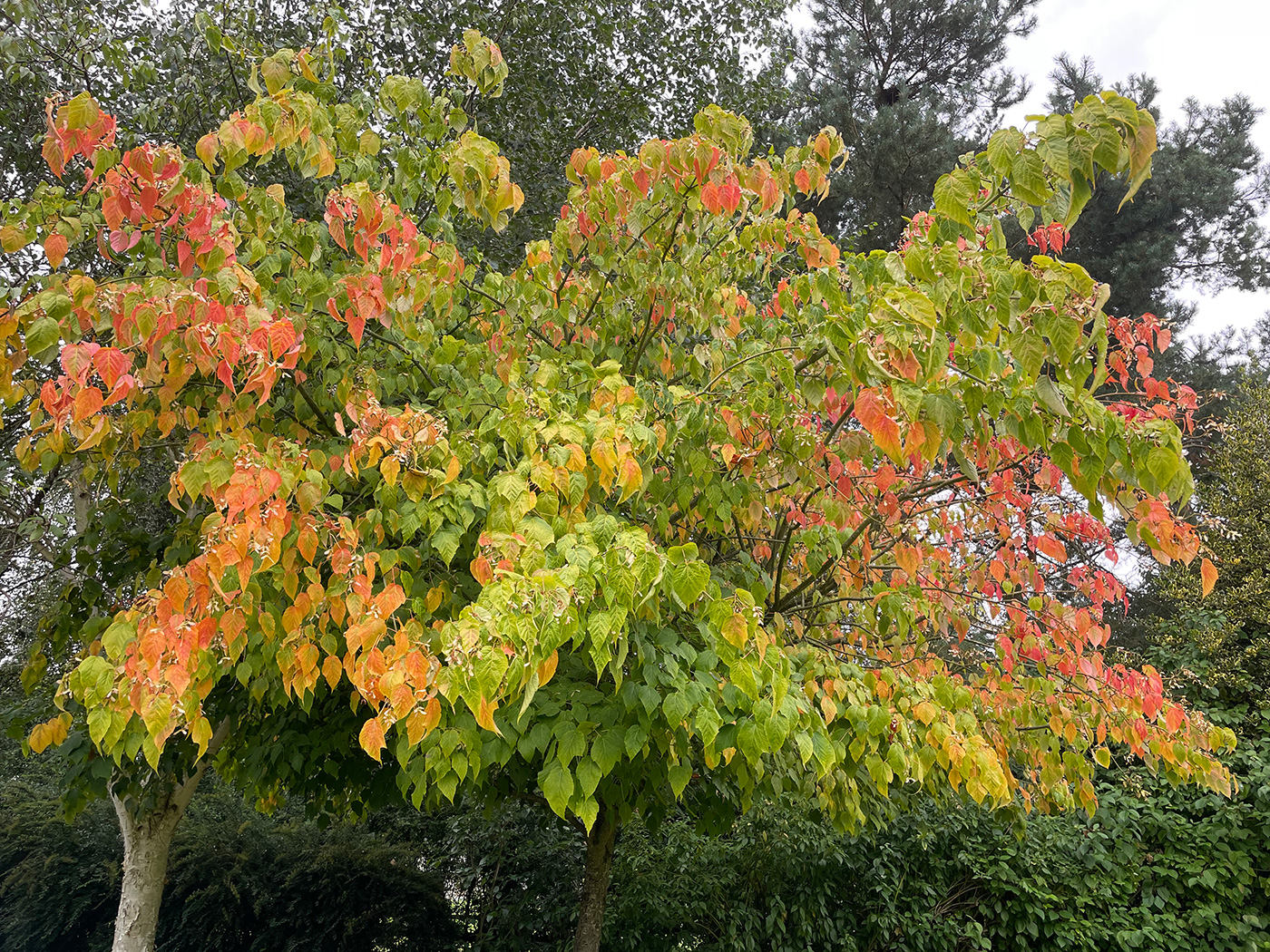 And finally – the trees are just starting to turn colour.
This fabulous tree in a client’s garden is the first that I have noticed, but other deciduous trees won’t be far behind.
The crackle of autumn has arrived.
Leave a Reply