

Taken from Lynne’s weekly column ‘Green Scene’ for the Western Mail
16th February 2019
 Snow Drop in the Ocean

They may have been out for a while, but the snowdrops are in all their glory now, and I absolutely adore them. They have spread themselves so prolifically in a shady part of my garden and they look like little pearls under the skeletal tree canopy. I added a few solar lights to the white carpet last week so they even look magical at night. Solar lights have come on in leaps and bounds and often don’t need sunlight to recharge, just daylight – handy at this time of year!
Snowdrops will spread naturally and quite quickly by both creating new bulbs within a clump, and by spreading further afield by seed. After flowering, snowdrop stems flop down and the seed pods will either naturally develop on the surface of the soil or often enlist a little help. Each seed has a small oil and protein-rich appendage called an elastiome, and when the seedpods open, these attract ants, which take them down into their nests as food for developing larvae. The seeds themselves remain untouched and, thanks to the ants, are both dispersed to new locations and conveniently planted underground.
So you can either let them spread under their own steam (and ant power) or speed up the process by lifting a well established clump, dividing it and replanting. You can do this before the end of the month, just after the flowers have faded but before the leaves die back – known as ‘being in the green’. Simply lift a large clump with a fork and divide it up into three or four smaller clumps with your hands. Plant these either in a brand new place or at the edge of the original group.
A neighbour has developed the snowdrop-lined path that Yogi is strolling down over a few years just by dividing original clumps. The effect is beautiful.
 You could buy bulbs from your garden centre in the autumn. But it is notoriously difficult to establish them that way. Even the deep-green fingered Monty Don confessed to once planting 1,000 bulbs in his London garden with only 12 coming up.
Some hybrid snowdrop bulbs have been sold for hundreds of pounds each, and in 2017 a single bulb of ‘Golden Fleece’ went for £1,390 on eBay plus £4 postage. I think I would have given it a police escort!
Described as, ‘The first fully yellow snowdrop, which took Joe Sharman 10 years to create,’ it was much sort after by the galanthomaniacs or galanthophiles – people who collect snowdrops. Most of us just appreciate the common Galanthus nivalis, and it’s natural white carpet.
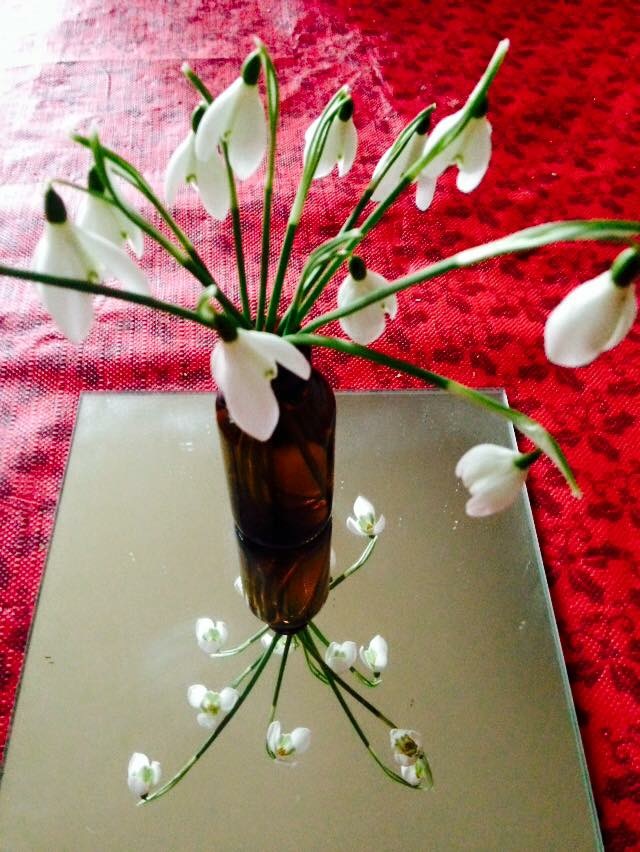
Folklore warns that it is unlucky to bring snowdrops indoors because it is thought they bring bad luck, or even death into the house, with them. However, I love displaying them on a mirror tile, which shows off the inside of their beautiful blooms, usually hidden as they shyly bow their heads.
Real Seeds – Real Treats
 It’s been a glorious week for gardening, and feels as though spring is just a round the corner. As the days get warmer and longer, there is real incentive to indulge in a little evening ‘Armchair Gardening’ and have a good look through the seed catalogues. Or I suppose, for the modern or techy gardeners – the seed websites.
I love Real Seeds, a Welsh family company who, as their name suggests, sell only ‘Real, Open Pollinated Seed’; No hybrids & no GM seed, and they explain why: “ Real seed breeds true, so you can save your own seed.”
Good old fashioned gardening tactics!
The company was started by Kate & Ben about 20 years ago. Kate has grown vegetables from childhood, and Ben studied as a plant scientist, which comes in handy for the more complicated breeding projects. They are also quick to sing the praises of the other people who help the company run smoothly, Cathy, Tam and Ian. More good old fashioned values.
They have a great selection of traditional veg seeds as well as some more unusual and rare tubers to try. This year I’ll be tying the Yacon and the Cinnamon Vine.
Yacon is a large plant from South America, distantly related to sunflowers, and it has huge, attractive fuzzy green leaves, so it’ll help keep the weeds at bay too. It also has very pretty little yellow flowers at the top of each stalk. The plants are very easy to grow and seem to thrive in almost any soil or climate, which is a bonus for Welsh gardens.
At the end of the season you dig it all up and the sweet, crunchy tubers are the bit you eat – you divide and replant the knobbly growing tips, so you don’t need to buy new – and once peeled, can be used raw in salads, or in stir-fries as a substitute for water-chestnut.
Andy’s Cinnamon Vine is an unusual edible, apparently grown more for amusement rather than as a staple part of your diet. The thing that attracted me to this is the promise of the incredible cinnamon scent given off by hundreds of small white flowers. What’s not to love?
The plants make 2 types of tuber – a huge underground one that is impossible to dig up, and small ‘air-tubers’ attached to the stem at the base of each leaf. It requires very little maintenance with the top growth dying back in winter and re-sprouting in spring.
Plants take 3-4 years to reach full maturity and the big edible root can then be up to 3 foot long, going straight down vertically, which is why most gardeners grow them in deep tubs. That way you can make sure they are grown where the scented flowers can be most appreciated too.
For more information and friendly advice visit www.realseeds.co.uk.
Thank you. I miss being free to enjoy gardens and so enjoy similar likes/dislikes to my own. Thanks again xx