
Taken from Lynne’s weekly column ‘Green Scene’ for the Western Mail
6th April 2019
 Rumble with the Bumbles
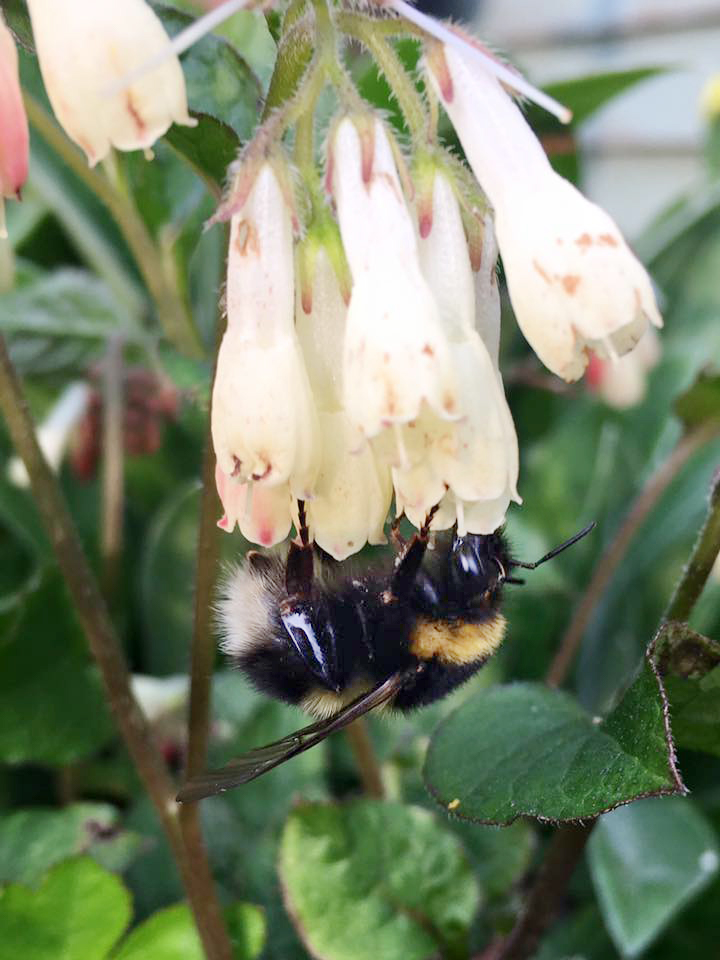
I got rather distracted from the dry stone wall I was building last weekend, by the numerous bumblebees feeding on the comfrey in an adjacent flowerbed. Distracted in the ‘just sitting and watching sense’. Obviously the phrase ‘busy bees’ was coined by their impressive working habits but they, and my honeybees, never cease to amaze me just how dedicated and hard working they are. The physical effort it must take for such slow and precision flying for the bumblebees is awe-inspiring with their wings beating up to 200 times a second. A full stomach will equate to about 40 minutes flying time (a bit like me in work).
And what’s not to love about a committed, furry, grafter called Bombus? Bombus is the Latin name for the bumblebee, and means ‘to buzz’. I also love the fact that my nan used to call them ‘Humble bees’ and that they also enjoy their sleep – scientists have recently discovered that sleep is imperative to bees to maintain a healthy memory needed to remember where the pollen-rich flowers are and the necessary routes to reach a lucrative patch.
Oh and did I mention that they have smelly feet? They leave scent markers just inside a flower head to indicate that it has been visited and pollinated to save other bees energy and time.
I am, indeed, in love with the humble bumblebee.
From the Bee-ginning
 The lifecycle of a bumblebee begins in spring, and is quite different from a honeybee. Rising temperatures awaken a queen bumblebee that has been hibernating alone in the soil, using up reserves of energy stored as fat in her body. When she first emerges, she visits flowers, drinking nectar to re-energise, and will then begin to search for a suitable nest site – maybe a hole in the ground, tufty grass, a bird box or under a garden shed.
She will then begin to collect pollen from flowers, to bring back to the nest. She forms a mound of pollen and wax (which she secretes from her body) and lays her first brood of eggs, keeping them warm by sitting on them and shivering her muscles to increase the temperature. Sipping from the nectar-pot-nest gives her enough energy to incubate the eggs for several days until little white grub-like larvae emerge. These larvae are fed on pollen and nectar, which the queen goes back-and-forth to collect from nearby flowers. After around two weeks, they spin a cocoon, inside which they develop into adult bees.
In contrast, a honeybee queen will only leave her colony to mate once in her life and then returns where she is unlikely to leave again. She’s real stay-at-home mum!
The first brood of bumblebee offspring are all ‘worker’ females, and will carry out work inside and outside of the nest. As the season males are produced and they don’t work a day in their lives! Once the male bees leave the nest they don’t normally return, they just spend their time feeding, and trying to mate. Most males will never mate and they all die off in the autumn, which is the same for the honeybee males (called drones).
So if you’re a female bee you work yourself to death, and if a male, you die of boredom!
Cuckoo in the Nest
 Not content with these amazing achievements, nature then throws ‘cuckoo bumblebees’, into the mix. Like the bird it is named after, it lays its eggs in another bumblebee’s nest and leaves the workers of that nest to rear the young. The cuckoo bumblebee differs physically from ordinary bumblebees as it is slightly less hairy, has a harder body and longer stings, which is why that in a fight a cuckoo bumblebee will usually win. And like honey bees, it is only the females that can sting, males have no stingers.
Cuckoo bumblebees do not forage as industriously as workers or queen bumblebees as they have no-one to provide food for but themselves. In fact their behaviour resembles all bee males. They drink some nectar and then just laze around until they are hungry enough to drink more.
Please Bee Helpful
 Around 270 species of bee have been recorded in the UK, including about 19 different species of bumblebee and six species of cuckoo bumblebees. Sadly, they have suffered huge declines over the past century with two species becoming extinct in the past 80 years, and eight species now endangered.
If you find a grounded bumblebee early in spring as the days warm up, then it is probably a queen. She may have been caught out in a sudden shower or a cold spell. If the temperature of the thorax falls below 30 oC the bumblebee cannot take off, so please pick her up using a piece of paper or card, put her somewhere warmer, and feed her. When she has warmed and fed she will most likely fly off. You can feed her using a 30/70 mixture of honey and water in a pipette or eye dropper, or just a drop of this on a suitable surface within her reach, but be careful not to wet her hair or get her sticky. By saving a queen you may have saved an entire nest. If the weather is really unsuitable for letting her go, or if it is getting dark, you can keep her for a day or so if you are willing to feed her.
You can help the species by creating their favoured habitat in your garden with suitable watering holes, plants and nesting sites. More details including how to build bumblebee abodes at https://www.bumblebeeconservation.org/garden-advice/
Leave a Reply