
Taken from Lynne’s weekly column ‘Green Scene’ for the Western Mail
21st May 2022

Oh My Darling Celandine
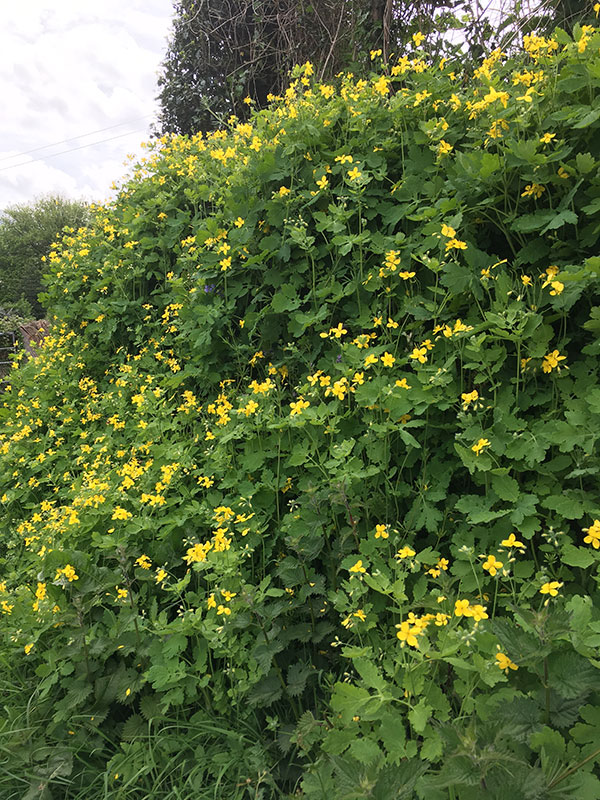
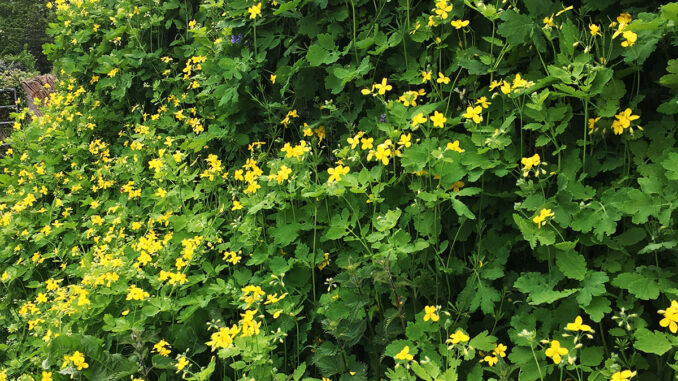
In early spring, I wrote about the sunny celandines in the hedgerows heralding the arrival of spring and pointed out whilst they are the easily recognised and much loved lesser celandine, there is also a greater celandines which flowers later. Well – it’s later and they’re flowering. They are clothing a bank at the bottom of my brother’s garden and whilst admired by many, I don’t think they realise that they are also called ‘celandine’.
Although, together with the yellow flowers, that is where the relationship ends. The greater celandine is actually a member of the poppy family (and sometimes known as the celandine poppy) and is totally unrelated to lesser celandine, which is a member of the buttercup family. Who said plant relationships were easy?! Or any relationships, for that matter …
The greater celandine is also known as ‘swallow wort’ as it is supposed to start flowering when the first swallows arrive – it’s botanical name Chelidonium is derived from the Greek for swallow.
Despite being useful ground cover in the right place, and loved by pollinators, it can become quite invasive and is often regarded as a weed. Herbalists have sometimes recommended the use of it for the topical treatment of warts, dried parts of the whole plant are used in several different medicines and there are reports of it being used in cancer treatments, but for the general public, it is worth knowing that the Greater celandine is actually poisonous, especially its reddish yellow sap, which you’ll see if you break a stem.
Berry Early – or Berry Late
 As I mentioned last week, nature throws up something new for me most days.
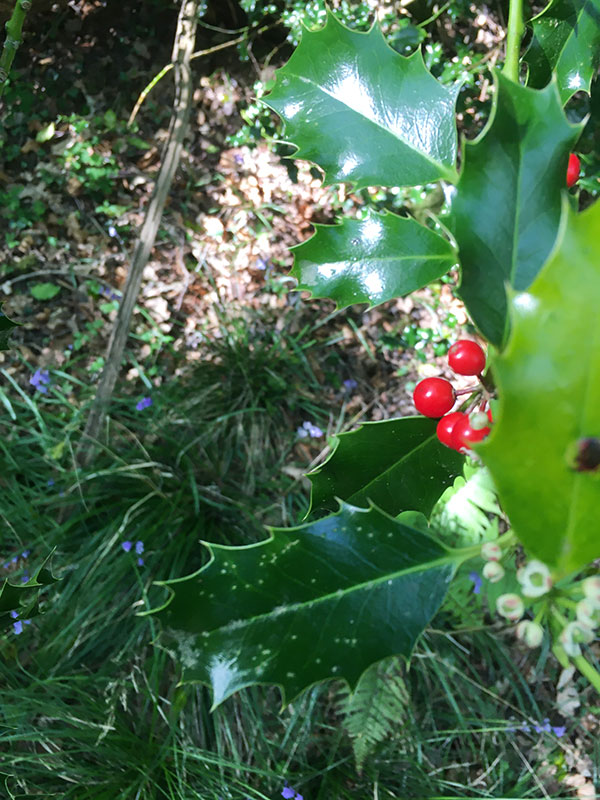
One day on a Yogi-sniffari, it was spotting bright red berries on a holly tree.
Blissfully unaware that it is 5 months late – or 6 months early – it was cheerfully ‘berrying’ away over a bluebell carpet.
The first time I’ve seen that.
Heart Swarming Bees
 The recent warmer weather has triggered the swarming of honey bees. Basically, when the hive gets too crowded, the bees ‘make’ a new queen and half the occupants leave with her to set up a new home. There is a bit more to it but I don’t have room in this column to give the whole process the credit it deserves. Therefore I highly recommend you reading up about it – and actually treat yourself to a good book on bees. You won’t be disappointed and their lives are far more interesting than those chosen to be on reality TV.
So when the occupants and their new queen leave, they won’t travel too far from the hive initially. They will rest and cluster around the queen to keep her safe whilst the ‘scout’ bees go in search of a new suitable permanent home. Bearing in mind that up to 30,000 bees could have left the hive, some of the clusters or ‘swarms’ that you may be lucky enough to see can be a fair size- the size of a rugby ball for example.
I have failed to find out what makes them choose this initial temporary resting place, but from experience it seems to be something to do with it being the hardest possible place for a keen beekeeper to retrieve them from.
Of all the swarms I have collected, only two have been easy. I have been able to shake the bees into a box, which is then turned upside down to encourage the ones who missed the box to enter it. Please don’t try this at home. It is without a doubt another fascinating aspect of bee life, but not as easy or straightforward as it sounds.
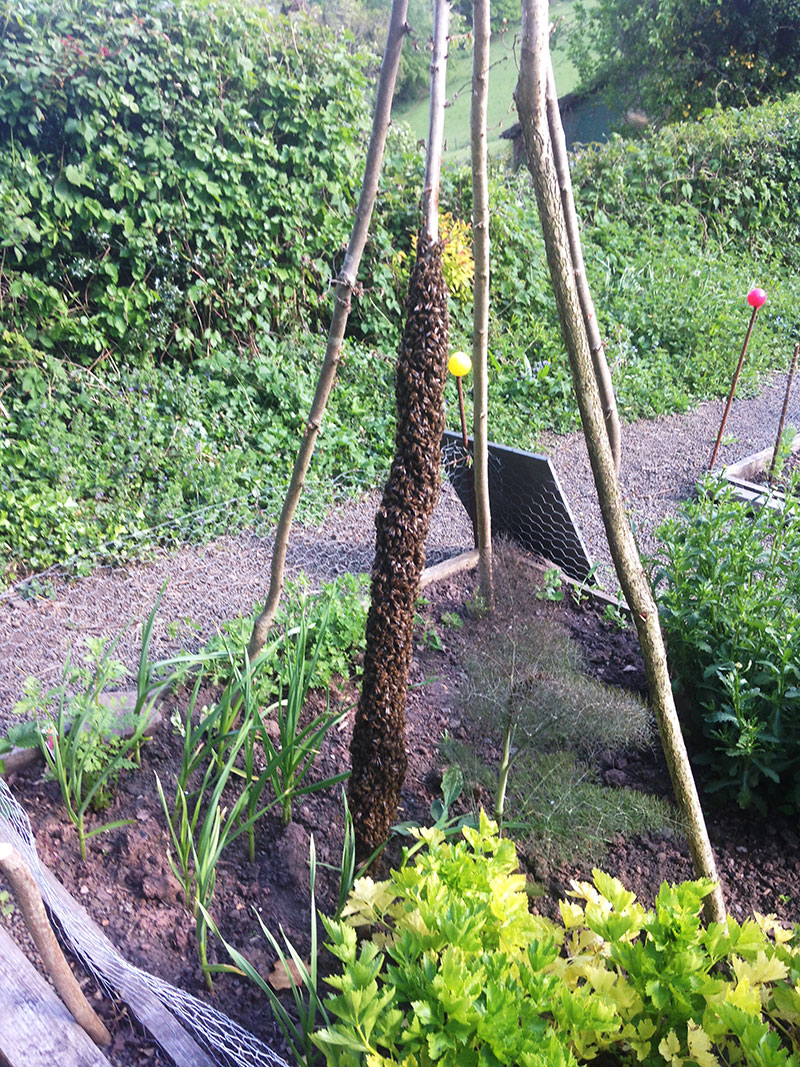
Most of the swarms I have been lucky enough to collect have been n the most awkward or almost-inaccessible places – from the framework of a push bike, to the top of an apple tree and lots in between. The photo shows my own bees having made their first stop clustered around my sweet-pea poles, only yards from their old hive. They were really difficult to scoop into a box – although nice and local.
Possibly the most important thing to remember about a swarm of bees is that they are not dangerous. They will be totally preoccupied with guarding their queen and have no malicious intent whatsoever. Also – and I love this bit – before they leave the hive they gorge on honey to keep them sustained during the move. Bees need to be able to bend to sting and they can’t when they have a tummy full of honey. They really are at their most docile. So please leave them alone.
Ideally, keep the number of a local beekeeper or beekeeping association in your phone and call them. If you can’t do that, just leave the swarm in peace. As soon as the scouts have found somewhere suitable to more to they will come back and fetch the others. A swarm will naturally move on by itself – it may take half an hour or a couple of hours but they will move on to somewhere safe when they’re ready.
So many people ask me how they can help the bees – the simple answer is to educate your self on their behaviour. It is absolutely fascinating and there are some brilliant books about bees. Also please make others aware of the importance of leaving a swarm alone and of having a local beekeeping association’s number in your phone.
Thank you.
Cool by Name and by Nature
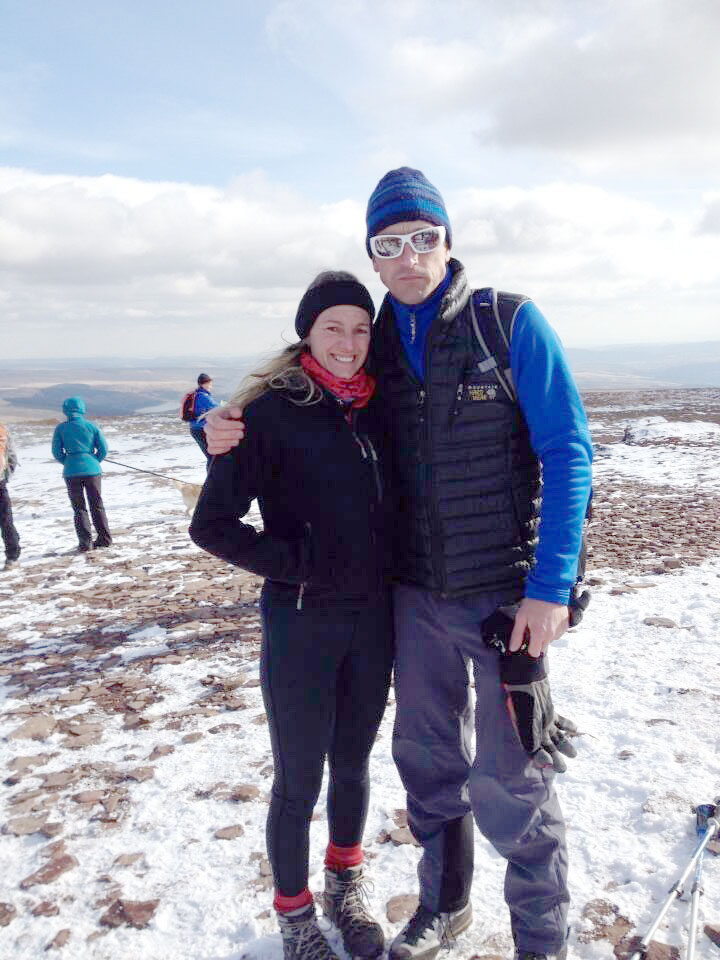 Congratulations to Kenton Cool for his recent record breaking 16th Everest summit.
Such a nice bloke – and I like to think our walk to the summit of Pen y Fan helped in some small way with his training!
Another gripping instalment and the bit about the bees is fascinating. I have always found that staying relatively still and calm around bees, results in them going about their (buzzy) business as though you’re not there. You can then watch them for ages. Love it.