
Taken from Lynne’s weekly column ‘Green Scene’ for the Western Mail
29th July 2023

Hope and Cope

The ‘Hope Index’, a survey by Gallup which polls what people feel about the year ahead, has revealed “pessimists exceed optimists by the largest margin since the index launched”.
Being in this age group, I can understand why 45-64 year olds are less hopeful compared to younger groups, but I was surprised to learn that a significantly higher proportion of those living in a city are more hopeful about the coming year than those living in villages and rural areas. And men are slightly more hopeful than women.
I am currently reading ‘FEELING BLAH?’ by Tanis Carey who introduces us to ‘anhedonia’ – derived from the Greek for ‘without pleasure’ and defined as ‘losing the ability to get pleasure from things you used to enjoy.’ Interestingly, psychologists suggest that as we refer to things that ‘make’ us happy, we expect it to be our ‘right’, dependant on external conditions and our ‘normal’ state – without any personal input.
Described as the opposite of hedonism, psychologist Adam Grant explains anhedonia by reflecting: ‘It wasn’t burnout — we still had energy. It wasn’t depression — we didn’t feel hopeless. We just felt somewhat joyless and aimless. … It feels as if you’re muddling through your days, looking at your life through a foggy windshield.’
It seems that there are numerous reasons for anhedonia, from the aftermath of COVID 19 and the cost of living crisis to the menopause and poor nutrition. If you feel that your get up and go has got up and gone, it’s well worth a read and it’s also worth remembering that whilst maybe not every day is good, there is good in every day.
Salvia Salvation
 Something I am hopeful about is that the seeds that I sowed last week – beetroot (again) wasabi rocket (new) and Greek basil (in a pot) – will come to fruition before the growing season slows or the rabbits find them. (Good luck with the wasabi rocket, bunnies!)
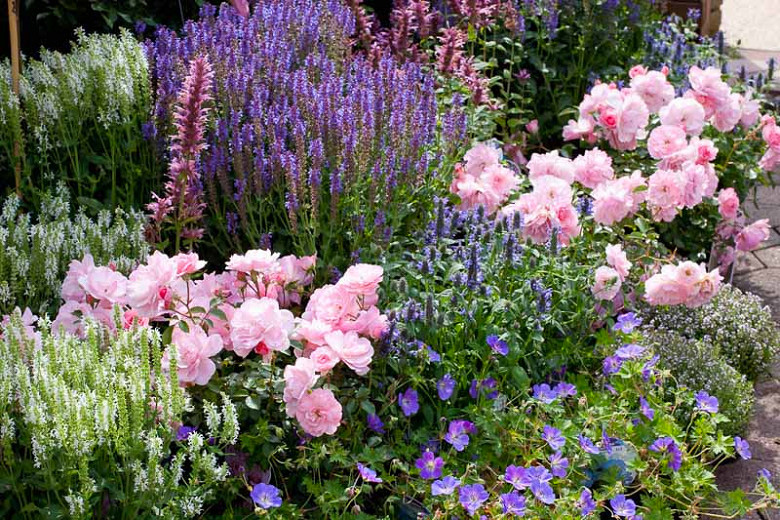
And I also have high hopes that the salvias I planted among a client’s beloved roses last week will help to keep the roses healthy and happy. This companion planting is recommended by Sarah Raven who writes, ‘Salvias and roses are a very beneficial planting duo. One of the things that we’ve experimented with our roses a lot is trying to protect them against blackspot and mildew without using chemicals, and we’ve had huge success with underplanting our roses with salvias, particularly the microphylla, the small-leaved varieties, and as I stand here I can, I’ve crushed a leaf or something because I can smell a sort of slightly, not acrid but really quite a pungent smell that is definitely slightly sulphurous, and of course sulphur is a fungicide, and my belief is that these salvias have sulphur in their scent profile, and when they get hot they warm up and they release that and they just give this whole rose garden sort of puffs of natural, home-grown fungicide, and keep our roses pretty pristine, so I just thoroughly recommend it.’
Companion Planting
I have always been fascinated by companion planting and wonder why more people don’t do it. Granddad always used to include rows of Tagetes patula (French marigold) in his vegetable beds, not to look pretty but to do a job. It is a great plant for killing perennial weeds as it secretes a chemical through its roots, which has an herbicidal effect and apparently even works well on tough garden weeds. The results won’t be visible immediately, and the process will have to be repeated year after year, but it is a great – and pretty – alternative to chemical weed killers.
Tagetes also emits a chemical called ‘limonene’, which works as a very strong repellent against most flying insects and therefore protects crops. Quite incredible to think that just one plant can act as a weedkiller and an insecticide – but it’s how nature rolls! You can also buy tabs of the limonene in isolation, which is naturally extracted from the tagetes and works as an effective deterrent in greenhouses. As a big fan of essential oils, I wonder if it would work to repel flies in the house or around horses, or midges and mosquitoes when camping or being outdoors in the evening.
Other essential oils which are supposed to help to repel unwanted insects include peppermint, lavender, eucalyptus, lemon and Greek basil. Greek basil has a distinctive lemony scent, and is widely used as a mosquito deterrent in vegetable plots in the Mediterranean, where it’s used to under-plant aubergines and peppers. Although the mosquitoes hate it, the scent naturally draws in bees, butterflies, and hoverflies with its tiny flowers and is great for pollination. Nature at it’s best.
Precious Pets
 ‘Having a dog will bless you with many of the happiest days of your life and with one of the worst’. It’s certainly not something I want to dwell on – I’ve always said the only problem with animals is that they don’t live as long as we do.
But I do want to share a lovely venture set up by two friends based in Ireland who are hoping to ease the pain of a pet passing a little by offering pet memorial gifts and jewellery. The beautiful necklaces, key-rings and bracelets are all designed to be able to hold a little of your beloved pet’s ashes or a little bit of their fur to keep next to you forever. And I did think that of course you could also keep a little bit of fur in the jewellery whilst your four legged friend is still with you.
‘Rainbows and Stars’ was established by Kelly and Sian (a proud Welsh girl), who are lifelong friends and owners of many beloved furry friends, both past and present. Knowing how much a beloved pet is missed when they pass, they wanted to do something to help owners at such a difficult time. The jewellery can be viewed at www.rainbowsandstars.ie Shipping to the to the UK is free and 2 euros of every sale is donated to the Animal Foundation Charity which pays for emergency vet bills when an owner is unable to.
If you are in the unenviable position of letting your pet run over Rainbow Bridge, there are several organisations that offer help with pet bereavement. Blue Cross offers a service, providing free, confidential support to anyone affected by losing a pet. Cats Protection has a confidential phone line called Paws to Listen, a service for any cat owner suffering grief or bereavement for a beloved pet. For equine support, The British Horse Society‘s ‘Friends at the End‘ is designed to make sure that no horse owner faces losing their companion alone and for more online support, the World Horse Welfare shares good advice on saying goodbye, too.
And a sensitive and sensible book for anyone coping with the loss of an animal companion is ‘Parting Words Parting Ways: Saying Goodbye to Your Pet”. Written by Laura Ritter Carlson, it offers creative and comforting ways of coping with the loss, and also ways of honouring their memory. All proceeds go to animal welfare charities and it’s available from Amazon and via most bookstores.
Now if you’ll excuse me, I’m off for a cwtch with Yogi. x
Lynne beautifully written as usual and fascinating
I need somehow to save your planting advice
Might you write another book? Please
I’m moving after 23 years in my lovely home to a bungalow
Tough but time and I’ll hopefully have a beautiful garden and conservatory – much love Ruth xxxx
Loved your article this week, ( when do I not)?
I definitely get the anhedonia. I don’t think the government, (and by this I mean from any political party) realise the stress they cause us with their negativity and greed. Enough politics!
On the very rare occasions that I have attempted to grow things, I always interplanted French Marigolds, especially with carrots as it seemed to get rid of carrot fly.
I live within 3 miles of the World Horse Society.
Finally there is no better Welsh word than cwtch. A close second is poppety ping for microwave!
Have a lovely week xx