
Taken from Lynne’s weekly column ‘Green Scene’ for the Western Mail
8th February 2025

Guard Your Garden
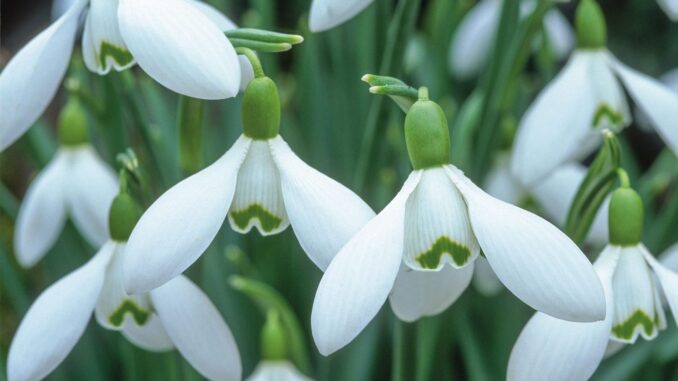
Whilst recently walking Yogi through a snowdrop carpeted wood on our ‘sniffari’ I thought, ‘I think snowdrops are my favourite flower’. But of course I’ll think that about each flower as they come into bloom. Apart from berberis and pyracantha, possibly. If you are a gardener, or have had dealings with these shrubs, then you’ll know these spiky shrubs don’t do themselves any favours when it comes to making friends. Any encounter with them usually results in spending evenings picking the thorns out of your hands.
Of course both berberis and pyracantha are excellent hedging plants and therefore ‘useful’, unless you are the one having to cut the hedge. When I used to give ‘Guard your Garden’ talks for Dyfed-Powys Police, everyone (apart from us gardeners) was always surprised by just how much of a natural deterrent a spiky hedge could be to would-be intruders.
For this reason I often recommend planting gooseberries as part of an ‘edible hedge’, as they add a level of security as well as the harvesting potential. We have recently planted an edible hedge for a client and included red, black and white currants, thorn-less blackberries, and raspberries as well as gooseberries.
It is true, as my rewards-based client pointed out, that the birds may well beat you to 50% of the fruit but I think 50% of something is better than 100% of nothing. An edible hedge also has the benefit of feeding wildlife, and adding seasonal interest to the garden with the gooseberries making it somewhat impenetrable.
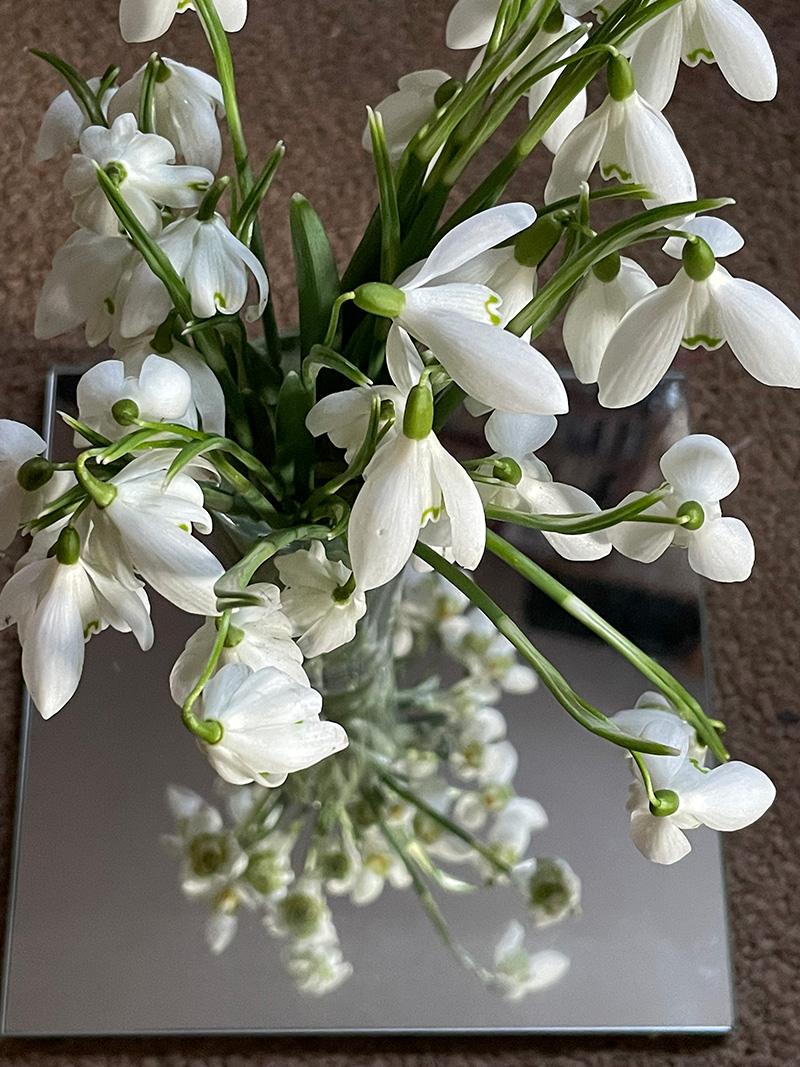
Back to snowdrops – although superstition has it that they are unlucky if brought into the house, they do make lovely cut flowers in a little vase and are particularly effective if that vase is placed on to a mirrored tile or even a handbag mirror. This allows you to see the underside of the bowed heads, which are stunning and actually seldom seen. I recently picked a little vase of snowdrops for Mum, and when I placed them on the mirrored tile realised that some of the snowdrops in my garden are the ‘double flowered’ ones – with quite frilly innards!
A Nod of (and to) Snowdrops
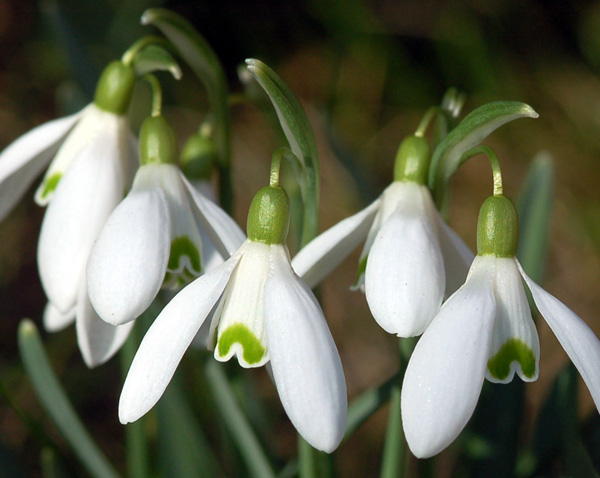 I also love the fact that one of the collective name for snowdrops is a ‘nod’ and another wonderful thing about them is that they provide essential early food for the bees. Over the years I have spent longer than I probably should have watching bees enter the bowed heads and then reversing out with bright orange dots on their back legs. This is the snowdrop pollen that they have put in their little pollen baskets. Not only does that skill never cease to amaze me but who would have thought that snowdrop pollen would be bright orange.
All pollen is a different colour and it is fascinating to watch my honey bees return to their hives with their different coloured bounty and of course is an indicator as to what they have been foraging.
Back to snowdrops (again) and there is a lot of folklore around these ‘heralders of spring’ – both positive and negative. They do tend to signify the nearness of spring and, in one legend, it is said that an angel breathed life into a snowflake which transformed it into a snowdrop, and which then broke the spell of winter.
However, snowdrops have also been associated with death and mourning. Their white petals are said to resemble a corpse’s shroud, and their drooping heads are said to look like funeral mourners. But I suppose it’s all about how you perceive death. As Oscar Wilde mused, ‘Death must be so beautiful. To lie in the soft brown earth, with the grasses waving above one’s head, and listen to silence.’
Which Witch Hazel
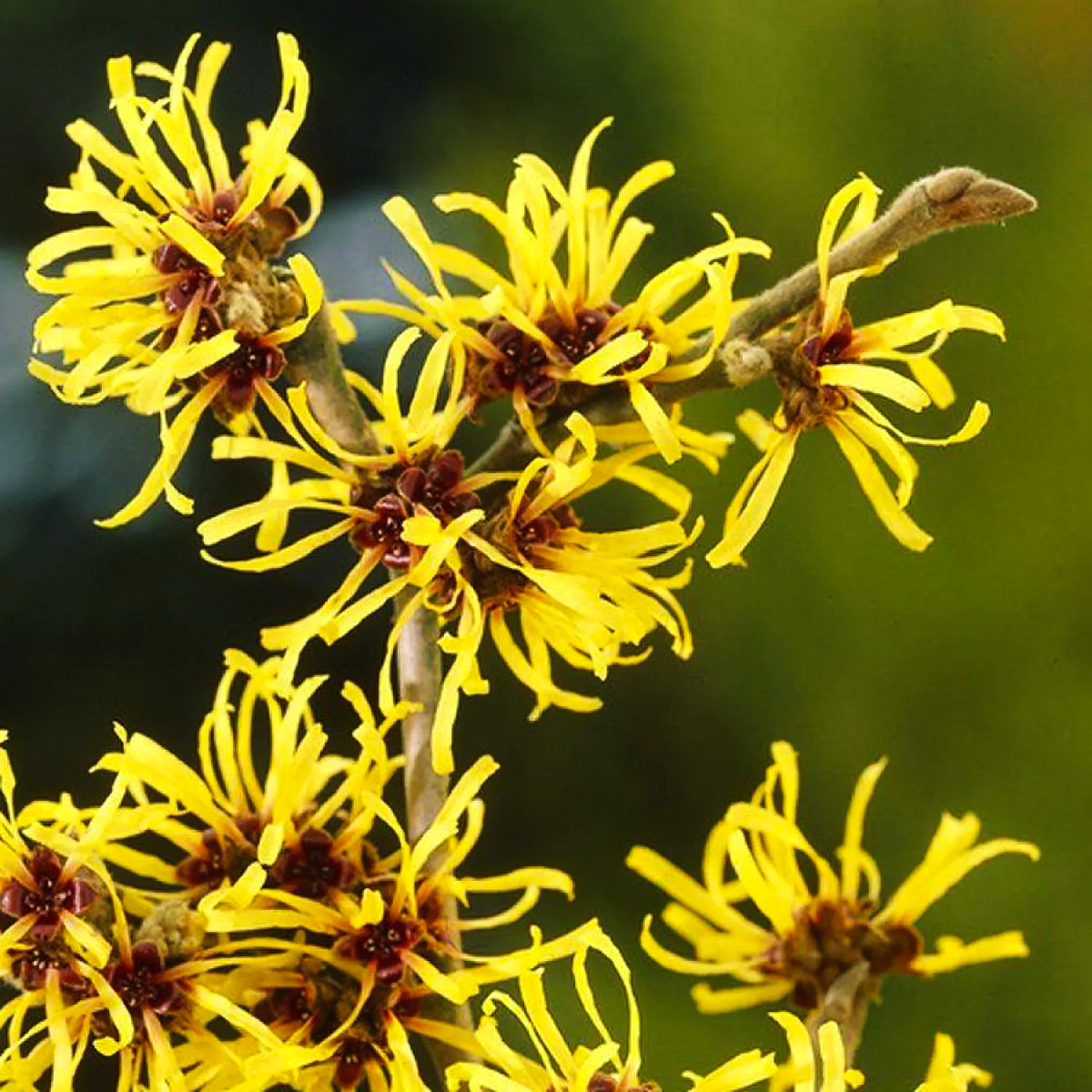 Whilst Mum was a great lover of all flowers, Dad definitely preferred trees and shrubs. Therefore to get late winter/early spring colour in the garden he planted a beautiful Hamamelis Mollis. For the last 40 years it has reliably produced clusters of large, sweetly scented, spidery, yellow flowers from December to late February on bare stems, which makes the flowers more vivid. The bright green leaves turn yellow, orange and red in autumn for another spectacular display – Dad always appreciated a hard-working plant!
As well as the better-known yellow flowering varieties of witch hazel, there are also some more exotic varieties to choose from with their variations of orange and red flowers all appearing on bare stems. Most have a distinctive, spicy fragrance and also provide vibrant autumn leaf colour.
Of course there are always the more exotic looking varieties too. The flowers of Hamamelis x intermedia ‘Strawberries and Cream’ are a mix of pale yellow and a soft red. Hamamelis x intermedia ‘Aphrodite’ has slightly crimped, orange-red, strongly scented flowers with the leaves turning an intense red before falling in autumn. Hamamelis x intermedia ‘Diane’ has unusual, copper-red flowers with a light scent, with leaves turning a dramatic shade of yellow in winter.
They will all reach around 3-4 metres in height but some varieties are considerably wider than others, which is something to bear in mind when choosing your witch hazel.
And yes, witch hazel – always used for stings and bug bites when we were kids – does come from the Hamamelis genus of plants. Witch hazel extracts contain tannins which help reduce swelling and fight bacteria, and so are used in various cosmetics and pharmaceuticals.
Witch hazel is actually the common name for several species of Hamamelis, including Hamamelis virginiana, Hamamelis mollis, and Hamamelis japonica. And if, like me, plant names fascinate you then I highly recommend the book, ‘Plant Names Simplified’, which has become an established classic. Now also available in pocket-sized reference book, it gives the name, pronunciation and classification of common plants and the meaning behind the Latin origins of the name.
Puppy Love
 As well as Valentine’s Day, this February you can also celebrate ‘Pawlentine’s Day’.
Thanks to WagIt (the first booking platform for dog parents), on Wednesday 12th February, dog owners across the UK can enjoy a special outing with their four-legged best friend at various participating venues. For more information on Pawlentine’s Day, and to view the full list of participating venues, please visit www.wagit.uk.
To be honest, I’m at the stage and age when I look forward to Pancake Day rather than Valentines Day – and so whilst I will give the customary nod to all the romantics out there next Friday, my own focus has changed from the food of love to the love of food.
Roll on 4th March.
I suppose I give the game away as to my previous profession when I tell you I have berberis behind a wall the local drunks used to climb over. I also have a Grape Oregon – nice and sharp too!
I’ve just ordered a copy of ‘Plant Names Simplified,’ through Amazon, which should arrive tomorrow (Sunday). Thank you for the recommendation.
I look forward to 4th March too! Lemon and sugar for me.