
Taken from Lynne’s weekly column ‘Green Scene’ for the Western Mail
10th May 2025

Growing Mad

Oh my word, it’s as though nature looked at the calendar and on May the 1st just ‘unleashed’ itself. As if by a flick of a switch everything has just started to grow at a rate of knots – including the grass, brambles, and weeds. It has all just become very verdant since Beltane, or May Day, which traditionally marks the peak of spring and the beginning of summer. It is also midway between the spring equinox and summer solstice, and there are only 45 days until the longest day.
When I was a kid, it felt like there were five years between each summer holiday, now it seems like only a couple of weeks.
Try to keep on top of jobs in the garden at this time of year. It will make things easier for you and your equipment. If you are doing No Mow May, then at least keep a few paths cut through your lawn so you can still ‘use’ the space and access other areas.
Pest to Share
 With increased gardening jobs, comes the inevitable increased annoyance about pests.
I have decided not to grow any veg this year as I battled against moles, voles, pigeons and rabbits last year – and they all beat me into submission.
Which is fine; this year I will just take my custom to Farmer’s Markets and save myself the stress of watering and pilfering pests.
However, I am growing salad leaves and herbs in the back yard where I can keep more of an eye on them and they also provide maximum fresh ‘home grown’ taste with minimum fuss.
A lot of the gardeners I talk to now have resigned themselves to covering crops with nets to stop pilfering pigeons and have had to rabbit-proof their veggie patch due to the increase in ‘burglaring bunnies’ in the last few years. A few of the more seasoned gardeners are unimpressed with my attitude, but I am going to concentrate on a couple of other projects this year instead of vying for my own veg!
And I think Pam Ayre’s poem sums it up nicely:
I share my lawn with a couple of moles,
Share my carrots with a couple of voles,
Share my earth with a worm or nine,
Because the land is ours.
Not mine.
Still on the subject of ‘pests’, a friend recently tried out the Pestects bracelets when she went abroad.
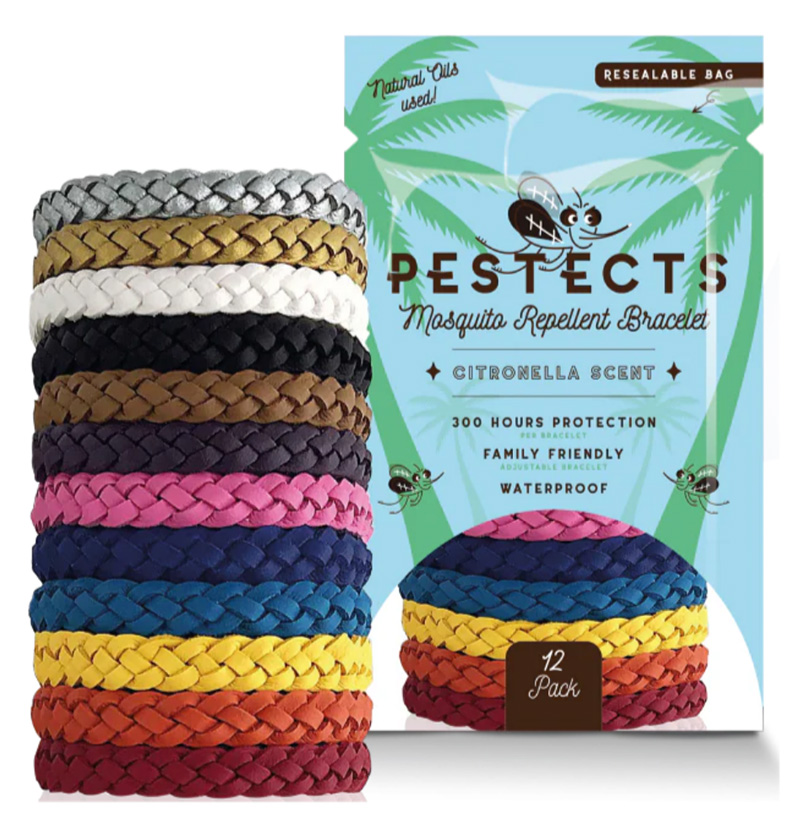
The bracelets claim to repel mosquitoes and other biting insects, and apparently worked well. I have ordered some and I will let you know if they repel midges and horse flies a bit later on.
For years, I have been using a well-known body oil by the company that used to ‘ding dong’ at your door, which is very effective and used by fishermen and the SAS.
But I’m always up for trying something new and love a plaited bracelet! They last for up to 300 hours, so no need to reapply oil or creams, keep working during and after swimming, and are made from vegan and eco friendly materials and only use essential oils. They can be worn on ankles and/or wrists as are fully adjustable.
Set up by Tom out of frustration at having camping trips and foreign holidays spoiled by biting insects, the company also offers insect repellent spray and patches. More details at pestects.co.uk
Hitting the Hedgelines
 Sadly, studies show that since 1945 half of all British hedgerows – covering around 118,000 miles – have disappeared. Despite having been planted and tended since at least 2500 BC, the ‘hedge’ plays a vital role in providing food and protection not just to humans and their farm animals, but also to a huge variety of birds, mammals and insects. In the push to end rationing after World War Two, hedgerows were considered to be hindering necessary crop production, and satiating human hunger was prioritised over wildlife havens.
Hedges are amazing things when managed properly. When coppiced and trimmed regularly, they become an impenetrable hedge that is able to retain and shelter livestock, protect crops from bitter winds, and delineate who owns what. I have tried my hand at traditional hedge laying and it is not only extremely complex but back-achingly physical work too.
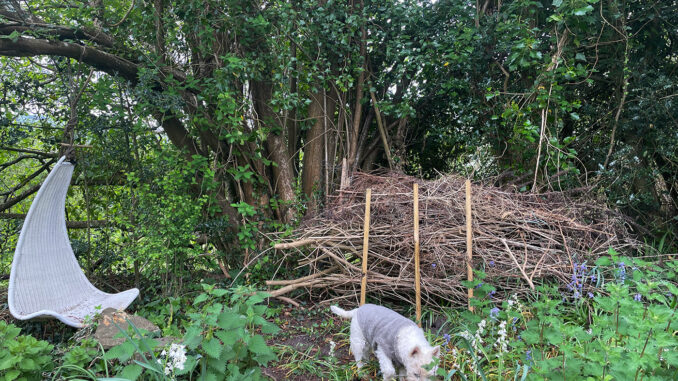
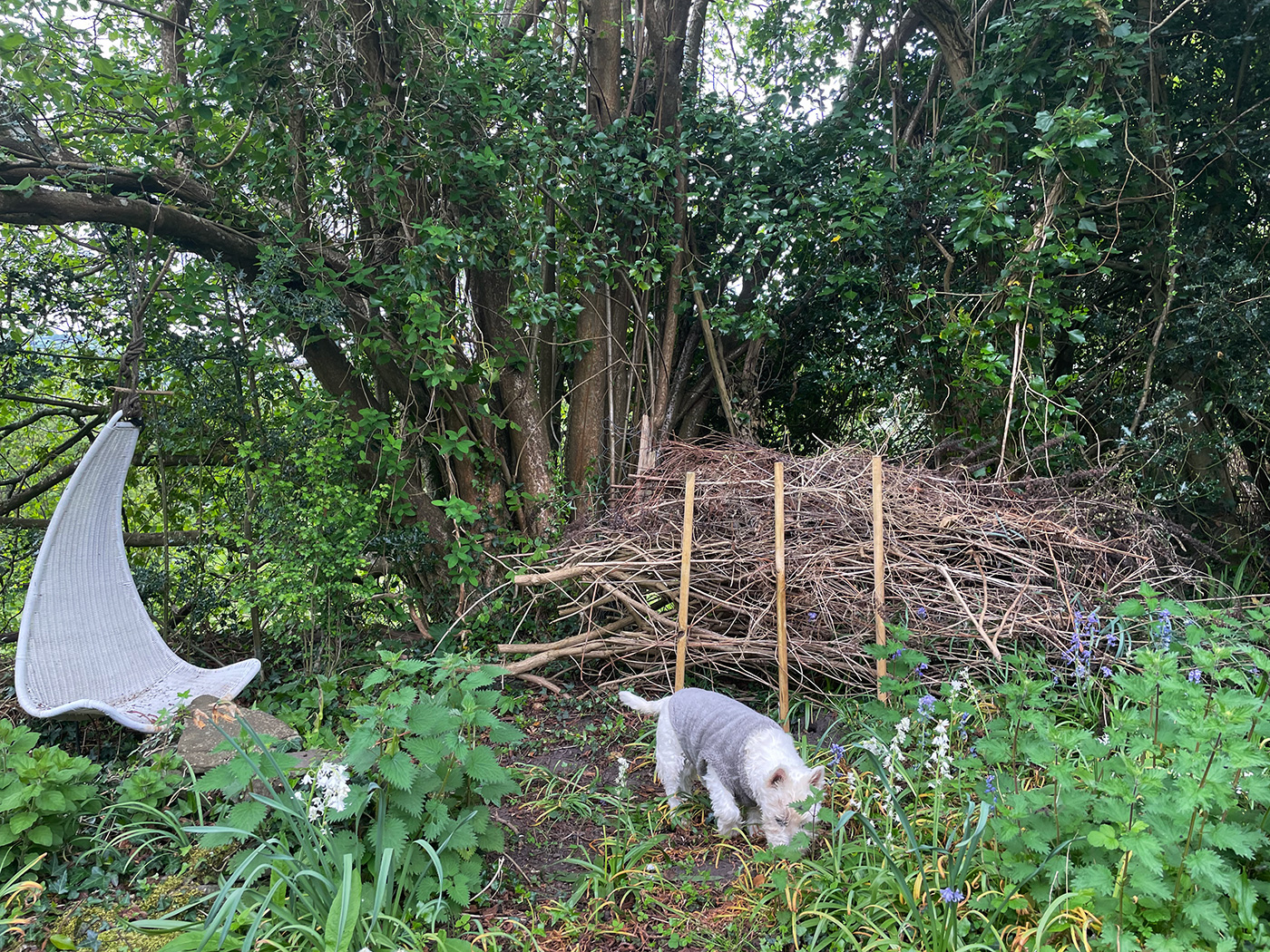
There is a more recent trend to “hit the ‘hedgelines’” and one that I have sort-of adopted at the cottage. The dead hedge. Not as macabre as it sounds, and created by design rather than default or destruction, a ‘dead hedge’ is basically an upright structure of woody cuttings woven, or even just stacked, between vertical stakes. The reason I created mine was that I didn’t want to have to lug all the wood I had cut back from the buddleia and shrub rose out of the garden. It is actually still a work in progress, (as you can see) because as I stacked up the dead buddleia at the end of last year, I noticed evidence of a house-hunting hedgehog, so left the half finished heap of wood plugging a gap at the bottom of some hazel trees at the end of the garden.
Recently I had worked my way through my to-do list to ‘D’ for dead hedge, and when I went to finish the job I noticed a wren busily building her nest – so left it alone again. So my own dead hedge maybe still under construction but it has already provided sanctuary for several house-hunters. Despite meaning that my to-do list is slow to clear, that is a good result as far as I’m concerned.
When done properly – and completed – a dead hedge is also great way to hide a compost heap or similar. It is the same principle as a willow hurdle really, but is far more likely to attract wildlife by providing a more natural habitat.
I know someone who has actually created a substantial dead hedge as a boundary fence between their garden and the farmer’s field – with great success. There are plenty of more detailed instructions online – have a look at www.rspb.org.uk/helping-nature/what-you-can-do/activities/build-a-dead-hedge-for-wildlife.
Exterior Design
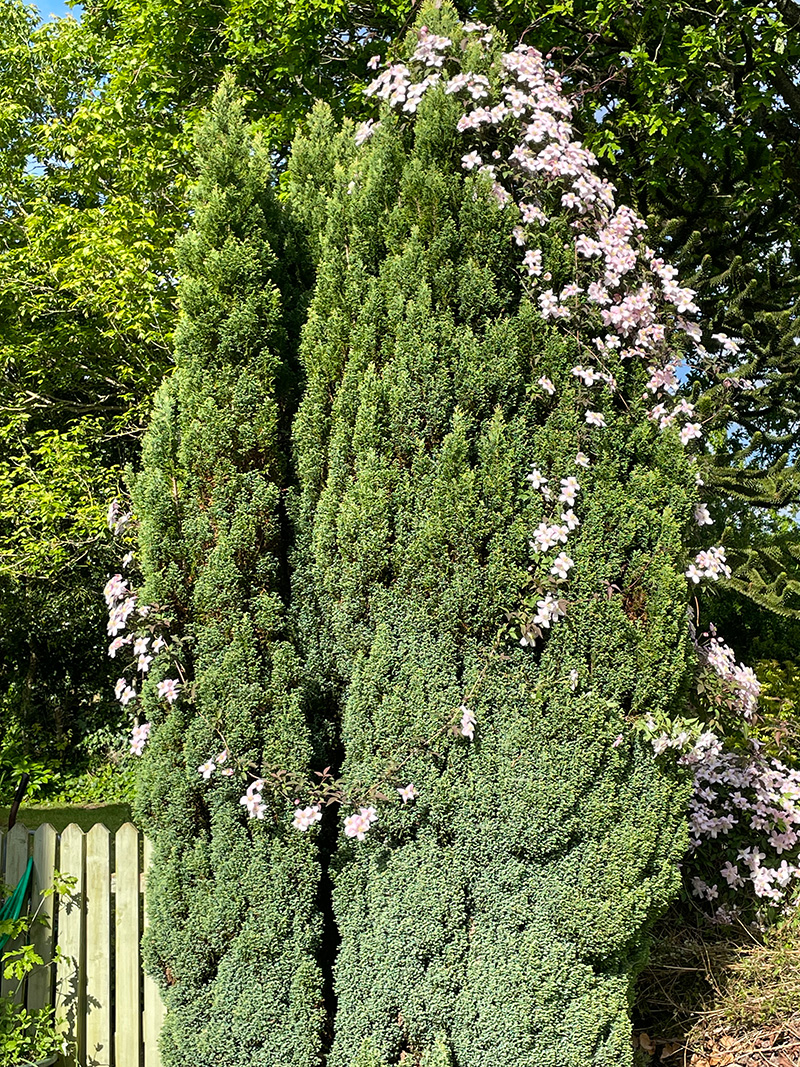 I had to share this photo of a clematis draped over a conifer in a client’s garden.
Its all nature’s own work – no intervention and reminded me of fairy lights draped over a Christmas tree.
Just brilliant.
It’s why I often use the phrase, “When gardening, one not only has to acquire a knowledge of what to do, but also to gain some wisdom in perceiving what is best left alone.”
sAge Words
And finally I’ll leave you with one of my brother’s latest ‘quips’. Working together last week, we were talking about getting older and who has ‘aged well’ – and who maybe not quite so well – and how sad (we think) it is when women feel they need to have ‘procedures’ to try and slow the aging process. The conversation took an unexpected turn when, refuelling the mower, my brother said, “But when it comes to getting older, you’re really lucky.”
Suspecting something as close to a complement as I would ever get, I looked surprised and said, “Really?”
“Yeah”, he answered, “’Cos you don’t care how you look.”
I have been using those mosquito repellent bracelets for a few months and they do actually work well.
I always love reading your column Lynne. There is always some gem you include that helps me in some way – often advice or a tip I would happily pay for – and you give it away for free! Just to say thank you!