
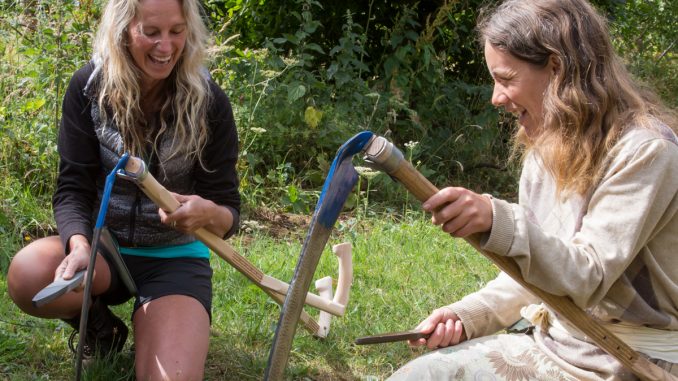
Taken from Lynne’s weekly column ‘Green Scene’ for the Western Mail. 4th August 2018 
All Things a Scythe
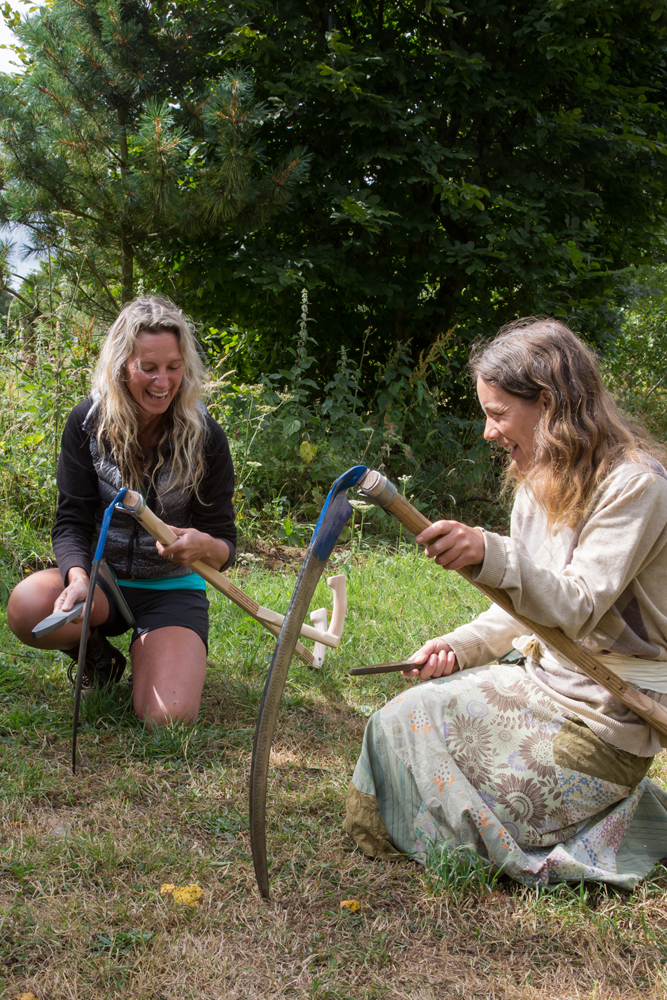
I think I am turning into my granddad. I’m not growing a beard (or anything else), or getting more grumpy (debatable) but I am growing my own veg, keeping bees and last week, I learned to scythe.
And I absolutely loved it. To be honest I was a bit sceptical about scything as a method of cutting grass; I thought it was a bit of a romantic option and let’s be honest, the hippy and eco warrior’s choice. Surely a strimmer made more sense, especially when submitting an invoice at the end of the job?
I was surprised; firstly it is much quicker than I thought, both to prepare for and to actually cut the grass. There is a bit of a tongue-in-cheek video on YouTube that shows a guy picking up his scythe and cutting a huge swath of grass whilst another chap puts petrol into the strimmer, gets the cord to the right length, puts his harness and helmet on and then starts his strimmer. By the time he starts strimming his patch, the guy with the scythe has finished his and is having a cup of tea.
I am wondering why the Council don’t use scythes, especially for verges as there is less risk of flying debris hitting motorists, you don’t risk pebble dashing yourself with dog mess or small stones, there is less risk of harm to wildlife and surely it would be cheaper without the fuel costs. The list of benefits seems a long one – or am I missing something?
Metamorphi-scythe
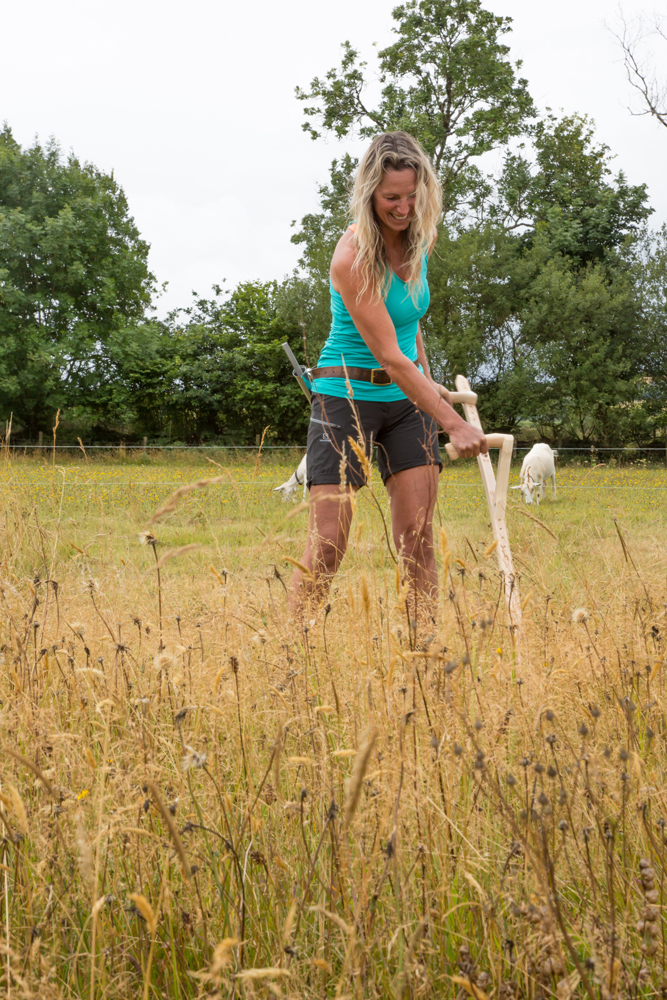 I spent the day with Scythe Cymru in West Wales, which is run by a twinkly-eyed couple, Michelle and Phillip. Michelle is friendly, slight and vibrant and is just the best teacher. She told me that more and more people are interested in scything and are taking their courses, adding with a wry smile, that Poldark had done a lot to raise the profile of it. The peace and quiet was so noticeable, listening to the birds whilst cutting grass was a new experience and the rhythmic ‘swoosh’ of the blade was almost meditative. I adored it. Michelle also spoke passionately about the healthy aspects of the mind and body connection and she is the perfect advert for good health.
Obviously mole/ant hills and large stones are not scythe friendly but there are specific blades that are better suited to clearing brambles, bracken and rough land, and scythes are not just for cutting hay, with a bit of practise you could cut your lawn with one.
As someone who has used a strimmer for nearly 30 years (I started young), the benefits of scything seem to be numerous. It’s an excellent workout (although not strenuous), you don’t have the cost of fuel (or hassle of walking back to the fuel can to refuel), and as already mentioned, it is far less hazardous. You do have to sharpen the blade every ten minutes or so but that is even enjoyable and provides an organic ‘whiff’, or break. And it is also an art in itself.
It is over 40 years since I used to watch granddad scythe his orchard but I now completely understand his love for it – I just need to practise to get up to his standard. Michelle and Phillip are running their next course at the end of August, more details at www.scythecymru.co.uk.
Moth Love
 We all love and appreciate butterflies but I think most people underestimate moths. As a kid, I thought that moths were just butterflies with their make up taken off. (Or that’s what granddad probably told me).
Studies have found the overall number of moths has decreased by 28% since 1968. The situation is particularly bad in the south, where moth numbers are down by 40%. Many individual species have declined dramatically in recent decades and over 60 became extinct in the 20th century.
Adult moths benefit plants by pollinating flowers, and both adults and their caterpillars are food for a wide variety of wildlife, including spiders, frogs, toads, lizards, shrews, hedgehogs, bats and birds. Night-flying adult moths form a major part of the diet of bats. Many birds eat both adult moths and their caterpillars, but the caterpillars are especially important for feeding the young. Some of Britain’s favourite garden birds rely on caterpillars to rear their nestlings, with our blue tit chicks alone needing an estimated 35 billion a year.
Moths also play a vital role in telling us about the health of our environment, like the canary in the coalmine. Monitoring their numbers and ranges can give us vital clues to changes in our own environment, such as the effects of new farming practices, pesticides, air pollution and climate change.
With that in mind, there is still time to whizz over to West Wales to join in the Dyfed Permaculture Farm Trust’s Lamas and Moth Celebration Count. From 4pm today (Saturday 4th) they will be having an afternoon of fun and activities, including a wildflower labyrinth and moth themed crafts, followed by a bring and share supper and camp fire. They will then set up a moth trap at dusk.
Those who would like to camp over in the wildflower meadows are welcome; otherwise you are welcome to go back early on Sunday to help identify the moths that have been trapped and release them back into the wide world.
To give you a taste of what to expect, some lovely pictures can be seen at www.dyfedpermaculturefarmtrust.org.uk/moth-celebration-species-list-and-bats.
Leave a Reply