
Taken from Lynne’s weekly column ‘Green Scene’ for the Western Mail
29th June 2024

What Day?
I had quite a shock when I typed up this weekend column and realised we are at the end of June. It reminds me of the story Dad used to tell us – ‘One day he met an old farmer on a remote part of the hillside and who asked him, ‘What day is it?’
Dad told him, and then the farmer asked ‘which month we were in’, Dad told him.
“Yes I thought we were about there,” replied the farmer, “and tell me, what year is it?”
Dad used to revel in telling this story – embellishing it every time. I have no idea of its accuracy but I am definitely identifying with it more and more as I get older.
Dog Days
 July heralds the start of the ‘dog days of summer’, often just referred to as Dog Days. The exact dates of the Dog Days can vary from source to source, and because they are traditionally tied to the dawn rising of Sirius, they have changed over time. Traditionally they refer to a period of particularly hot and humid weather occurring during the summer months of July and August. Some sources state more specifically that they are for the 40 days beginning July 3 and ending August 11. This is soon after the Summer Solstice in late June, which also tends to be the beginning of the worst of summer’s heat – and has certainly been the case for our most recent heat wave.
In ancient Greece and Rome, the Dog Days were believed to be a time of drought, bad luck, and unrest, when dogs and men alike would be driven mad by the extreme heat, but these days I think it’s a bit more cheerfully used for hot and sunny summer days.
High Roller
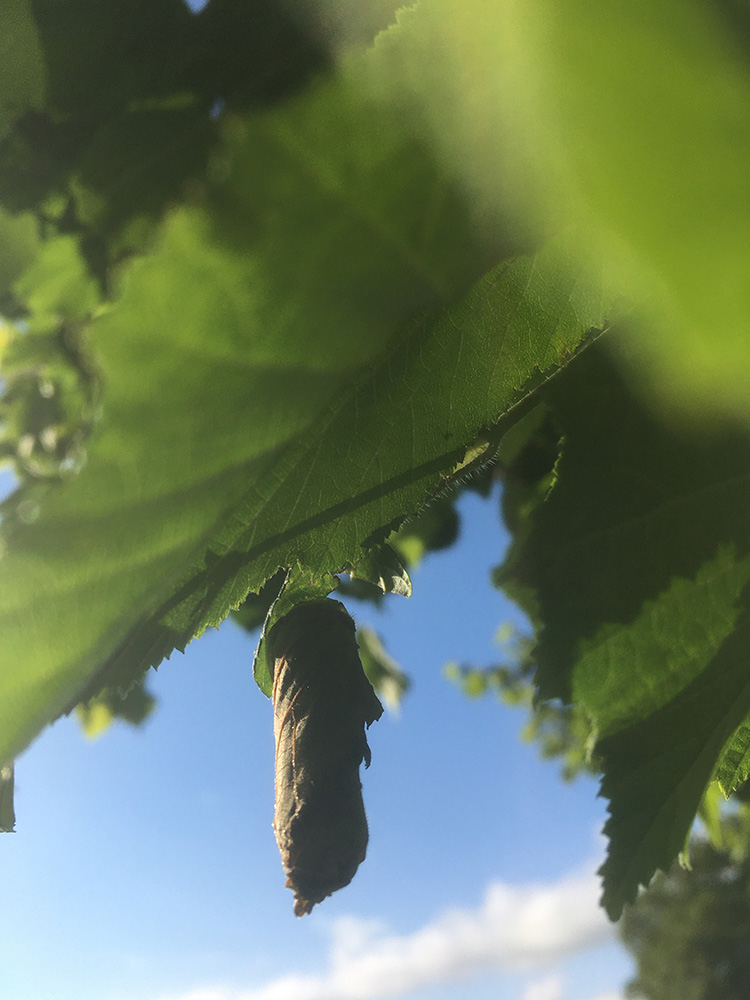 I have referred to several wonderful things that I have ‘witnessed’ as a result of my slow sniffari’s with yogi these days. As she sniffs and sends her pee-mails, I tend to have a little ponder and look around. This week I spotted something hanging from a hazel leaf that looked very much like a small cigar. Fascinated, I researched it as soon as I got home and found that it is the home of a Hazel Leaf Roller, a brightly coloured beetle with a red body and black head. The females cut the leaves and roll them into cigar-shaped cylinders or ‘cradles’ and lay their eggs inside them. The developing larvae will feed and pupate in these protective leaf wraps and the new adult beetles will emerge after a few weeks – I’ll have to keep an eye out for that!
I think it is worth reiterating that that these fabulous ‘observations’ are being enabled just by walking very slowly with Yogi in her dotage. Of course, all these wonderful things were happening in the hedgerows when I used to run past them, or even just stride past with a very energetic Westie, but I never saw them.
Taping of the Shrew
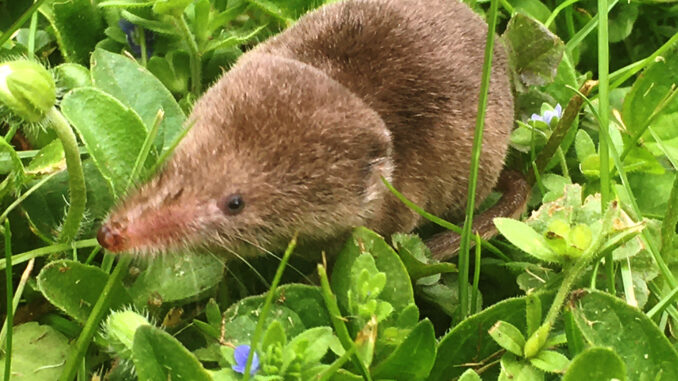
 And something else I noticed when I was in work this week – just sitting very quietly with a cup of coffee ‘between flowerbeds’ – was a tiny little shrew. He was very intent on getting a beetle or something out of the grass and had no idea I was so close. He has to eat every 2 or 3 hours in order to survive, and they consume one and a quarter times their body weight each day so it’s no wonder he was so engrossed with his food source. About half the size of my thumb, I’m pretty sure it was a pygmy shrew as they are smaller than the common shrew.
They are solitary and territorial animals and despite their size are aggressive towards other individuals, emitting a high-pitched squeak and sometimes swiping their tail from side to side if they encounter another pygmy shrew. They have a distinctively pointy nose and tiny eyes – and sadly only live for about a year, despite being unpalatable to many predators because of an unpleasant smelling secretion from their scent glands. But being unpalatable isn’t enough to ‘save’ them as they are often caught and killed by domestic cats that simply discard them rather than eat them.
It is such a privilege to be able to sit and watch something so special and there’s also something very special about noticing things that most people are overlooking.
Give Peas a Chance
 The first week of July hosts Great British Pea Week, marking the busiest season for the UK pea industry, and celebrating the versatile vegetable and the hard-working farmers who bring them to our plates.
The annual week long event aims to increase awareness and understanding of the provenance and heritage of peas, and champions the 700 pea farmers around the country, who work within 16 different grower groups to ensure that Great Britain remains the largest producer and consumer of frozen peas in Europe, maintaining the country’s impressive track record of being 90% self-sufficient in pea production.
The harvesting process, which lasts an average of eight weeks, is a huge operation which takes place between June through to August, 24 hours a day, 7 days a week. Harvesting machines, known as pea viners, work in unison to harvest, shell and transport the peas from field to frozen as quickly as possible, with the majority in just 150 minutes, ensuring the freshness and nutrients of each pea is locked in.
With the average Brit consuming around 9,000 peas a year, the pea harvest is critical providing 160,000 tonnes of frozen peas each year.
I am excited to watch the progress of my ‘special peas’ this year. I have grown a few amazing varieties supplied by the Seed Detective, Adam Alexander – see www.theseeddetective.co.uk
By far the most successful are the beautiful Bream Black Pea, a tall pea yielding heavy crops of purple podded peas that start almost black – hence the name. Its pretty purple and white flowers would also make it a good addition to the back of a border, as well as the veggie patch. Described as, “Very rare and tasty too,” I am looking forward to confirming out the latter.
So whether you are growing your own or just reaching into the freezer, celebrate British Pea Week by giving Peas a Chance this week – and every week.
Leave a Reply