

Taken from Lynne’s weekly column ‘Green Scene’ for the Western Mail
9th October 2021

Weather Without Technology

So we have gone straight from summer to winter then – ‘the wrong side of winter’, as Dad used to say.
Going back to college, albeit part-time, has suddenly seemed a whole lot more appealing, as apparently it’s not going to be a great month weather-wise.
For years I have been a fan of Weather Without Technology’s Dave King, who has been monitoring the weather and it’s correlation with nature for 50 years. He is a wonderful character – always entertaining and often accurate.
And this is his prediction for October:
“October, which is the rainiest month of the year over most of England and Wales (December is the rainiest month in Scotland), sets up the pattern which seems to be followed by the following winter months – stormy at the beginning and end of the month but relatively fine in the middle. In 35 out of every 50 years there is a period of stormy weather around 5-12 October, with a peak of intensity 8-9 October. This windy period is associated with a succession of depressions travelling west to east across the country. Generally the wettest days in this period are 8 October in the Home Counties and 11 October in much of Scotland.
In 30 out of every 50 years there is a short, fine period at some time between 8 and 28 October, the average dates being between 16 and 20 October. This coincides with St Luke’s Day on 18 October, and is recognised in folklore as ‘St Luke’s Little Summer.’ Actually, although the weather is fine and dry, it is not particularly warm, the air being partly polar in origin, but sunshine brings an illusion of warmth during the day. Nights are usually cold and frosty at this time.
The last week of October and the first fortnight of November bring prolonged stormy weather almost every year, the average dates being 24 October to 13 November. After a storm peak around 29 October there is usually a break in storms from 30 October until 4-5 November, after which storms occur with fresh intensity.
Temperatures are normally much milder than average, and frosts are rare. In fact, the frequent south westerly winds check the autumn fall of temperature at the end of October – there is often some snow in the north.
The general weather is dull and cheerless.”
That last line sums it all up!
Dave has published a great book which is available from his website – along with all his seasonal weather predictions and other relevant information. www.weatherwithouttechnology.co.uk
Work Mates
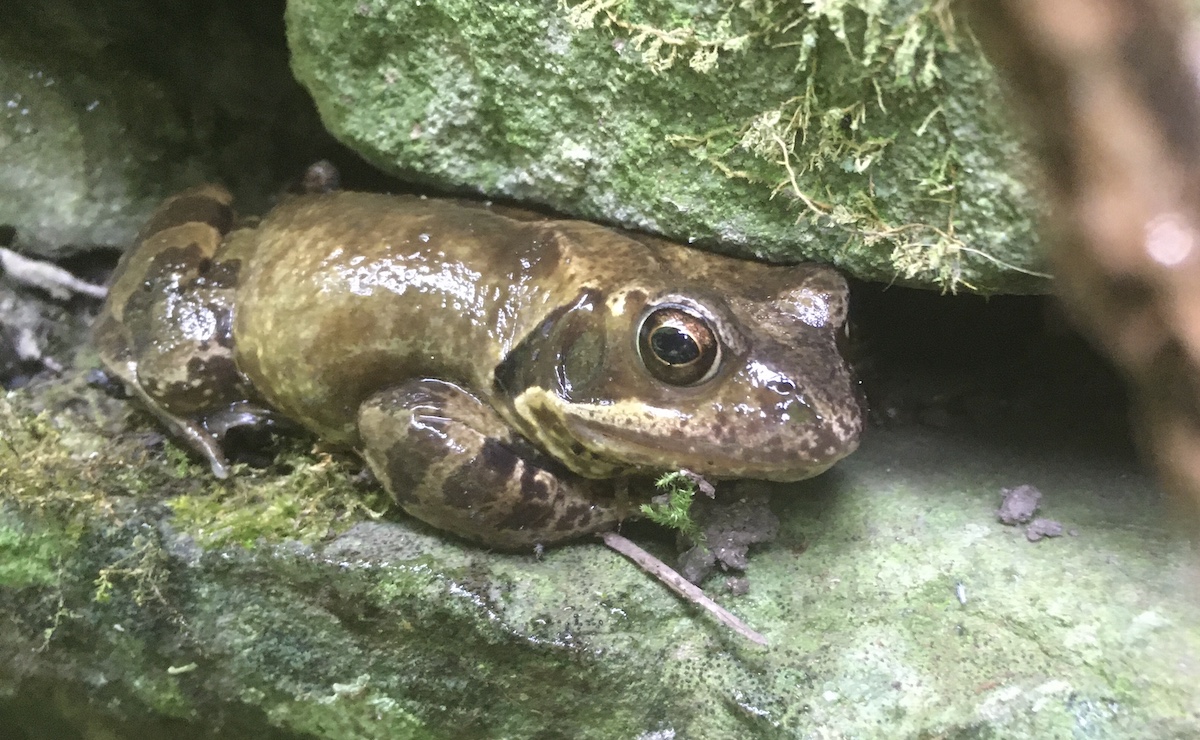 This week’s photo’s are of a few friends I made in work last week. Please be careful when clearing beds and borders at this time of year, I have already disturbed a few sleepy frogs and toads, and a not-so-sleepy newt – they’re all very well camouflaged amongst the spent autumnal foliage.
And mind your pets too as dogs (and cats) can be exposed to poison from toads if they lick them or carry them in their mouth. Eating (yup, it happens) or even mouthing a toad can cause salivation with foaming or frothing at the mouth, vomiting and some animals may paw at their mouths.
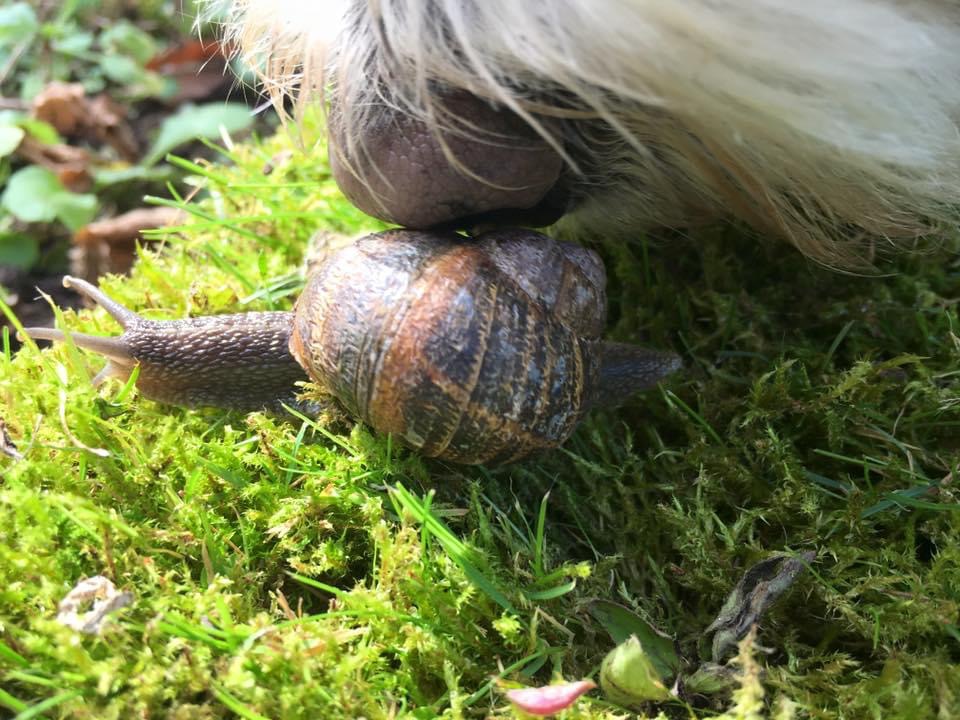 Severe poisoning is unlikely in the UK, but it’s always best to be aware of the dangers and remember that prevention is better than cure.
And whilst snails and slugs aren’t poisonous to dogs, – and apparently taste horrible – they may carry the larvae of the parasite Angiostrongylus Vasorum. This parasitic worm is the cause behind the potentially fatal infection of lungworm. Once very rare, cases of lungworm in dogs have risen gradually in the UK over recent years and can only be contracted by ingesting a slug or snail that hosts the parasite.
Thankfully Yogi is only inquisitive and not a fan of eating anything that isn’t actually given to her.
Nature As Teacher
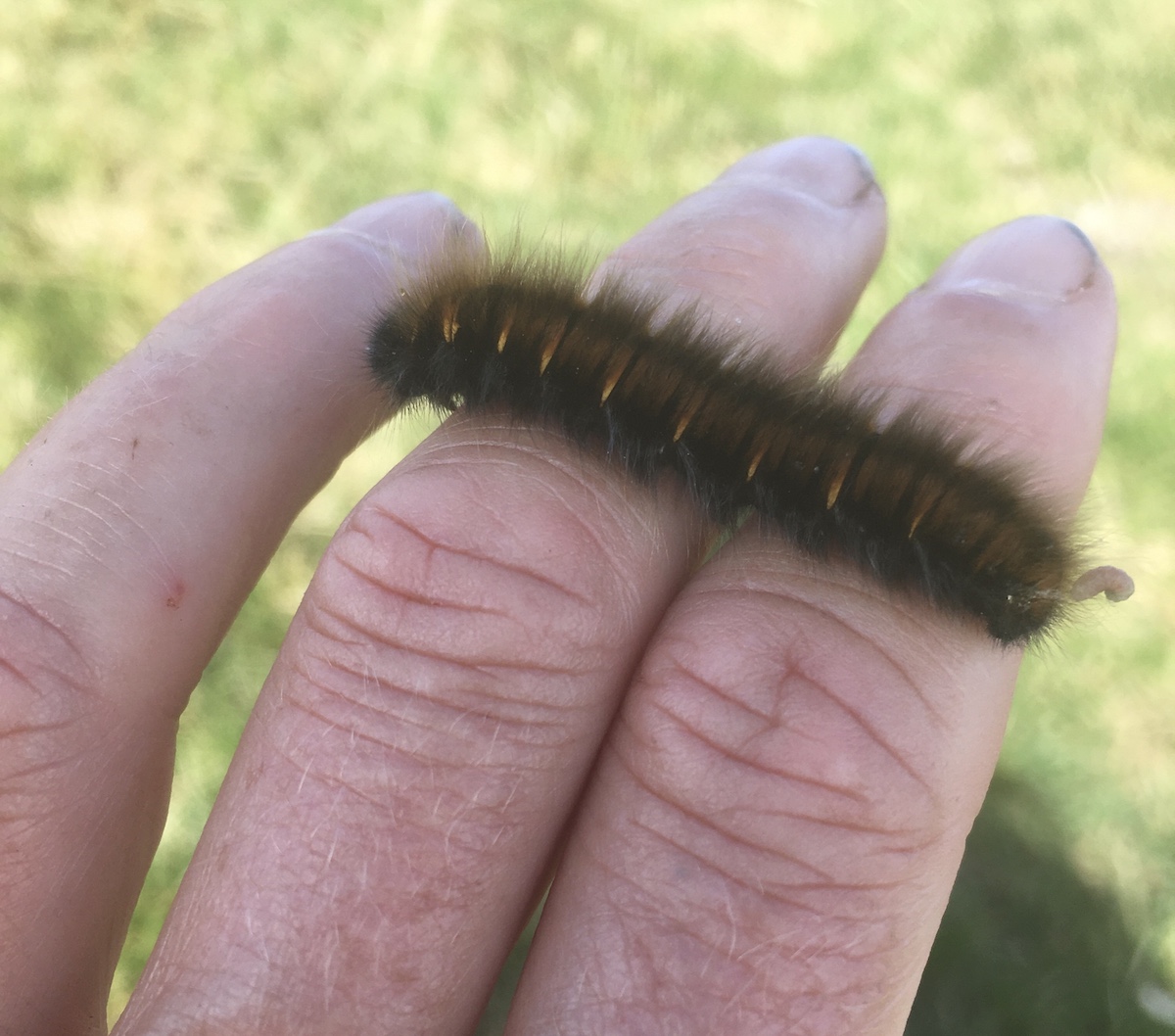
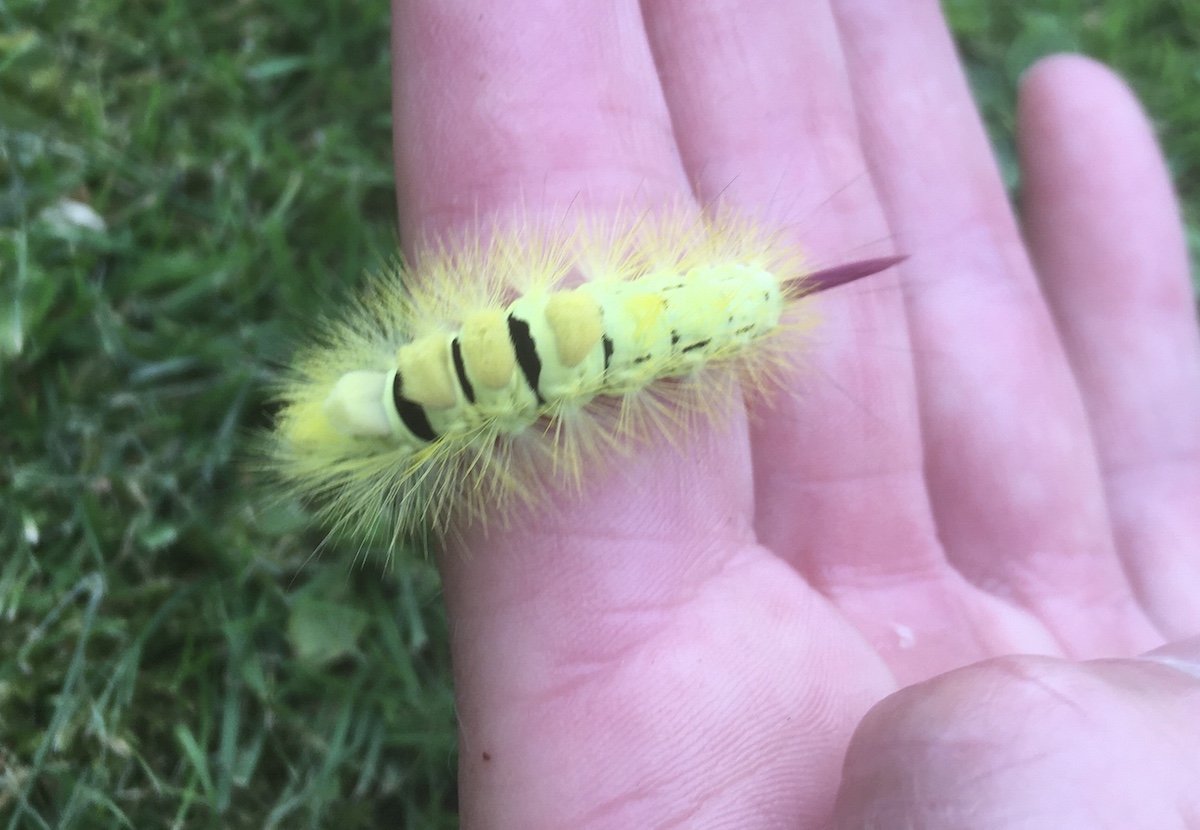 I also had the company of a few furry friends … a striking bright yellow-green, and therefore poorly named, Pale Tussock, and the Garden Tiger (I think) caterpillars. Again, these beautiful little creatures come with a warning – sometimes their hairs can irritate your skin. You can also see a little parasite grub on the Garden Tiger caterpillar – nature is endlessly fascinating and flies will lay eggs in the hair of some caterpillars as it’s deemed to be ‘safe place’ from a lot of predators. I never cease to be amazed.
I love this fabulous ‘caterpillar’ story, attributed to Henry Miller, about a little boy in India who went up to a guru who was sitting and looking at something in his hand. The little boy went up and looked at it. He asked the guru, “What is that?”
“It’s a cocoon,” answered the guru, “Inside the cocoon is a butterfly. Soon the cocoon is going to split, and the butterfly will come out.”
“Could I have it?” asked the little boy.
“Yes,” said the guru, “but you must promise me that when the cocoon splits and the butterfly starts to come out and is beating it’s wings to get out of the cocoon, you won’t help it. It is important not to help the butterfly by breaking the cocoon apart. It must do it on it’s own.”
 The little boy promised, took the cocoon, and went home with it. He then sat and watched it. He saw it begin to vibrate and move and quiver, and finally the cocoon split in half. Inside was a beautiful damp butterfly, frantically beating its wings against the cocoon, trying to get out and not seeming to be able to do it. The little boy desperately wanted to help. Finally, he gave in, and pushed the two halves of the cocoon apart. The butterfly sprang out, but as soon as it got out, it fell to the ground and was dead. The little boy picked up the dead butterfly and in tears went back to the guru and showed it to him.
The guru said, “You pushed open the cocoon, didn’t you?”
“Yes, I did,” sobbed the little boy. The guru spoke to him gravely, “You didn’t understand what you were doing. When the butterfly comes out of the cocoon, the only way he can strengthen its wings is by beating them against the cocoon. It beats against the cocoon so its muscles will grow strong. When you helped it, you prevented it from developing the muscles it would need to survive.”
It’s a great lesson, isn’t it? And a good example of the motivation behind my new Facebook page called Nature As Teacher. Do have a look and join us.
He’s Hilarious, He’s my Brother
Clearing a huge flowerbed with my brother this week, we had established that there were a few things we had to be careful not to tread on or dig out. But our awareness didn’t stop our new client shouting at my brother, ‘Be careful, there are bulbs in that bed. You’re treading on them.”
My brother straightened up slowly and replied, “Sorry – but my powers of levitation aren’t what they used to be.”
Leave a Reply