
Taken from Lynne’s weekly column ‘Green Scene’ for the Western Mail
7th November 2020

Underground, Overground
If you didn’t just read that heading and add ‘wandering free …’, I worry for you.
I have had ‘something’ undermining my veggie beds at home for a few months and at first thought it was the rabbits that I sometimes see helping themselves to the crops that they think I have planted for them. Despite not being very ‘gardener-ish’, I like seeing them about, and always leave them to it. I don’t mind sharing the top growth of various crops but that ‘sinking feeling’ when I tend the beds, is getting frustrating and affecting the health of a lot of plants.
A little later, I noticed the obvious absence of earthworms. That made me think my tunnelling terror was a mole, but there were no evident mole hills, so maybe a rat? If you’ve shuddered, there is a shocking estimation that (in urban areas particularly), you are probably never more than 20 ft away from a rat. It has become more popular to suggest 6ft, but more reliable sources ‘reassure’ us that it is nearer 20ft .
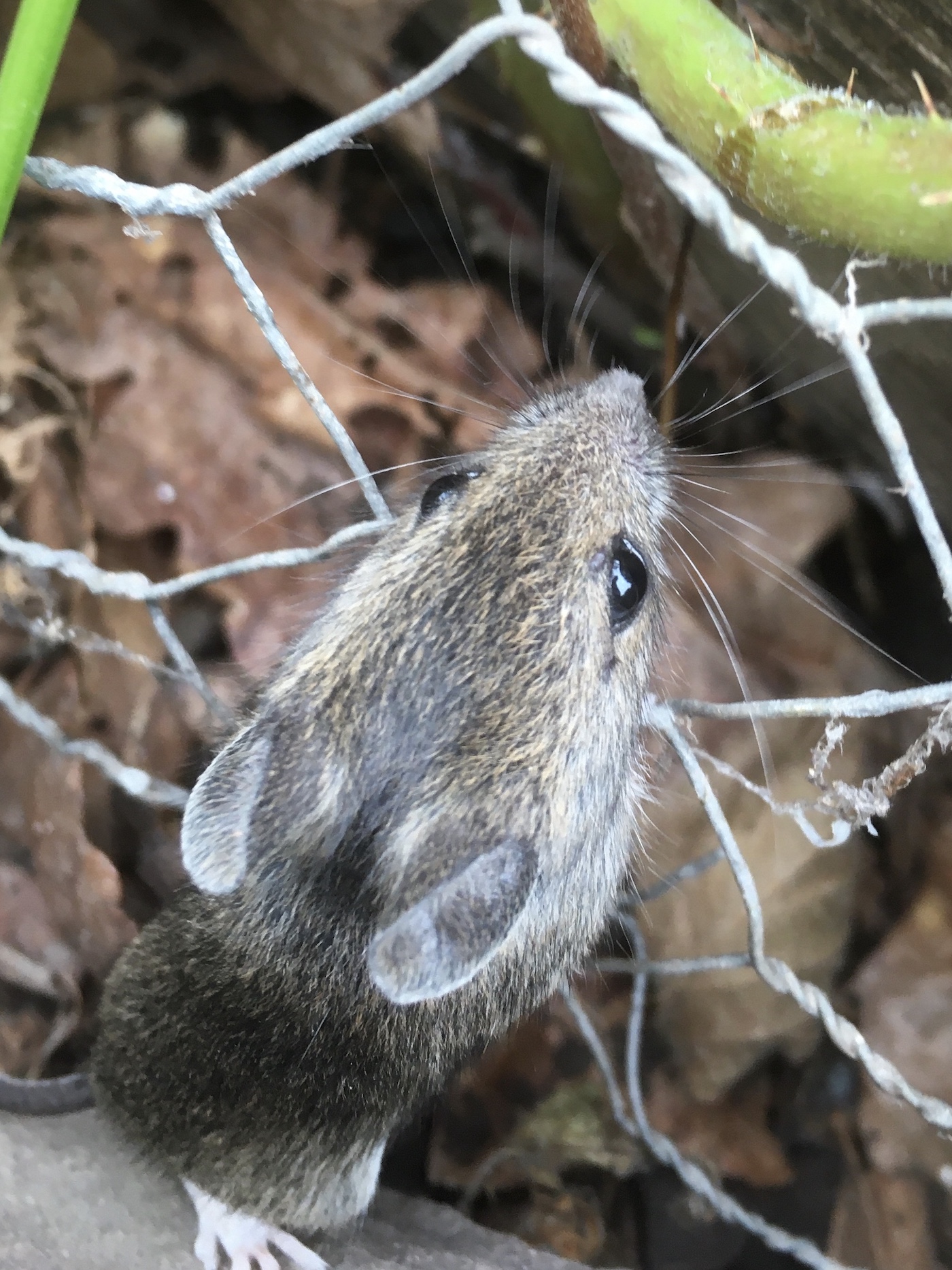
Last week I was clearing a few beds and disturbed a few field mice – also known as wood mice (see pic). But the underground warrens are far too big for mice – it’s more likely to be Welsh coal miners looking for anthracite, the way the ground is collapsing.
And then a few weeks ago a client had ‘something’ tunnel under her asparagus bed. It was chewing the roots and cheekily bringing them up to the surface. We were baffled. Her husband set up a wildlife camera for a few nights but saw nothing.
So we turned to Google. Possibly not the most reliable gardening pest expert, Google suggested it is likely to be voles. The field vole (or short tailed vole) to be exact. This species is very elusive and far less likely to be seen than it’s relative, the bank vole, as it spends more of its time in runs and burrows. It also eats roots. But they also spend most of their time in long grass and are not very big, certainly not big enough to create the tunnels that are undermining my garden and my client’s asparagus bed. I wondered if they could have ‘squatters rights’ in an old mole run. Google didn’t know.
Although I would rather it not be, my money is still on a rat, although my client seems to think they are blasé enough to have been spotted on the wildlife camera. I have to agree; with my experience of rats and their confidence, if they saw a camera they would be more likely to be presenting a piece to it.
It remains a mystery, so if you have any idea, or experience of the same, I’d be glad to hear from you.
Leaf Art
 I am always quite intrigued by the rate and sequence that trees change colour and discard their leaves in autumn. Some trees started turning in colour at the beginning of September this year. Some are now standing fully naked, whilst others are hanging onto their green canopies like cloaks clutched against the recent high winds and rain. Ash are traditionally the first to drop their leaves whilst sycamores can often hang on to theirs until mid winter. Different species form the abscission layer, (which causes the leave to fall), at different rates, resulting in leaves falling at different times. The oak doesn’t completely form an abscission layer, so oak leaves will often remain attached to the tree throughout the winter.
Great to see Monty using his besom broom to sweep the leaves off a grassed area last week, even if it did look a bit like a ‘token gesture’. I remember granddad using his ‘witches broom’ often at this time of year, in that same unhurried, rhythmical action that he used when scything. Great for the mind and body as well as the garden, I’m sure.
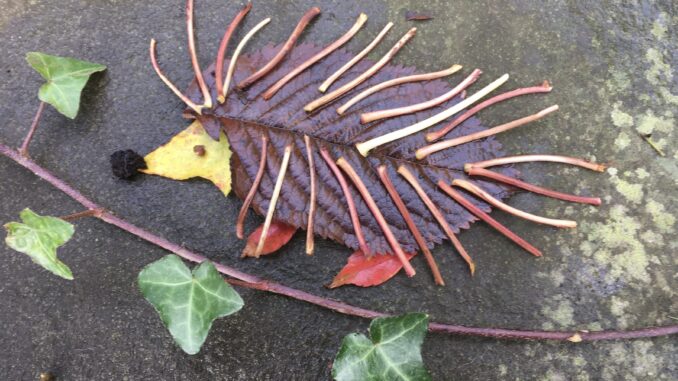
Whilst stopping for a cup of coffee in my garden recently, I started messing about with a few fallen leaves and came up with a few arty efforts (see photos). I also learned that it would be far better to do it indoors, or at least out of the wind. I have always felt that the wind can watch you, as it devilishly scuppered several of my early attempts at leaf art – and as it similarly often redistributes a neatly raked pile of leaves.
Winter Weather
 Whether the wind has eyes or not, keep your eye on it this week. If the wind is in the south-west on St Martins Day (11th), it will stay there until February, ensuring a mild, snow free winter. But if the wind is in the north-west on St Martins Day, it is thought that a severe winter will follow.
It seems that St Martin’s Day is a key pin for a lot of the weather forecasting folklore. Apparently if the leaves of the grapevines do not fall before Martin’s Day, a cold winter will come. I checked, and the leaves have definitely fallen from my grapevine.
And if ducks do slide on St Martin’s Day, at Christmas they will swim. If ducks do swim on St Martin’s Day, at Christmas they will slide.
Regular readers will know that I like to follow David King’s weather predictions too. David predicts ‘weather without technology’, relying on his experience of nature and copious years of note taking. He is predicting – a little tentatively as he says ‘extreme weather is buggaring up his traditional methods a bit’ – a wet November, a drier and colder December (stormy toward the end of the month), a wet January and a cold, dry February and March.
You can find more detail at www.weatherwithouttechnology.co.uk
Leave a Reply