
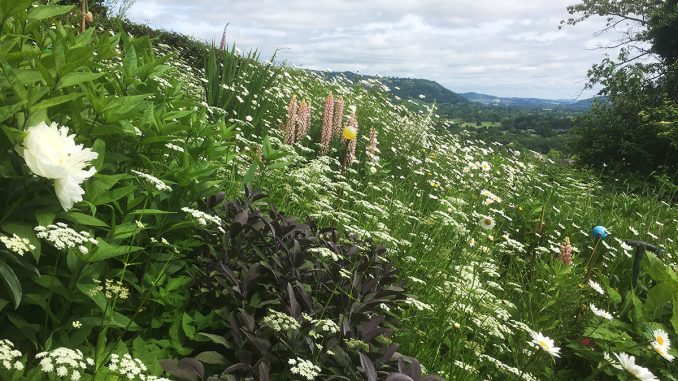
Taken from Lynne’s weekly column ‘Green Scene’ for the Western Mail
20th June 2026

Short-icultural Cuts
After another busy weekend spent in my own garden, I can completely understand why people get a bit overwhelmed with theirs at this time of year. Everything is growing at full throttle and the line between ‘managed happy space’ and ‘jungle’ becomes finer each week.
I think everything is growing quicker this year too – possibly because of the constant fluctuation in temperatures, as well as the rain. My theory is that cold-then-hot conditions trigger growth as plants think it’s spring. So if this is happening frequently, they keep blasting out that ‘spring growth’, and the result is the triffid-esque growth we are seeing now.
If you are overwhelmed, I think the main things to concentrate on are hedges, grass and keeping pathways and seating areas clear. ‘That’s the whole garden’, you may think, but it’s really not. There are some professional ‘tricks’ to help – I think they are called ‘hacks’ now, but that used to be a pony when I was a kid.
The first is to keep hedges neatly clipped. As I mentioned last week, you’ll still need to be mindful of nesting birds, but being vigilant and only lightly clipping them will mean that the hedges provide a sort of framework in the garden and take the eye away from less tamed areas. Similarly, any topiary should always be kept neat as it also provides a focal point.
Also aim to keep the grass cut regularly. No Mow May often leads to a Just-A-Mess June, so do endeavor to keep some control over your grassed areas, even if it’s just cutting paths through longer grass. Nothing says, ‘neglect’ more than a completely unkempt lawn. Also keep the edges of borders and lawns clipped too. I love that job – it’s so satisfying and looks so professional when done. It also helps to keep grass seeds out of beds and borders.
 And finally, keep pathways and seating areas weed free and accessible. It is soul-destroying to have to push through unruly shrubs and floppy herbaceous plants to get around the garden – especially after it’s rained. So either stake the potentially floppy plants so they don’t hamper access, or be brutal and cut them back as necessary.
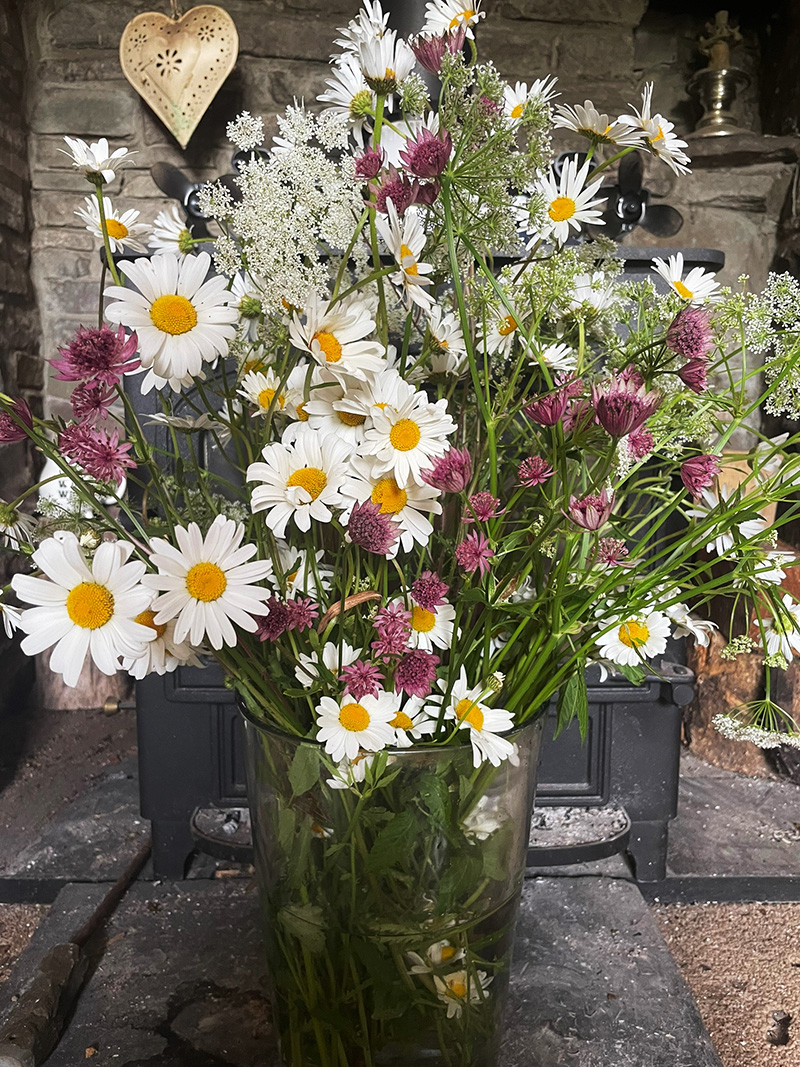
The cottage is awash with Michealmas daisies at the moment, which Is fine by me, although some people consider them to be a weed. But at this time of year I have to put pegs along side the paths and use long runs of string either side to keep the daisies off the paths. When the rain beats me, and they do flop, I just cut them back ‘en mass’ and put them in a huge vase in the cottage. It all looks very ‘Country Life’ but is basically because I hate throwing anything thing that’s in flower on the compost heap.
I think they’ve worked hard to get to that stage.
Vole Picture
 There’s a new(ish) pest on the block. At least, locally. One of my neighbour’s gardens that I look after has had a problem with voles for the last 2 years or so, but now they are ‘spreading’ – quicker than the sea of ox-eyed daisies – and seem to be a growing problem in several other gardens I work in. Including my own.
And the problem is that voles don’t work alone. With their hugely successful reproduction rate, they live in groups and work in gangs to maintain their tunnels and find food. Not only will they cheerfully remove the top growth of freshly planted out seedlings, but they also devour the roots of lots of established plants, which tends to kill them more slowly and by stealth. You don’t know they’ve been nobbled until it’s too late to do anything about it. And that’s the other problem, there doesn’t seem to be much you can do about it.
Apparently voles don’t like members of the Allium family, and I read that planting a little border of chives around borders and veg beds will help deter them – but I want that many chives about as much as I want voles.
Chair the Love
I love an ‘unusual career’ – one that make me think, ‘Well, they didn’t mention that in my career’s talk in school’.
So I enjoyed reading about Gavin and Alice Munro in Derbyshire, who have spent the past 20 years trying to ‘grow trees into chairs’. The process, which takes up to 12 years, involves planting oak, willow, beech in their ‘Chair Orchard’, then using specialised ancient techniques including coppicing, grafting, and pleaching to encourage them into the desired shape. They then dry the trees indoors for a year and sand them down into their finished form.
It’s the sort of thing I would have thought about doing in the past, but then – like a grasshopper – I would have bounced onto something else. Maybe I should have taken it further, as whilst some of the chairs are usable as furniture, most are sold as works of art, fetching upwards of £65,000. They are breathtakingly beautifully and the process is just breathtakingly intricate.
More details at www.fullgrown.co.uk
Sibling Styles
 Whilst working in my own garden, I was thinking about the difference in my and my brother’s gardens – in spite of us having the same upbringing and being fourth generation gardeners – on both sides!
My brother’s garden, where we were brought up, still has several of Dad’s traditional, professionally chosen, specimen trees and shrubs – you can tell it was professionally landscaped and planted at one stage – and swathes of the most beautifully mown grass. My brother’s not known as the Lawn Ranger for nothing. The boundaries are also defined by beautifully clipped beech hedges and there are no beds and borders, no statuary, no pots and no ‘tat’. He deliberately undertook some projects to make the garden as low maintenance as possible, with the exception of lawn mowing. It has a sort of ‘country estate’ feel about it.
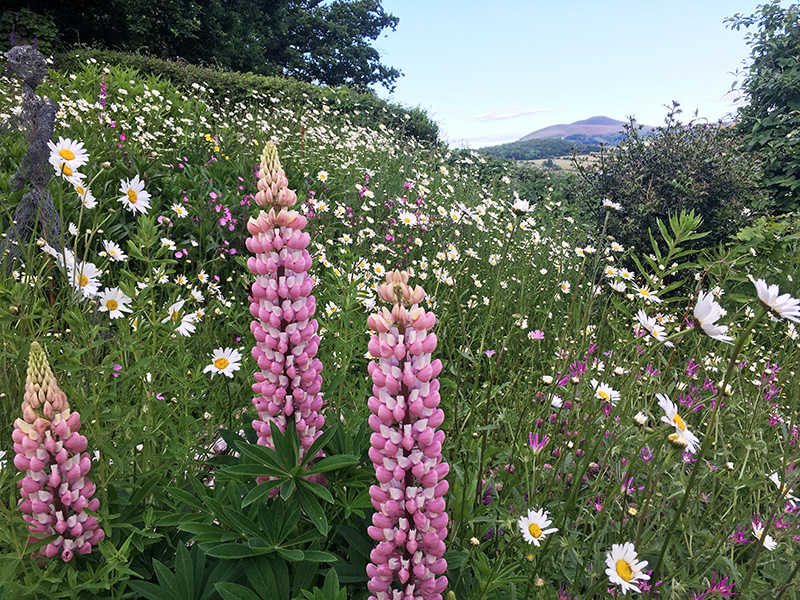 My garden, on the other hand, is more like a burst bag of Haribos.
It is locally renowned for the life size giraffe I have – which also serves as a landmark for directions – look for the giraffe and turn left etc.
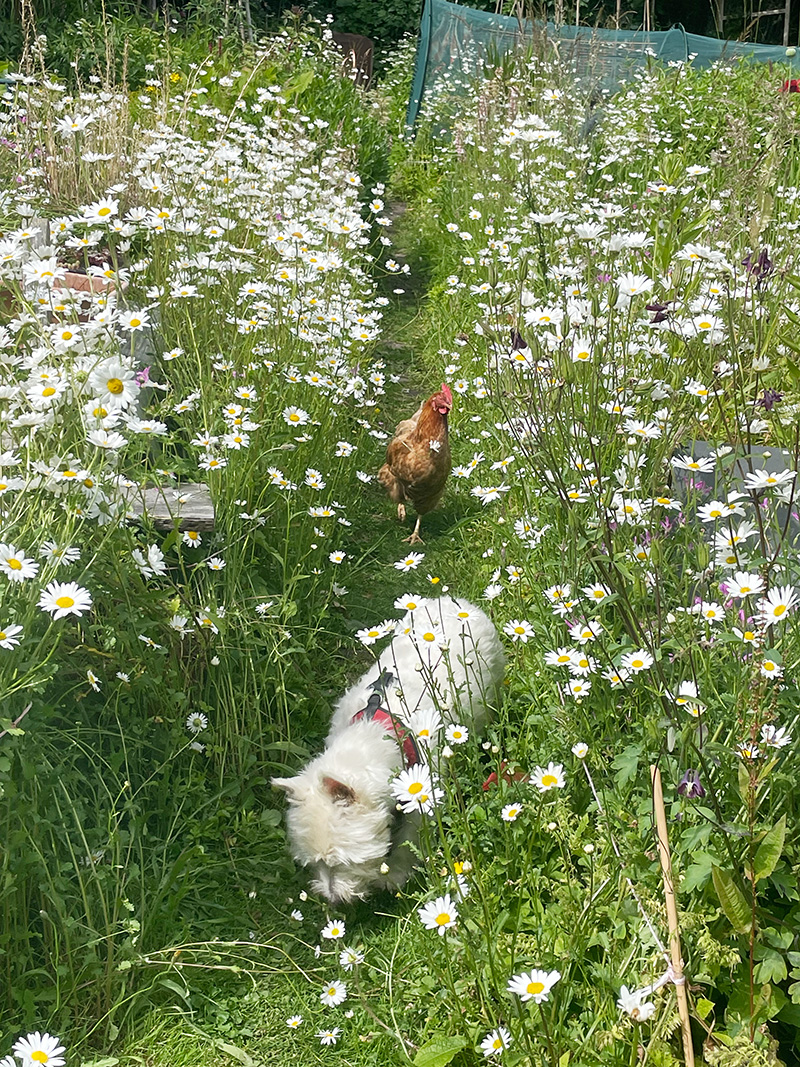
It is full of ‘statuary’, although I use the term loosely as that includes a lot of my own hand crafted wires sculptures, and other creative bents. My chickens run loose. I have pathways cut through swathes of ox-eyed daisies and other billowy plants.
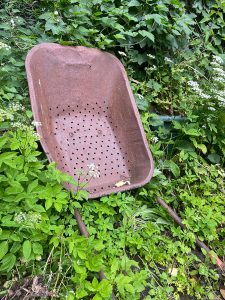
There are seats squished into borders, and ‘dead’ wheelbarrows used as seats in the veggie patch.
Old tools are used as garden stakes and supports and everywhere you look there will be a story about whatever you choose to pick out.
My hedges are ‘edible’ and consist of gooseberries, raspberries, blackcurrants and blackberries.
Every project I have undertaken has increased the amount of maintenance needed – including the little ‘dipping pond’ I built for Yogi to cool off in a couple of years ago, which now transitions between varying shades of green but is full of dragon flies.
There are ‘dead hedges’ – hedges built from things like buddleia and hazel which have been cut back and ‘laid’ in a hedge to provide accommodation for hedgehogs and other wildlife and, yes, there are hedgehogs, slow worms and birds – lots of birds.
And I love every square inch of it. Your garden should be a place where you can be and forget all the trails and tribulations of the world, the neighbourhood and even the family. Whatever your location, your style or your budget, make your garden a place you can lose yourself for a few hours … and ultimately, find yourself.
Your garden sounds lovely. I love your turn of phrases.
What a bloomin lovely post.
I always look forward to your emails xxx