
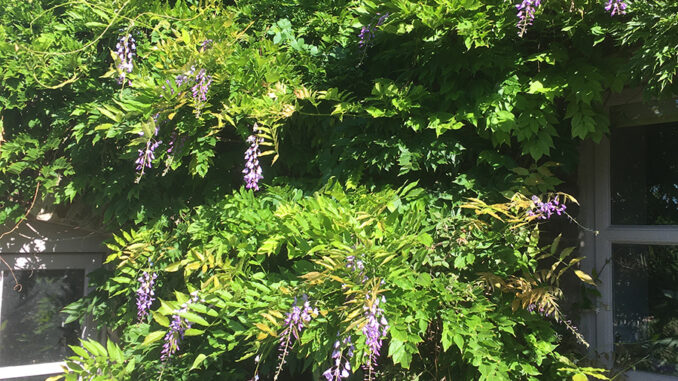
Taken from Lynne’s weekly column ‘Green Scene’ for the Western Mail
20th August 2022

Repeating Myself
 Yes, I am still banging on about the Buchan spells of ‘predictable weather’ during August.
Two weeks ago I said that the 12th – 15th often develops into a heat wave; then last week, as I had to get the copy in at the beginning ofthe week, the weather forecast was for the ‘heat wave’ to be from the 9th – 12th, so I mentioned (a little prematurely) that this year’s Buchan spell was just 48 hours out – not bad for a prediction originating back in the 19th century BUT the forecasted heat wave overslept and actually occurred from the 11th -14th.
Bang on. Full marks.
Typical woman, I know – can’t let things go – but let’s face it, it is pretty astonishing, especially when my phone app can’t correctly predict the weather day by day, let alone two centuries ago.
Anyway, you’ll be glad to hear that I’m going to leave the Buchan spells there now. Until next year, at least.
Repeating Blooms
I’m not the only one repeating myself lately. A few people have asked me why some of their shrubs are repeat blooming now. I wonder if it’s because they are stressed and are producing more seed to try to ensure their survival. I like trying to think like a plant and therefore that is my theory. The most common second-bloomers seem to be Magnolia soulangeana and Wisteria sinensis and floribunda.
Magnolias are prehistoric, with fossils revealing that they existed at least 20 million years ago. They would have appeared before bees did, which is probably why the flowers evolved to be pollination by beetles – and beetles continue to be the preferred pollinators. It also proves that Magnolias know a thing or two about survival.
 According to the Tree Register, Wales hosts the tallest recorded Magnolia tree in the UK. The Magnolia campbellii is in Clyne Gardens, Swansea standing at an impressive 26 metres. There are, of course, varieties suitable for small gardens, such as Magnolia liliiflora ‘Nigra’ and Magnolia stellata. Magnolia soulangeana is commonly referred to as the Chinese Magnolia whilst Magnolia liliiflora is known as the Japanese Magnolia – although Magnolia soulangeana is also often referred to as the Japanese magnolia. Plant names are a never-ending learning curve. I love the book, “Plant Names Simplified: Their Pronunciation, Derivation & Meaning”. It’s a great book but I’m not sure they’ve simplified the subject that much!
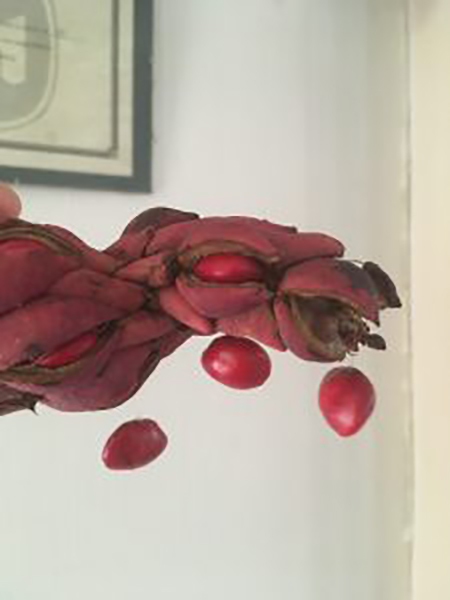
Magnolias also have the most amazing seed pods (see photo) – keep an eye out for them toward the end of the autumn.
Wisteria Hysteria
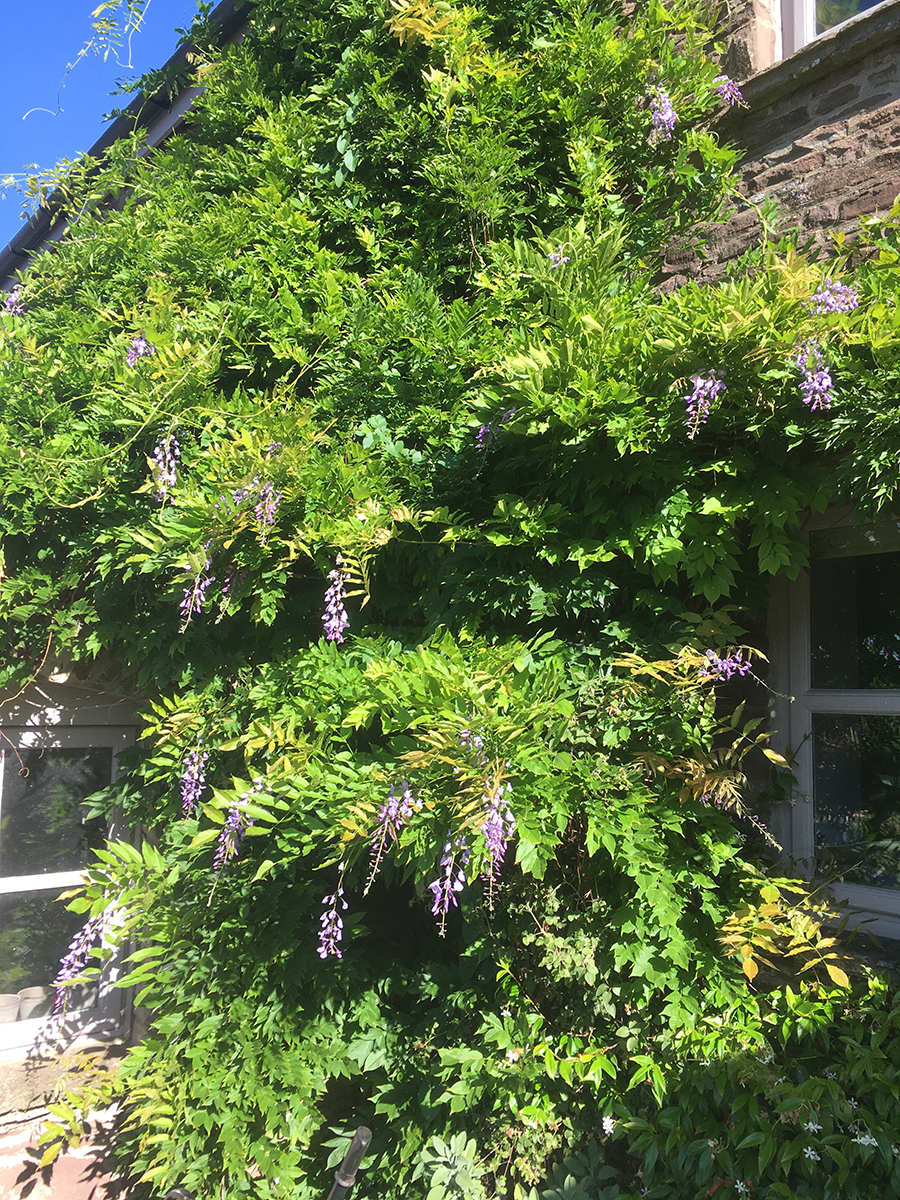 Both Wisteria sinensis and floribunda are repeat-flowering this year too. You can tell the difference between the two by the way they climb. If the stems twine clockwise (when looking from above), it’s probably a Japanese Wisteria (W. floribunda). The Chinese Wisteria (W. sinensis) twines anticlockwise and is the most common one in the UK.
Wisterias are quite magical plants I think and folklore agrees. It tells us that as Wisteria likes to grow on doorways, it was often seen as a portal to different worlds, and washing your hands in the bloom-soaked water is said to give healing hands. Another quirk is that the flowers are edible, but the seeds and stems are poisonous. I’m not sure if that indicates nature’s dark sense of humour or just that ‘she’ has a sense of adventure.
However, some gardeners lack patience with the diva-esque behaviour of Wisterias as they often refuse to flower until around 7 or 8 years old and can quickly choke out other plants once they do get going. It’s also worth remembering that when grown against a house wall, a mature Wisteria can provide excellent access for burglars. And beware of the sap when pruning – it can stain skin and leave brown marks on clothes that nothing will shift. I’m sure these reasons contribute to the fact that many gardeners claim that it is a plant that should only be given to your enemies.
Typically, Wisterias will only bloom once in late spring early summer. However, although unusual, they will occasionally bloom again in August – if they feel like it. Apparently a second bloom can also be encouraged by deadheading spent blooms as soon as they start to wilt or droop in the spring.
Water Week
 There is no irony lost on the fact that next week is World Water Week. The theme of this year’s World Water Week is, ‘Seeing the unseen: The value of water’. More irony – after all many people only value something when its not there.
Despite the recent focus on the lack of water, on empty reservoirs and trickling rivers, many of the world’s most urgent water challenges are invisible to the naked eye – the availability and state of our groundwater, the global streams of so-called virtual water (virtual water is defined as the water embedded in a product, that is, the water consumed during its process of production), and the impact water has on people, nature, and economies.
Ismail Serageldin has been one of the most important voices calling for attention to the issues of water throughout the last decade and in August 1995 he warned that, ‘If the wars of this century were fought over oil, the wars of the next century will be fought over water – unless we change our approach to managing this precious and vital resource.’
This year is the first year that you can attend seminars online and you can see the full programme and more details at www.worldwaterweek.org
Hoh and have you sorted out your water butts yet?
Footnote
 I fell in love with (and bought) a beautiful pair of ‘Mar y Viento’ shoes recently and messaged a friend saying, “I’m not sure whether to keep these or not – no good for gardening or running!”
She immediately replied, “Exactly the reason you should keep them.”
I have.
Leave a Reply