
Taken from Lynne’s weekly column ‘Green Scene’ for the Western Mail
24th April 2021

Ozzy Osmanthus
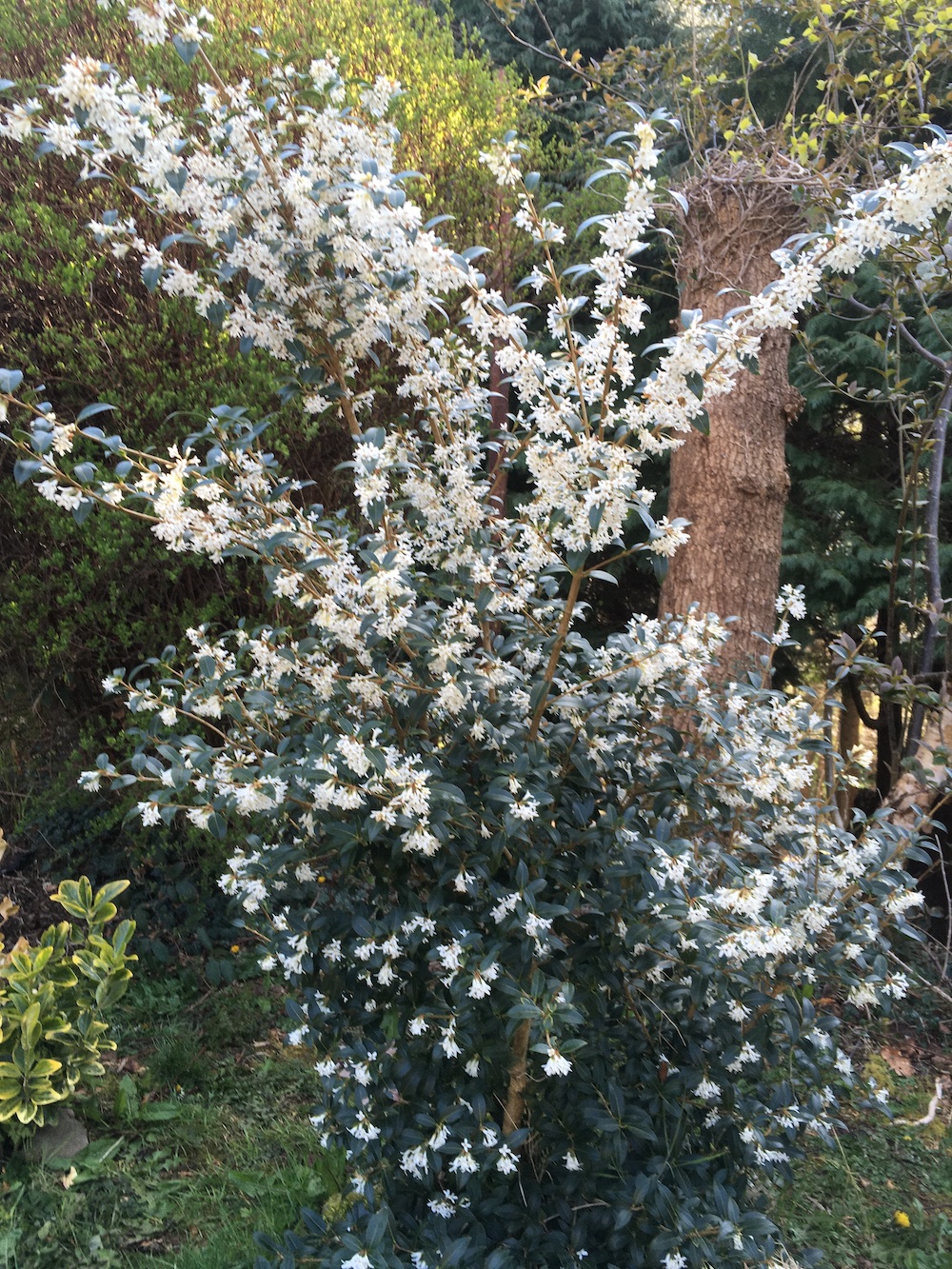 When taking Yogi for her haircut last weekend, I was reminded of the attributes of the undervalued shrub Osmanthus burkwoodii, which was in the Groomer’s garden. I could smell it before I could see it – which was even more special after 8 weeks of not being able to smell anything courtesy of Covid – and which also reminded me of my very first encounter with it.
I was about 10 years old and got out of the car with my dad in a car park in Abergavenny, which was next to a public garden. “What’s that lovely smell?” I asked him. His reply was “It’s a shrub – go and find which one.”
Like the Bisto Kid, I tracked it down to an evergreen shrub with small white flowers – deceptively scented for their size.
He then told me the name of it, breaking it down to Os as in Ozzy Osbourne (cool dude, my Dad), who was a ‘man’, ‘thus’ the shrub being named after him (which of course it wasn’t). Obviously I didn’t appreciate how clever this type of teaching was but I remember the name over 40 years later, post menopause and when I can’t remember a lot more important things!
Lots of white flowered shrubs are highly scented, especially in the evening which makes them ideal for planting next to a seating area or outside door. Osmanthus burkwoodii will be happy on it’s own in a large tub on the patio or lined up with a load of mates to create a dense, evergreen hedge. If left to it’s own devices it can reach a height of 12 ft by about the same width. It does tolerate enthusiastic pruning though and if you just trim the shrub or hedge after flowering, it will increase the flowering for the following year.
The leaves are small which helps it cope well with the winter weather and clusters of small, highly-scented white flowers appear during April and often May. Occasionally they will be followed by a few black fruits.
Jazzy Camassias
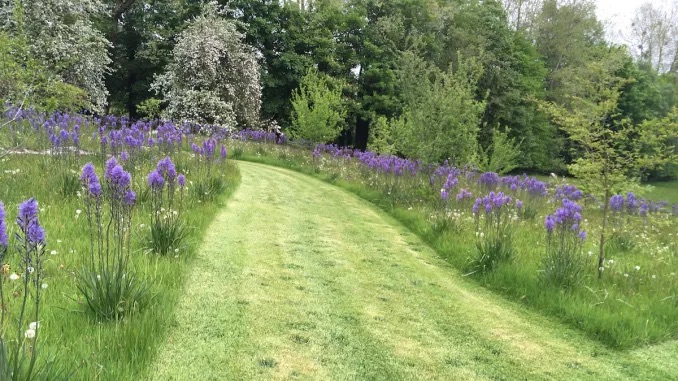 Another of my favourite flowers out in all its glory now, are the Camassias. As well as their architectural stature I love them because they are just so self sufficient and uncomplicated. They will thrive in damp places and yet mine are also doing well in dry-ish beds. Very dry at the moment. They love full sun and yet mine are in semi-shade. They look great in borders, tubs and when naturalised in grass.
A large local private garden, where I used to work, has used them en mass to naturalise a large orchard and then mown paths between the tall, blue swathes to enable visitors to appreciate them.
Planted in the autumn, the Camassia leichtlinii subsp. suksdorfii Caerulea Group are often overlooked, which is a shame as they are far easier to grow than to pronounce. They are available with white, pale blue and pale pink flowers which are all great for ‘lifting’, or brightening up, shady areas whilst the Camassia quamash has stunning bolder blue flowers.
All Camassias make fab’luss cut flowers, which is another reason I love them.
Water Good Way to Help
 If we don’t have some rain soon I’m never going to get any paperwork or housework done. And of course the gardens need rain too.
I had to move a few shrubs and herbaceous plants last month and have been watering them in regularly ever since. Together with the sharp frosts, it’s not ideal weather for gardening. But then when do we ever get that? What we need is nice sunny days, with a bit of cloud cover now and then and gentle, warm rain during the nights.
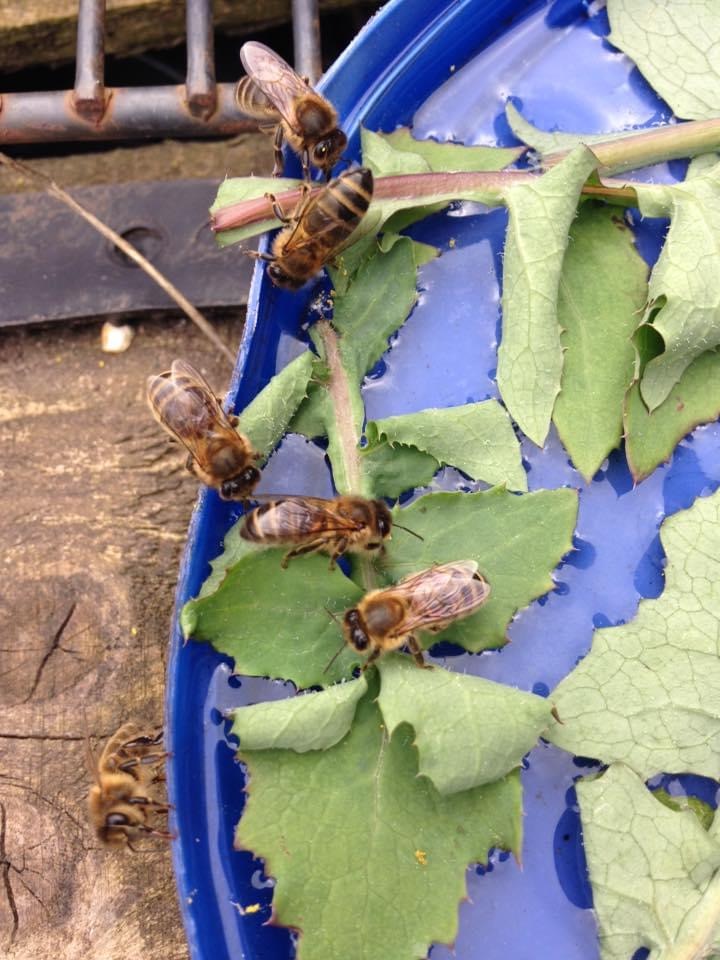
As well as watering my relocated plants, I’m also putting out water for my honeybees. They are busy out and about foraging in the sunshine but will be finding it hard to access water. Bees and butterflies can’t drink from deep water as the surface tension won’t hold them, so they drink from shallow water, muddy puddles and boggy ground and of course, these are always the first to dry out.
It would be great if you could make sure there are ‘drinking holes’ or ‘Bee Bars’ around your garden, or balcony even, for them to drink from. As the photo shows, all you need is a shallow dish of water (rainwater from a water butt is best) with some leaves or small stones for them to stand on. Once they feel stable and safe they’ll put their proboscis in the water to drink. It’s a great way to encourage them into the garden – and butterflies.
If you are feeling creative, you could make a large bog garden out of an upturned dustbin lid or something similar – or even create one in the ground in the garden. Just add peat free compost and a few sticks and stones and keep it soggy. They will be able to extract the moisture from that.
Birds also need water, of course – to bath in as well as drink. So a birdbath is a nice idea – for them and you. It is the best entertainment, watching them having a good old wash, and often you’ll see others lining up waiting. It never gets boring.
Vitamin G
 The UK’s biggest annual celebration of gardening is taking place from Monday 26th April to Sunday, 2nd May 2021. Ever since the launch of National Gardening week in 2012, the annual event has grown in popularity.
This year, the Royal Horticultural Society is encouraging everyone to “Get Your Dose of Vitamin G!”
“Vitamin G is ‘green’, and research has shown that getting a daily dose improves our sense of personal wellbeing,” explains RHS Director of Science, Professor Alistair Griffiths.
Over the last year many people have come to rely on and appreciate their gardens and green spaces more than ever, discovering the importance of connecting with nature for mental, emotional and physical wellbeing – the Natural Health Service, as I like to call it.
Find out how to harness the feel-good power of plants and gardens, learn the scientific links between gardening and wellbeing and discover lots of easy tips and projects to get your daily dose of Vitamin G at www.rhs.org.uk/get-involved/national-gardening-week.
Leave a Reply