
Taken from Lynne’s weekly column ‘Green Scene’ for the Western Mail
13th April 2024

Have a Whiff

One of the many enjoyable things about repairing sections of a dry stone wall is, because it’s so physically demanding, I find myself having regular ‘little breaks’ – mainly to pacify my back! My nan used to call it ‘having a whiff’ and it is an integral part of any hard, physical graft. These ‘bijou breaks’ are inevitably used to watch the surrounding wildlife in all it’s glory. I watch the crows bomb the buzzards and chase them off their territory, and I watch numerous bumblebees feeding on celandines and wild primroses, making the heads bow with their weight.
The physical effort it must take for such slow and precision flying for the bumblebees is awe-inspiring, with their wings beating up to 200 times a second. A full stomach will allow about 40 minutes flying time (a bit like me in work).
And what’s not to love about a committed, furry, grafter called Bombus – the Latin name for the bumblebee, and means ‘to buzz’. I also love the fact that they really enjoy their sleep – scientists have recently discovered that sleep is imperative to bees to maintain a healthy memory needed to remember where the pollen-rich flowers are.
And they have smelly feet – to leave scent markers just inside a flower head to indicate that it has been visited and pollinated to save other bees energy and time.
The lifecycle of a bumblebee is quite different from a honeybee. The bumble bee queen is very ‘hands on’ when it comes to raising her brood. Firstly she collects nectar to energise herself after the spring hibernation, then builds her own nest and then lays and ‘shivers’ on her eggs so the vibration keeps them warm. She then feeds the larvae for the two weeks that it takes for them to reach adult bumble bees and live their own lives.
In contrast, a honeybee queen will only leave her colony to mate once in her life and then returns, where she is unlikely to ever leave again. She’s a real stay-at-home mum.
The first brood of bumblebee offspring are all ‘worker’ females, and will carry out work inside and outside of the nest. As the season progresses males are produced and once they leave the nest they don’t normally return, they just spend their time feeding and trying to mate. Most males will never mate and they all die in the autumn, which is the same for the honeybee males (drones).
So if you’re a female bee you work yourself to death, whilst the males die of boredom.
Go Slow
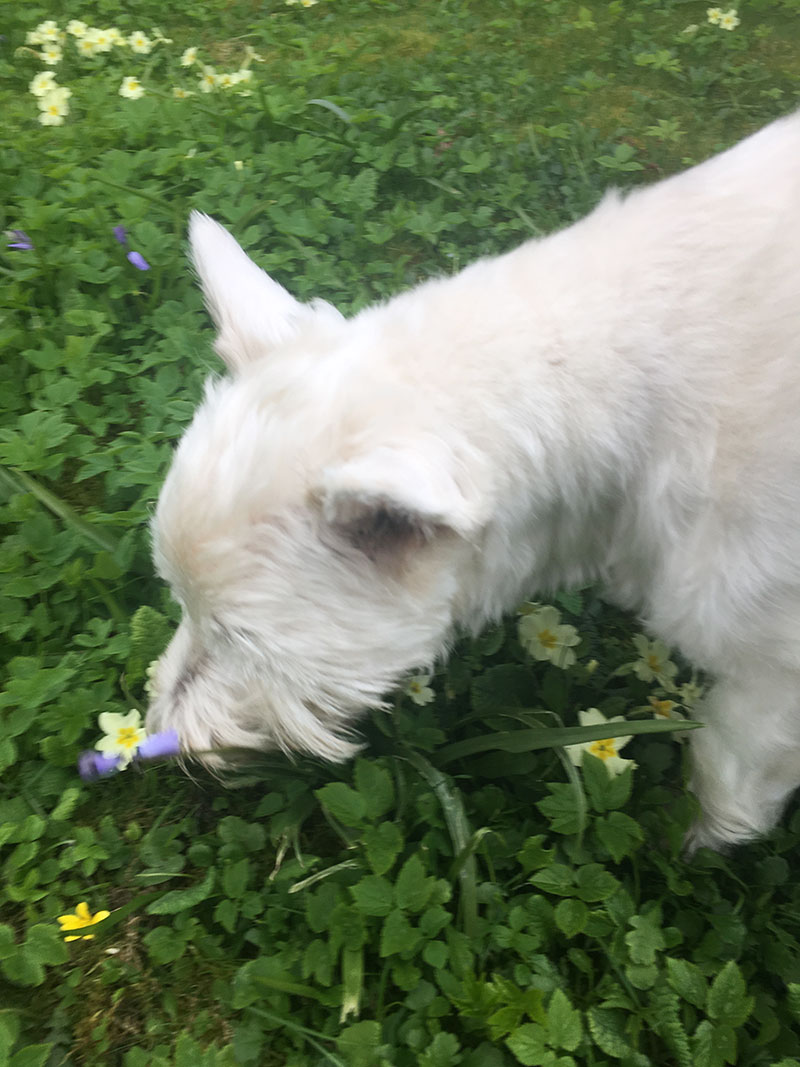 I also have time to notice more when I walk Yogi these days. Our long treks have gently slid into short ‘sniffaris’ as she gets older, which changes things for both of us.
Instead of hurtling after rabbits and squirrels, she is now just content to smell where they’ve been and send a few non-urgent pee-mails to ‘own’ that particular spot. As that involves a lot of standing for me, I used to try and use the time wisely and get in a couple of sets of squats or lunges. That lost its appeal quite quickly and now I’m content to just look and notice the things around me in more detail.
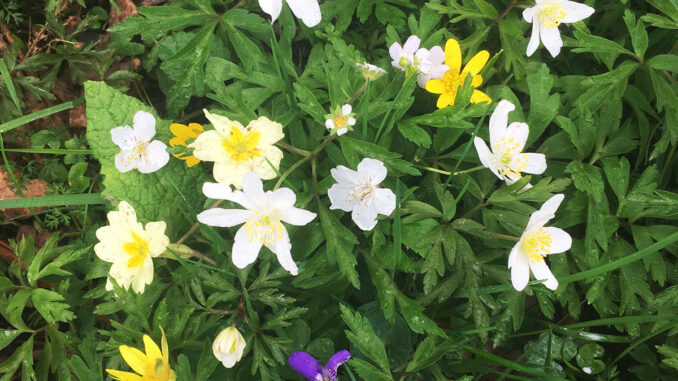
 And one of the things that never gets boring is just how many different kinds of plants there are in a single square foot – or two. In the photo (taken on the canal bank last week) there are wood anemones, wild violets, celandines, primroses, wild strawberry flowers and even the fallen blossom of a cherry tree that was in the hedgerow.
Just out of shot were dandelions, shepherds purse, the purple flowers of Honesty, a swathe of daisies and a few bluebells still tight in bud but full of blue promise.
All those flowers – and more – in such a small space. It’s just brilliant and beautiful – as is the opportunity to slow down and notice it all.
But Keep Moving
 Experts are now warning that ‘sitting is the new smoking’ with regard to the associated negative health implications. Surprisingly, is not uncommon for an adult to spend half their day sitting down, either at work, whilst travelling, relaxing or ‘engaging with a screen’.
As well as being detrimental to physical health, sitting has psychological disadvantages too. Health experts admit, “We don’t understand the links between sitting and mental health as well as we do the links between sitting and physical health yet, but we do know that the risk of both anxiety and depression is higher in people that sit more.”
I remember being a guest at a Tony Robbins seminar when I was about 30. The ‘well-respected wellbeing coach’ has the most amazing attitude and energy and one of the (numerous) things I have never forgotten from that seminar is that he said it is really hard to feel ‘low’ when you ‘move briskly’. Now of course I appreciate it’s not always ‘that easy’ and that ‘one size doesn’t fit all’ with low moods and depression, but I have also definitely witnessed ‘movement improving mood’.
A Discontented Winter
And as everyone is remarking on the fact it looks like winter is never going to leave us, I wondered (whilst building my wall) if, after all the bad press, winter should maybe issue some sort of statement. Maybe something along the lines of:
I, Winter, would like to make it clear that I am actually only filling in until Spring decides what it is going to do. As my contract officially ended on the 20th March and I didn’t want to leave you without weather as a result of Spring’s indecision, this means that I am actually working overtime. Spring hasn’t even called in sick or given an estimated time of arrival. I am already tired as I worked longer than my scheduled season last year to fill in for summer and autumn. I too am fed up with the lack of commitment shown by other seasons and their lack of respect for our rota. It seems I am the only season doing any work.
Yours sincerely
Winter.
Leave a Reply