
Taken from Lynne’s weekly column ‘Green Scene’ for the Western Mail
11th May 2024

Hanky Panky
I have been impressed by a couple of things this week.
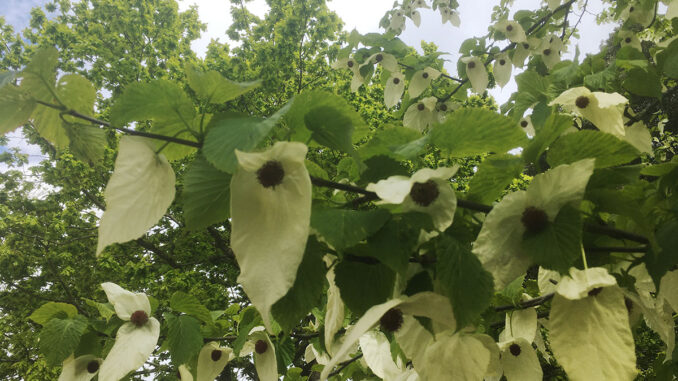
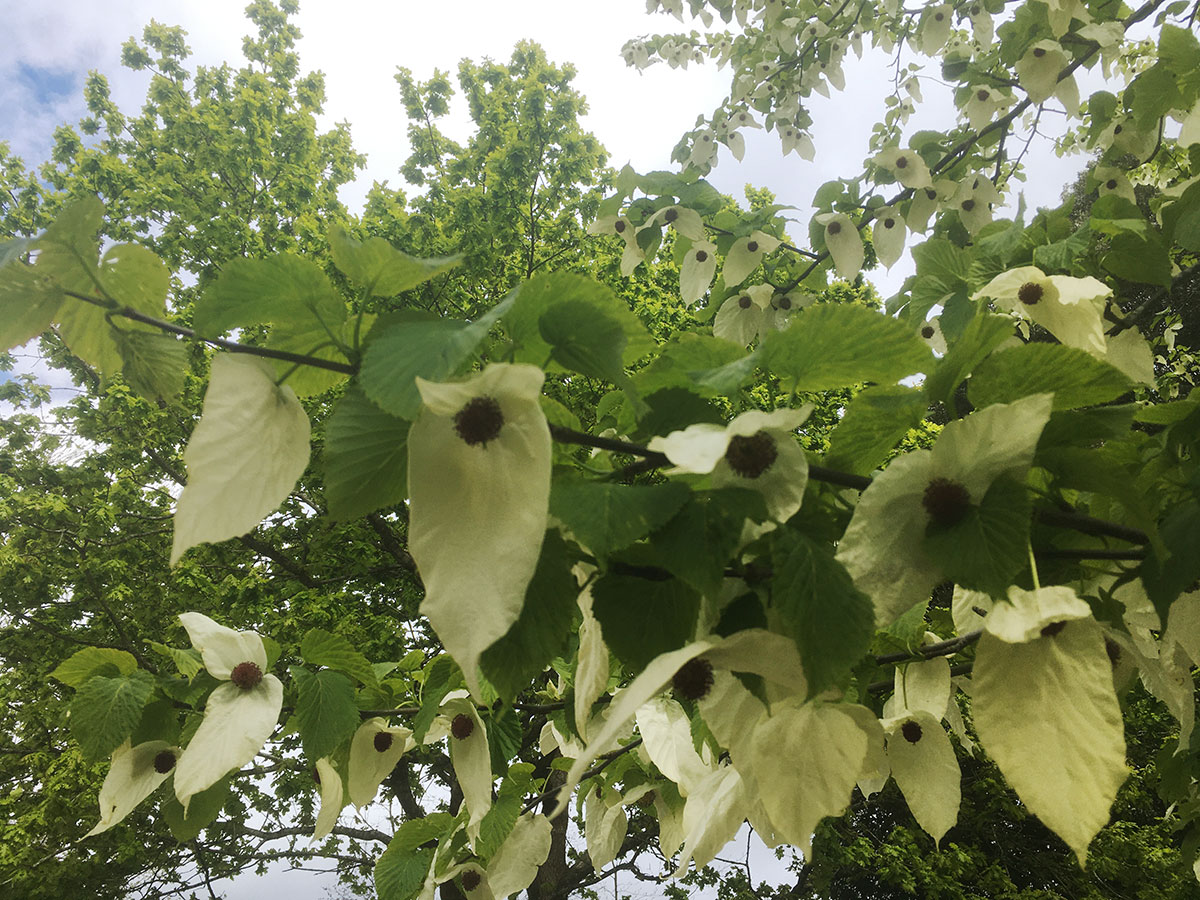
The first was the absolutely stunning blossom on a Handkerchief Tree in a ‘new’ client’s garden. It was a double-whammy as I had already been fascinated by the large green fruits which stayed on the tree most of the winter, but which I didn’t recognise. Every time I worked at the garden I thought ‘I must research that when I get home’ and every time I got home I had forgotten.
Described as, “A beautiful tree native to South-west China, Davidia involucrata has masses of glorious, white flower bracts in May and June (up to 15 cm long) on mature specimens. These beautiful flower bracts dance on wind, looking like fluttering handkerchiefs or doves and are followed by large green fruit later in the year. The leaves are oval and bright green, sometimes turning shades of plum purple before falling in autumn. One of the most spectacular flowering garden trees once established!”
That last sentence is a ‘polite warning’ that that these trees are famous for not flowering as young plants. The flower bracts usually appear any time after the tree’s 15th birthday but have occasionally been known to flower at only eight years old. I recall Dad being very fond of these magnificent trees, and have to say, having been reminded just how majestic they are, I would say it’s well worth the wait.
Water Wonderful Result
 Another thing that impressed me, although I have only read about it and not actually witnessed the results, is the ‘Plantsurge’. Marketed as being, “Powered by magnets, proven by science and endorsed by growers. Plantsurge creates structured water that will give you stronger, healthier plants, abundant flowers and bigger yield.”
Yes, please!
Further exploration revealed that the inspiration behind Plantsurge was Guy Cinnamon, keen gardener and founding member of London company Ecocamel, who himself had enjoyed almost a decade of success with the highly popular Ecocamel Descaler, a magnetic water softener for domestic homes. With the discovery of magnetic water being used to irrigate crops on a huge scale in Australia and horticultural journals recording dozens of studies showing benefits to seeds, fruits, and plants, Guy decided to evaluate magnetic water on plants in his own garden using an adapted descaler device.
When results showed the clear-cut benefits of magnetic water on his garden crops including tomatoes, peppers and courgettes and plants like dahlias and sunflowers, a decision was made to fund independent UK plants trials. Trial results proved to be remarkably successful.
If you have you ever noticed just how vibrant and healthy your plants and gardens look after a thunderstorm, it’s because these effects are caused by the electrical charge in the rainwater. Plantsurge harnesses the power of magnets to give a similar effect on your plants, effects proven from independent plant trials, observations by commercial growers, professional gardeners and hobby plant enthusiasts – without flattening your plants!
The science behind magnetic water can be traced back to the work of French scientist, Louis Pasteur, who in the last century began experiments on magnets and plant growth. More details at www.plantsurge.co.uk
I am a huge fan of these ‘woo woo’ things (as my brother refers to them). I have seen magnetic discs – from World Development Systems have an amazing effect on the health of my own plants (and beehives!) www.wds-water-treatment-quality.com/plant-enhancer.aspx and of course the Music of the Plants, and Cleve Backster’s fascinating experiments and documentation is just as compelling all these years on.
And as I always say, when someone asks, “How does it work?”
“Very well, thank you.”
May All Your Weeds Be Wildflowers
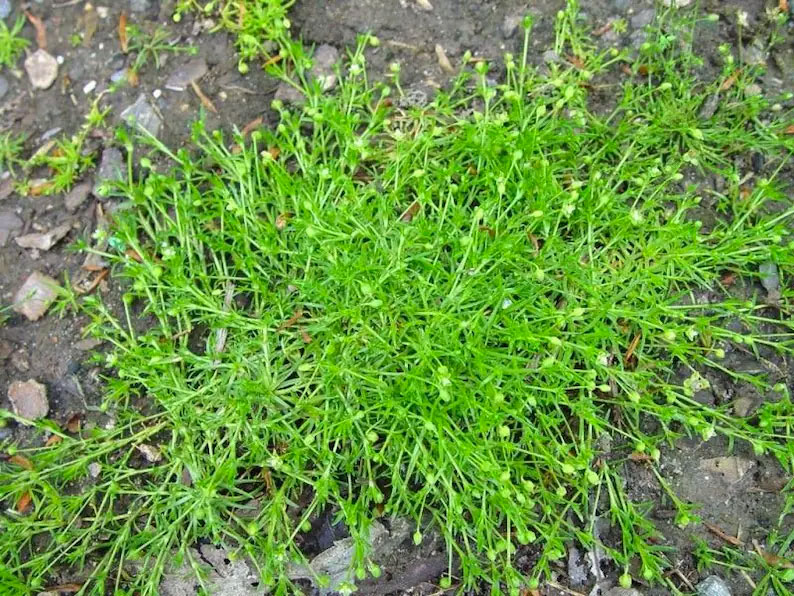 I learned a lot about Pearlwort this week too. A client has been ‘driven to distraction’ by a ‘menace of weed’ (her description). The weed ‘in the dock’ is Pearlwort – but I was unsure which variety – after a bit of research, I think there are several varieties in her garden. Annual Pearlwort, or Sagina apetala, is, as the name suggests, an annual plant, also known as Dwarf Pearlwort – and is very much in evidence in the cracks in the paving. However the Pearlwort that is threatening to take over the bare spaces in the borders looks like a ‘much posher relation’ – one that has ‘done well for itself’! I am sure that one is Heath Pearlwort, (Sagina subulata) also known as Wild Pearlwort or Irish Moss. Although it is not technically a Moss, but belongs to the Carnation family. I do love ‘plant families’ – they’re even more complex and complicated than the human type.
The real irony is that this ‘more substantial’ Pearlwort (Irish Moss) is the one doing the menacing – and as my research shows – can also be bought at your local garden centre, and is described the RHS as, ‘A low-growing evergreen perennial, forming dense mats of slender stems that root at the nodes, with fine, linear mid-green leaves held in pairs along the stems. Tiny white flowers are held up on stems to 4cm high in summer. Excellent ground cover and suitable as a grass alternative for a lawned area.’
It can also be bought as Sagina subulata var. glabrata ‘Aurea’ – a lovely vibrant lime green/golden variety – and is sold on www.victoriananursery.co.uk with the description, ‘In our opinion this is the best lawn alternative there is. We have personally seen this growing as far south as a beachside lawn in Athens –where it was baked in the sun and subject to heavy foot traffic –and as far north as Northern Norway – where it was happily putting up with snow, cold and heavy rainfall. Once established, these need absolutely no attention at all – no trimming or cutting – nothing! In warm, wet summers it will grow to around 4″ (10 cm) tall and become a lovely spongy surface to walk on – whilst in a drier summer or over the winter the growth becomes a ‘tighter’ and more compact 1″ (2.5 cm). Whatever the weather, late spring and early summer will see the lawn covered in a mass of tiny white flowers that later turn into dainty white seed pods that resemble pearls, hence its name – Pearlwort.
That glowing report definitely makes it sound more of a hero than a menace.
It always makes me smile – one man’s (or woman’s) weed is another man/woman’s flower. I have had similar experiences with celandines – being asked to dig them out of the border in one garden and then asked to purchase and plant them in another; and the same with the little Mexican daisies, or Erigeron (or Fleabane) – so prolific at self seeding, they are often considered to be a ‘menace’, whereas they will be in another gardener’s trolley at the garden centre. And of course, their larger, several-times-removed cousins, the Ox Eyed daisies – hated by some gardeners, loved by others. And which reminds me of that beautiful saying, “May all your weeds be wildflowers.”
Leave a Reply