

Taken from Lynne’s weekly column ‘Green Scene’ for the Western Mail
6th January 2024
Christmas Cracker

Top marks have to go to my brother for a fabulous Christmas present.
As well as spending a lot of time cutting, hauling, and stacking wood to feed a hungry wood-burner through the winter months, a lot of time is also invested in chopping kindling – the ‘appetiser’ for the wood-burner. They are both jobs that I love, although ‘kindling material’ is getting harder to come by. So – drum-roll please – I give you the Kindling Cracker. Aptly named for a Christmas present too.
As the name suggests, it ‘cracks’ or splits wood into kindling. The simplest description is an upside-down-fixed-axe, although I’m not sure the creator – a woman, incidentally – would be that enamoured with that.
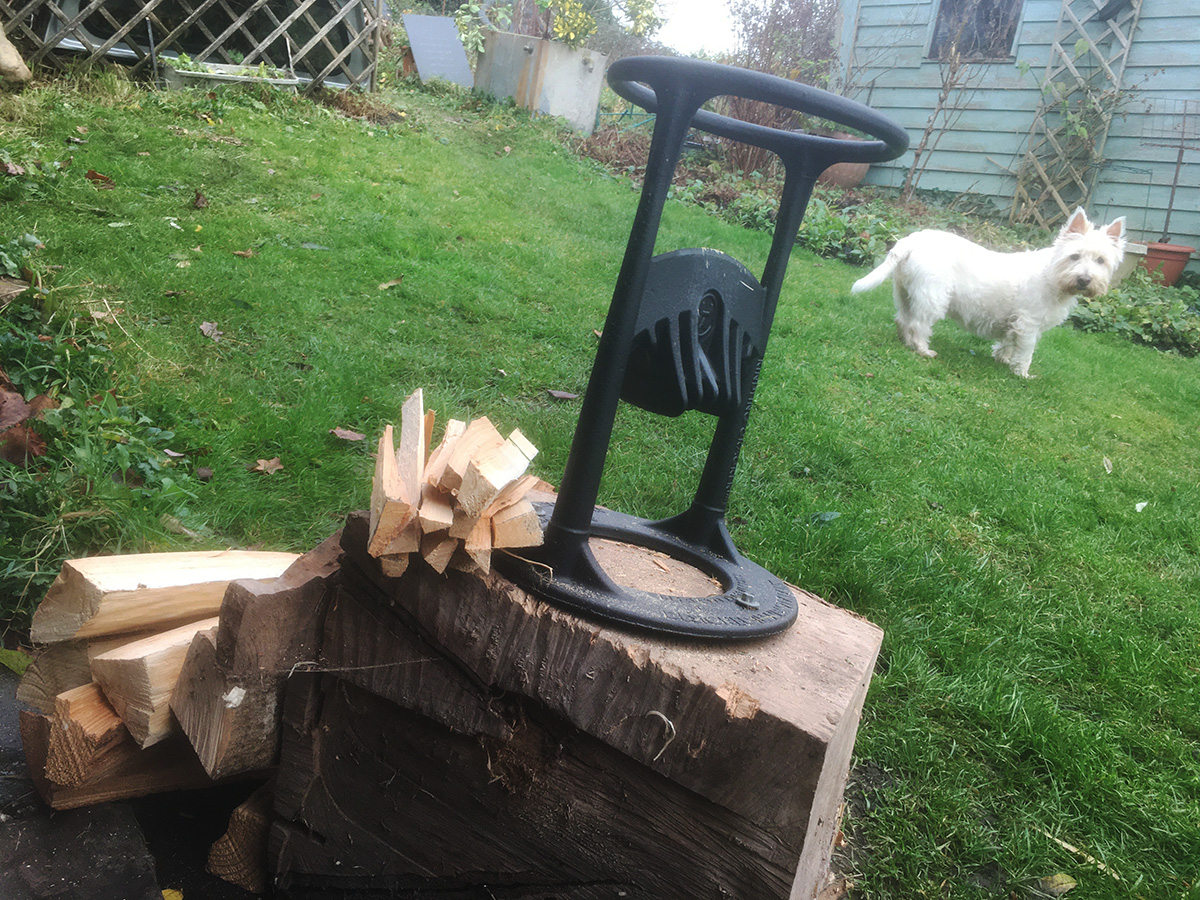 Recently I wrote that I have just discovered how to light my wood-burner ‘from the top down’ –see YouTube videos – and now I am chopping kindling from the bottom up. It goes to show that you are never too old to learn – or discover – a better way of doing something.
So, instead of swinging an axe, and then hatchet, to split and create the kindling – or even ‘intermediate blocks’ (the ones that go between kindling and ‘proper blocks’) – you just place a block of wood within the metal circle and tap it down onto the blade with a small lump hammer to secure it. A few more taps will split the wood. I wasn’t convinced – until I tried it. It is just brilliant. Meditative, effective and practical, I wish I had invented it and I highly recommend it.
And of course, a (kindling) Cracker isn’t just for Christmas.
Sole Sowing
 I’m not so sure about another ‘invention’ that I read about – Rewilding trainers. Apparently these clumpy soled trainers were designed to ‘trap seeds’ in the ‘specially designed hooks’ and then release them randomly as you run, hence distributing and dispersing the seeds.
It’s not a new concept. It is thought that some of the main ‘distributors’ of the invasive Himalayan Balsam are walkers and even vehicles, as seeds get stuck onto footwear and tyre treads respectively and lots of seeds are ‘naturally’ distributed by getting stuck in animal’s fur and hair. See more here. 
Don’t Trust the Process
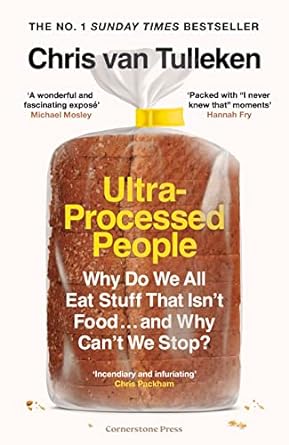 One of the books I read over the festive break is Ultra Processed People by Chris van Tulleken. Despite being unsure of the title and thinking ‘we all know highly processed food isn’t good for us’, the book is about so much more – and I totally devoured it (pun intended). It is staggering and should be read by everyone who eats food! The gist is that the problem with ‘processed food’ isn’t so much the quantities of sugar and fats but the way in which food is processed – the processes it goes though. To be honest I re-read so many lines and paragraphs several times as the information is hard to comprehend – and believe. Chris van Tulleken quotes Brazilian scientist Fernanda Rauber as saying: “Most UPF is not food. It’s an industrially produced edible substance.”
Ludicrously, so many of the ‘natural’ ingredients are removed by bleaching and then refined and deodorised, and replaced with chemical substitutes to provide the flavours and textures that we have come to crave.
It also seems that chewing is so ‘last year’ – we would rather not to put the effort in now, preferring soft, fluffy foodstuffs.
Some brands of butter-substitutes are only a couple of ingredients away from soap. Flea treatment and ice cream often share the same ingredients.
I was discussing the book with a discerning friend who has known this information for a while and who shared her motto, “If something has an ingredients list, I try to avoid it.”
It is not as hard as you might think. There are helpful lists of unprocessed and minimally processed foods, containing ingredients that you would have in the kitchen – and I am simply rotating recipes with those. Obviously fresh (and frozen) vegetables are a staple, as are grains, pulses, pasta and potatoes. It may not sound very exciting if you are used to ‘soft, fluffy’ processed food and takeaways but interestingly, you also eat less of these ‘real’ foods as you feel full quicker, so you buy less and fret less about food choices.
There is also a fascinating (and hard to grasp) chapter about calorie expenditure and how our bodies will automatically ‘use calories’ even if just laying on the couch eating popcorn, as various body functions – like breathing – will use calories. But the only way I can explain it – is that if your ‘calorie consumer’ (imagine a little cartoon character) gets bored, it will ‘use’ or burn calories through anxiety and stress. If we keep our ‘calorie consumer’ occupied, by exercise for example, then it is less likely to burn calories through negative methods. This is why we feel less stressed when we exercise regularly – even if it is just a good walk. I don’t really do the concept (the result of extensive research and numerous studies) justice but I urge you to check it out for yourselves. Like ‘cracking kindling’, sometimes there is a new and better way to do something.
The author, doesn’t preach or try to convert the reader – in fact he claims that obesity and inflammatory diseases are not our fault – but he works on the premise that if you read and absorb the information in the book, you will organically want to make better food choices. He also links the ingredients involved in ultra-processing foodstuffs to lethargy, weight gain, depression, anxiety and a number of illnesses and inflammatory diseases. Frustratingly, many of the UPF’s (ultra processed foods) are cleverly ‘disguised as ‘health foods’ – it’s not enough to trust the word ‘health’ or ‘low fat’ on the packaging. We need to take responsibility for our choices – I think it is one of the most important and biggest resolutions and ‘gifts’ you can give yourself for the new year. Rather than that ‘diet’ you have pledged to follow, just try avoiding UPF’s for a month and see the difference.
Dry January
Another satisfying job that got done over the festive break was to turn my cupboard under the stairs into a drying room for my waterproofs and work clothes. It is a classic case of ‘necessity being the mother of invention’ and ironically, I was glad of the wet weather to be able to spend time inside getting it done. After a good sort out – why do we hoard so much stuff’? – a quick lick of paint (optional), I fixed a few rails and a glove rack and added the essential ingredient – a dehumidifier. It works a treat, drying the wettest coat, leggings, boots and gloves in just a couple of hours. Why on earth it took me so long to figure out, I don’t know – but along with the appealing Kindling cracker and appalling food processes – and possibly age-related – my Christmas wasn’t about revelling but all about revelations.
Thank you. Top stuff!!