
Taken from Lynne’s weekly column ‘Green Scene’ for the Western Mail
15th May 2021

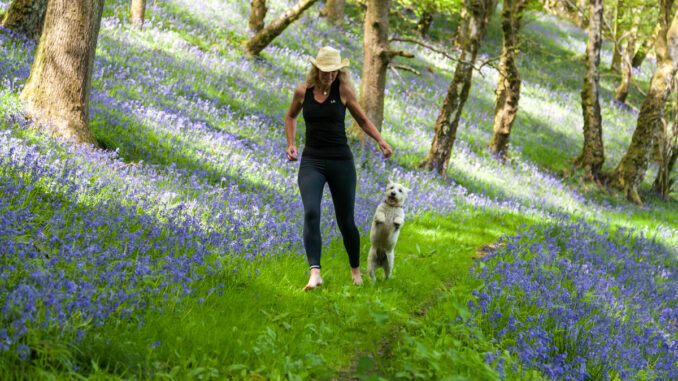
Beautiful Bluebells
 It’s bluebell time. I think my year is always divided into ‘flowering times’ rather than months or weeks. In the same way that people with kids in school tend to relate everything to either term time or holidays, I always use whatever is flowering as a marker. Snowdrop time, daffodil time, primrose time, cherry blossom time, bluebell time …
The bluebells are a little late flowering this year, the beautiful blue carpets are usually at their best at the beginning of May. Tree canopies are late coming into leaf, which has delayed the flowering of the bluebells beneath them. They wait for a certain amount of canopy coverage so they have the light and shade, which they prefer. Bluebells are often found in beech woods and have sharp leaf tips to allow them to push through the tough beech leaf carpet on the woodland floor. Sometimes you will actually see a beech leaf speared on the bluebell’s leaf – it can be a great way to keep ‘little people’ entertained, looking for one. Bluebells are often seen amongst bracken too, as on Skomer, as bracken provides a false canopy.
Their presence in ancient woodland sites indicates that the original bluebells in that woodland could well be over 400 years old. They take an age to spread by seed – as little as under a metre in a year – so when you see the really impressive huge blue drifts you can imagine how long they have taken to spread.
As tempting as it might be, it is illegal to take plants from the wild and if your do want to have bluebells in your own garden it’s important that you buy the native species from a specialist nursery. Many of the garden centres sell the Spanish Bluebell, which is incredibly invasive and is threatening our more delicate native species.
Spanish bluebells were first introduced to our shores hundreds of years ago, but now their numbers are multiplying at an alarming rate. Sadly studies show that British bluebells are gradually being wiped out by their Spanish equivalent and could be completely eradicated within 50 years.
The Spanish bluebell is more vigorous than our native species and can crossbreed with the native to create a fertile hybrid. This crossbreeding dilutes the unique characteristics of our native bluebell. In a recent study conducted by Plantlife volunteers across the UK, one in six broadleaved woodlands surveyed were found to contain the hybrid or Spanish bluebell.
The Spanish flower is much bigger than the native one and is also available in white, and even pink, whereas the native variety is predominantly blue. The anthers of the native bluebells are white and it is fragrant, unlike the Spanish imposter.
Native bluebells have narrow leaves, usually about 1cm or 1.5cm wide with deep blue (occasionally white and very rarely pink) narrow, tube-like flowers, with the very tips curled right back. The flowers are mostly on one side of the stem only, and distinctly drooping or nodding at the top. They have a distinct, sweetish scent and the anthers are usually cream.
Spanish bluebells have broad leaves often 3cm wide and paler blue (or pink and white) conical or bell-shaped flowers that have spread-out tips. They have flowers all round the upright stem and inside the flowers the anthers are usually blue (although this may vary a little).
If you do already have the Spanish bluebells in your garden, don’t panic, you won’t have a visit from the Bluebell Police, but please don’t share them with neighbours and friends and definitely don’t dig them up and dump them in the countryside. That’s how they get introduced to the wild and take over natural areas.
Folklore has it that you can summon fairies by ringing a bluebell – but be warned, if you hear the bluebell’s chime yourself, you don’t have long to live. Harsh.
Currently, the UK hosts over 75% of the world’s native bluebell population and a large proportion of those are found in Wales – they know where they’re best off, so we need to look after them.
Common Scents
Whilst discussing the tenacity of a lovely white flower growing cheerfully out of the face of a stone wall recently, I admitted to my client that I wasn’t 100% sure what it was but thought it was Iberis, or Candytuft. The ground cover perennial is usually happy in rockeries where it will form a useful dense, evergreen mat and its flowers are a favourite of bees, butterflies and other pollinators. I hadn’t seen it growing out of a stone wall before, hence the uncertainty. My client said, “Don’t worry, I have an plant identification app on my phone. I’ll see if I can get a good photo later and let you know.”
She did and it was.
It lead to a conversation about the virtues of technology and it was generally thought that this sort of app is a good way to enable the younger (although not exclusively) generation to have a greater connection with nature. I wasn’t convinced. To be honest, for me ‘an app’ is still something best had laying in the sunshine around mid-afternoon, but I could see their point. I suppose my disappointment with this method of plant knowledge is that if the information is at your fingertips you don’t actually learn it, you just access it. You know the information is accessible at all times so there is no need to retain the knowledge.
And there are ‘app-arent limits’ as I discovered later in the week …
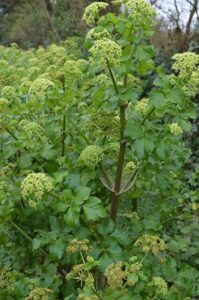
Yogi and I spent the day at Marloes in search of some much needed ‘vitamin sea’. It didn’t disappoint; it never does. As well as the beautiful beach and stunning rock formations, I adore the abundance of flora and fauna of that area. The coastal paths were flanked by a vast array of spring flowers from clovers to thrift and the hedgerows were frothing with a soft-yellow plant that looked like cow parsley on steroids. As we walked back up the lane from the beach, a couple stopped me and asked if by any chance I knew what the prolific plant was.
I replied cheerfully, “I am a gardener, I should do …”, but before I could share it’s identity the chap said a little gruffly, “Yes, well, we’re are all gardeners. We have just used a plant identification app on our phone and it says it’s either lovage, celery or maybe even a type of parsley, but that’s not very helpful.”
No it’s not. But a gardener who knew what it was would have been, had he not been so rude.
For any other visitors to Marloes wondering what the lovage-celery-parsley plant is, it’s Alexanders, or Smyrnium olusatrum. To be fair to the app, the leaves do look a bit like lovage, the stems do resemble celery and one of its common names is Horse Parsley. But it’s none of those.
Interestingly, one of the easiest ways to identify this plant – and many others – is by its unmistakable smell. Alexanders exude an unforgettable pungent, sweet smell that is irresistible to a wide range of pollinating insects. It is thought that it gained it’s Latin name Smyrnium, due to its distinctive myrrh-like fragrance.
Scent is obviously something an app hasn’t yet mastered. Sometimes ‘you just knows you need a nose’.
Leave a Reply